

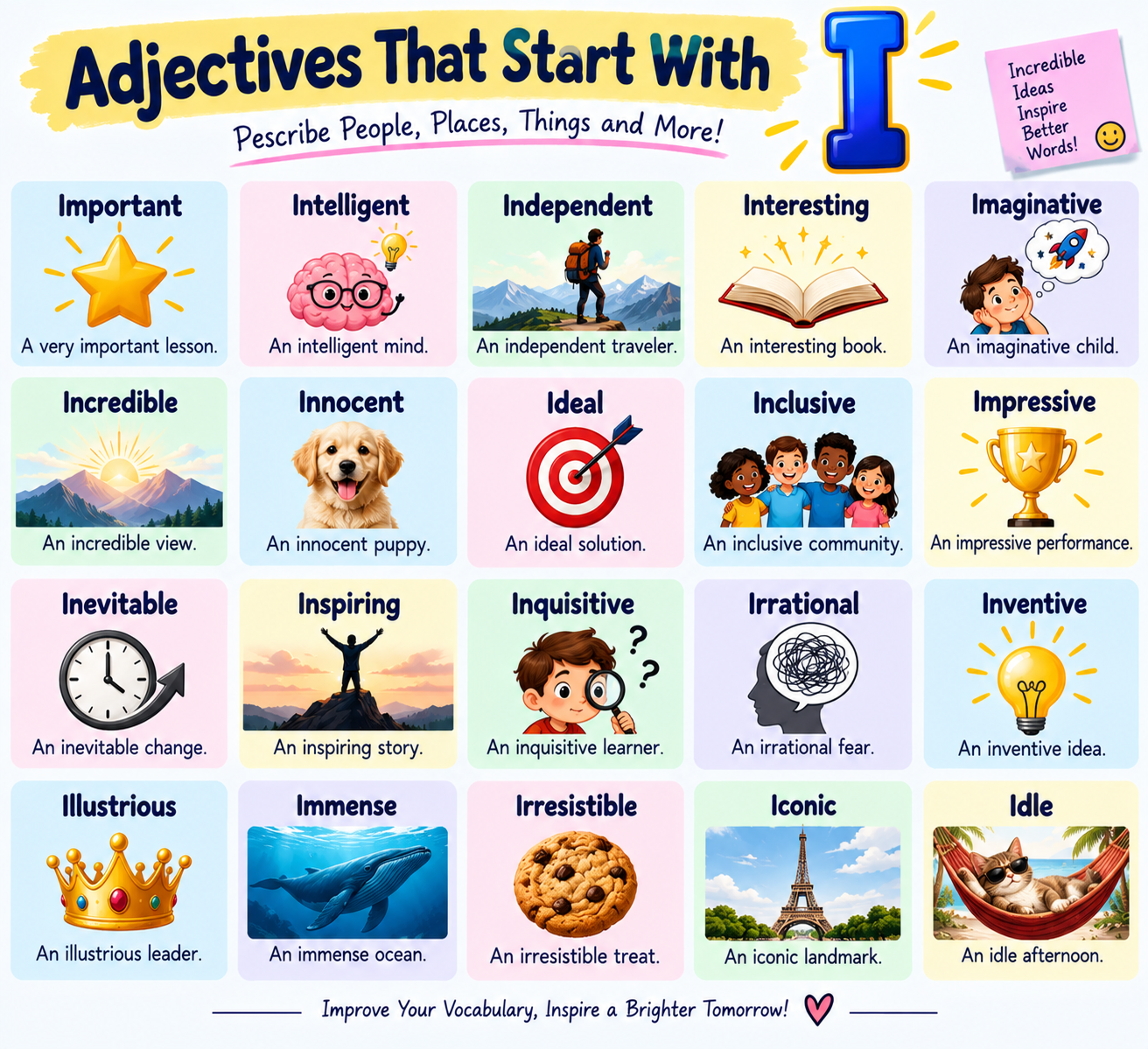
Adjectives that start with I are descriptive words—like insightful, iconic, and impromptu—used to modify nouns by detailing traits, intellectual depth, intensity, or distinct status. They expand your vocabulary for persuasive copywriting, creative writing, and daily communication by assigning precise attributes to people, places, and ideas.
Literal dictionary entries tell you what a word means on paper, but they rarely show you how to deploy it naturally in a sentence without sounding like a textbook. Here is a breakdown of the most useful I-adjectives, how native speakers actually use them, and the subtle usage traps that trip up most writers.
Positive Adjectives That Start With I
When you need to praise a colleague, elevate a resume, or describe an inspiring experience, these positive I-words carry strong emotional weight.
| Adjective | Definition | Natural Sentence Example |
| Insightful | Showing a deep understanding of a complex issue | Her insightful analysis completely reshaped our product strategy. |
| Innovative | Featuring new methods; advanced and original | The startup introduced an innovative approach to renewable energy. |
| Inspiring | Filling someone with the urge or ability to do something | He gave an inspiring talk that energized the entire audience. |
| Impeccable | In accordance with the highest standards; faultless | She handled the high-stakes negotiation with impeccable timing. |
| Illustrious | Well known, respected, and admired for past achievements | The professor concluded her illustrious career with a final lecture. |
| Invaluable | Extremely useful; indispensable | Your guidance during the audit was truly invaluable. |
| Invincible | Too powerful to be defeated or overcome | After winning three consecutive championships, the team felt invincible. |
Descriptive & Visual I-Adjectives
Visual and sensory descriptors build vivid pictures in your reader’s mind. Drop these in when establishing setting, scale, or texture.
- Immense: Extremely large or great, especially in scale or degree.
- Example: The team felt immense relief after meeting the midnight deadline.
- Intricate: Very complicated or detailed in design or structure.
- Example: The clockmaker assembled the intricate gears with absolute precision.
- Iridescent: Showing luminous colors that seem to change from different angles.
- Example: The soap bubble displayed an iridescent sheen under the morning sun.
- Imposing: Impressive and formidable in appearance or demeanor.
- Example: An imposing stone fortress guarded the entrance to the mountain valley.
- Implicit: Implied though not plainly expressed.
- Example: There was an implicit agreement among members to keep the project confidential.
Real-World, Slang & Conversational Contexts
Language shifts depending on context and media. Here is how modern English speakers use specific “I” descriptors in casual settings:
1. “Iconic” in Pop Culture
While iconic traditionally referred to religious icons or historical symbols, modern pop culture uses it to describe anything wildly memorable or culturally dominant.
- Real-World Use: “Her outfit at the award show last night was completely iconic.”
2. “Ironic” in Everyday Speech
In casual conversation, people often call unfortunate coincidences ironic, though strict grammar defines irony as an outcome contrary to expectations.
- Conversational Context: “It’s pretty ironic that the fire station caught fire, but most people use the word for simple bad luck.”
Common Misunderstandings & Usage Mistakes
Misapplying near-synonyms degrades your writing precision. Avoid these common mix-ups:
WRONG: "Your help on this project was completely worthless and priceless."
RIGHT: "Your help on this project was invaluable."
- Invaluable vs. Worthless: Invaluable does not mean “without value.” It means the value is so high it cannot be measured. Worthless means having no value at all.
- Ingenious vs. Ingenuous: Ingenious means clever, original, and inventive. Ingenuous means innocent, naive, or unsuspecting.
- Infamous vs. Famous: Famous means widely known for positive achievements. Infamous means well known for a bad quality or deed.
Categorized Entity Mapping: I-Adjectives at a Glance
For quick reference, here is how top I-adjectives map across major descriptive categories:
| Category | Primary Adjectives |
| Intellect & Character | Insightful, Ingenious, Ingenuous, Impulsive, Intelligent |
| Scale & Intensity | Immense, Infinitesimal, Intense, Inordinate, Incalculable |
| Appearance & Texture | Iridescent, Intricate, Imposing, Immaculate, Illusory |
| Status & Impact | Iconic, Illustrious, Infamous, Invaluable, Indispensable |
Frequently Asked Questions
What are some strong negative adjectives that start with I?
Common negative I-adjectives include infamous (badly reputed), irresponsible (lacking accountability), ignorant (lacking knowledge), insidious (proceeding harmfully in a subtle way), and impudent (not showing respect).
What is the difference between “Implicit” and “Explicit”?
Implicit describes something implied or understood without being stated directly. Explicit describes something stated clearly, fully, and leaving no room for confusion.
The One Rule for Mastering I-Adjectives
Match the precision of the prefix to the exact nature of the noun.
Don’t call an item invaluable when it is merely useful, and don’t label a person infamous when they are simply famous. Selecting the precise I-adjective turns generic statements into powerful, authoritative communication.
