

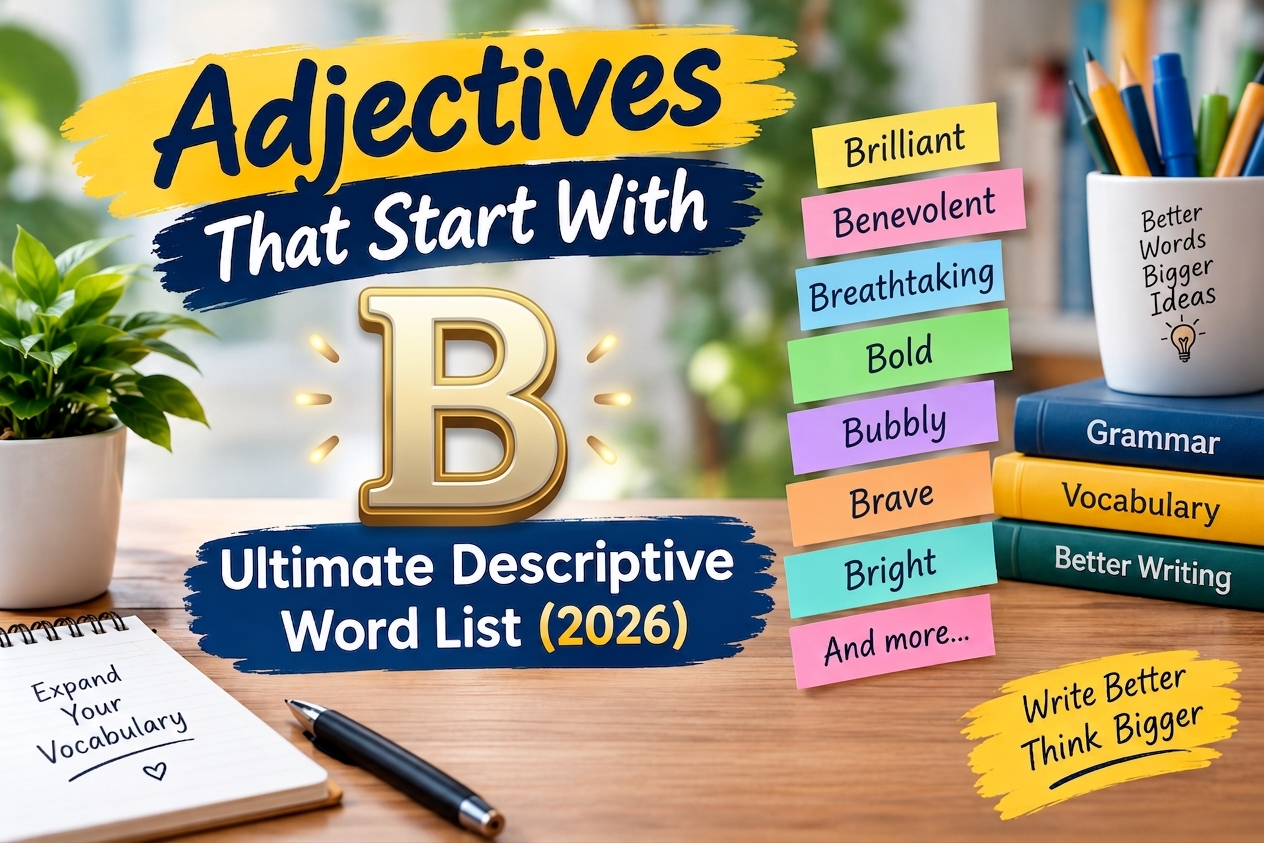
Adjectives that start with B are descriptive words used to modify nouns by highlighting specific qualities, states, or characteristics, ranging from personality traits like bold to visual conditions like bright. Mastering B-adjectives expands your vocabulary, sharpens your writing, and helps you communicate with precise nuance across digital chats, professional emails, and creative projects.
Whether you are crafting a resume, writing a social media post, or looking for the perfect word to describe a friend’s vibe, the letter B offers some of the most dynamic descriptive tools in the English language.
What Do Adjectives That Start With B Mean in Text & Chat?
In everyday messaging, text threads, and comment sections, B-adjectives set the entire tone of a conversation. Unlike generic words that just convey information, specific B-adjectives communicate underlying attitude, mood, and energy.
- Positive Energy: Words like blessed, bubbly, and brilliant instantly lift the mood of a chat, signaling optimism and warmth.
- Edgy or Critical Tone: Terms like basic, brutal, or bitter deliver sharp feedback, social commentary, or sarcastic critique.
- Casual Vibe Check: Describing an event as chill is fine, but calling it boisterous or breezy paints a far clearer picture of the environment instantly.
Straightforward, no confusion there. The right descriptive word prevents misunderstanding and makes your digital voice instantly recognizable.
What Does a B-Adjective Convey From a Guy vs. a Girl?
Context and sender dynamics completely change how certain B-adjectives land in a text thread. Here is what most people miss when using these words in casual conversation:
When a Guy Uses B-Adjectives
- “Basic”: Often used as light teasing or direct call-outs about mainstream trends (e.g., “That coffee order is so basic”).
- “Bold”: Usually functions as a high-value compliment, praising confidence, risk-taking, or a strong decision.
- “Brooding”: Used self-deprecatingly or to describe a quiet, moody aesthetic without sounding overly emotional.
When a Girl Uses B-Adjectives
- “Bubbly”: Frequently used to describe high-energy personalities, welcoming social vibes, or outgoing friends.
- “Bossy”: Often deployed sarcastically to reclaim control or jokingly call out micro-managing behavior in group chats.
- “Brilliant”: Functions as enthusiastic affirmation for a great idea, plan, or outfit choice.
Quick Reference Table: Popular B-Adjectives at a Glance
| Adjective | Primary Meaning | Short Meaning | Common Tone | Suitable For | Not Suitable For |
| Bold | Showing willingness to take risks | Courageous / Daring | Empowering | Resumes, compliments, pitches | Apologies, quiet moments |
| Basic | Lacking originality; overly mainstream | Unoriginal / Cliché | Sarcastic / Casual | Social banter, memes | Formal performance reviews |
| Bountiful | Large in quantity; abundant | Plentiful / Generous | Warm / Expressive | Food, nature, gifts | Minimalist contexts |
| Brisk | Active, fast, and energetic | Quick / Refreshing | Crisp / Professional | Weather, walks, meetings | Lazy weekends |
| Befuddled | Unable to think clearly | Confused / Puzzled | Lighthearted | Funny stories, self-critique | High-stakes crisis management |
| Breathtaking | Astonishing or awe-inspiring | Stunning / Amazing | Enthusiastic | Travel, art, major news | Minor daily tasks |
Origin, History & Evolution of B-Adjectives
The evolution of B-adjectives reflects the broader history of the English language itself. Many of our standard descriptive terms trace back to Old English, Proto-Germanic, and Old French roots before morphing into modern slang and digital vernacular.
- Historical Roots: Words like bold (beald in Old English) have meant courageous for over a thousand years. Meanwhile, brilliant entered English via French (brillant) in the 17th century to describe shining light before expanding to mean high intelligence.
- Modern Shifts: Internet culture frequently repurposes formal B-adjectives into slang. The word basic, which historically meant fundamental or elementary, shifted dramatically in the 2010s across pop culture and social platforms to describe someone conforming to mainstream consumer trends.
- Digital Adaptation: In short-form content, heavy B-adjectives are often paired with visual aesthetics (e.g., describing a video style as boho, bubbly, or brutalism).
Usage Across Social Media Platforms
How you drop a B-adjective depends heavily on where you are posting. Here is how usage breaks down across major apps:
- WhatsApp / SMS: Used for direct, emotive commentary. Texting “That was a brutal exam” or “Feeling super blessed today” keeps messaging personal and immediate.
- Instagram: Dominates post captions and aesthetic descriptions. Words like breathtaking (for travel photos), bold (for fashion reels), and blissful (for weekend dumps) rule the platform.
- TikTok: Driven by slang and audio trends. You will frequently hear content creators use basic for calling out overdone trends or boisterous to describe chaotic energy in storytime videos.
- Snapchat: Short, punchy overlay text. Snaps often feature quick descriptors like bored, busy, or buzzing.

Real Chat Examples & Real-World Scenarios
Here is how B-adjectives look in everyday digital communication:
Scenario 1: Planning a Weekend Trip (Casual Group Chat)
Friend A: Are we still hiking up the ridge tomorrow morning?
Friend B: Definitely! The view from the top is absolutely breathtaking, plus the weather is supposed to be super brisk and clear.
Scenario 2: Reacting to a Bold Move (Direct Message)
Friend A: I just emailed the director directly to ask for the lead role.
Friend B: Wow, that was a bold move! Respect. Let me know what they say!
Scenario 3: Debriefing After a Social Event (SMS)
Friend A: How was the party last night?
Friend B: A bit too boisterous for me honestly, but Sarah was her usual bubbly self!
Common Confusions, Mistakes & Wrong Interpretations
Using B-adjectives incorrectly can lead to awkward miscommunications or tone-deaf messages. Watch out for these common traps:
- Biannual vs. Biennial: This is a classic stumbling block. Biannual means occurring twice a year, whereas biennial means occurring once every two years. Mixing these up in business proposals creates massive scheduling headaches.
- Basic (Literal vs. Slang): Don’t confuse technical contexts with internet slang. Calling a code structure “basic” in software engineering means foundational; calling a person’s style “basic” on social media implies a lack of originality.
- Befuddled vs. Bemused: Befuddled means completely confused or perplexed. Bemused actually means mildly amused in a detached or bewildered way. They are not interchangeable!
Similar Terms, Alternatives & Cleaner Substitutes
If you need to swap out a B-adjective for a alternative—whether to elevate your tone or smooth out a sentence—use these categorized options:
Positive & Complimentary B-Adjectives
- Benevolent (Alternative: Kind, generous, compassionate)
- Boisterous (Alternative: Lively, spirited, exuberant)
- Bountiful (Alternative: Abundant, plentiful, copious)
Professional & Resume-Ready B-Adjectives
- Balanced (Alternative: Well-rounded, impartial, stable)
- Benchmark (Alternative: Standard, exemplary, foundational)
- Businesslike (Alternative: Professional, efficient, methodical)
Sharp & Critical B-Adjectives
- Blunt (Alternative: Direct, frank, candid)
- Bite-sized (Alternative: Compact, concise, digestible)
- Bland (Alternative: Insipid, dull, flavorless)
How to Reply When Someone Uses These Terms
When someone hits you with a strong B-adjective in conversation, here is how to respond effectively based on the context:
- When called “Bold” (Playful/Confident):
- “Fortune favors the bold, right?”
- “Gotta keep things interesting!”
- When called “Basic” (Sarcastic/Lighthearted):
- “Hey, classic things are classic for a reason!”
- “Guilty as charged, no regrets.”
- When described as “Brilliant” (Supportive/Professional):
- “Appreciate that! Credit goes to the team for pulling it off.”
- “Thanks! Glad the idea resonated with you.”
Are B-Adjectives Still Popular? (Current Trends & Longevity)
Descriptive language never goes out of style, but specific B-adjectives rotate in popularity based on viral trends and cultural shifts.
Search interest for specialized vocabulary lists remains consistently high as writers, students, and professionals seek ways to avoid repetitive language. While slang terms like basic have peaked and stabilized into standard internet vernacular, powerful descriptive adjectives like bold, brilliant, and resilient (and its B-counterpart buoyant) continue to dominate professional and personal discourse in 2026.
Conclusion & Final Takeaway
The core rule for using adjectives that start with B is simple: match the word’s specific weight to your context. A well-chosen B-adjective transforms flat prose into vivid, memorable communication—whether you are polishing a formal presentation or dropping a quick reply in the group chat. Expand your selection beyond everyday defaults, and let precise description do the heavy lifting for you.
