


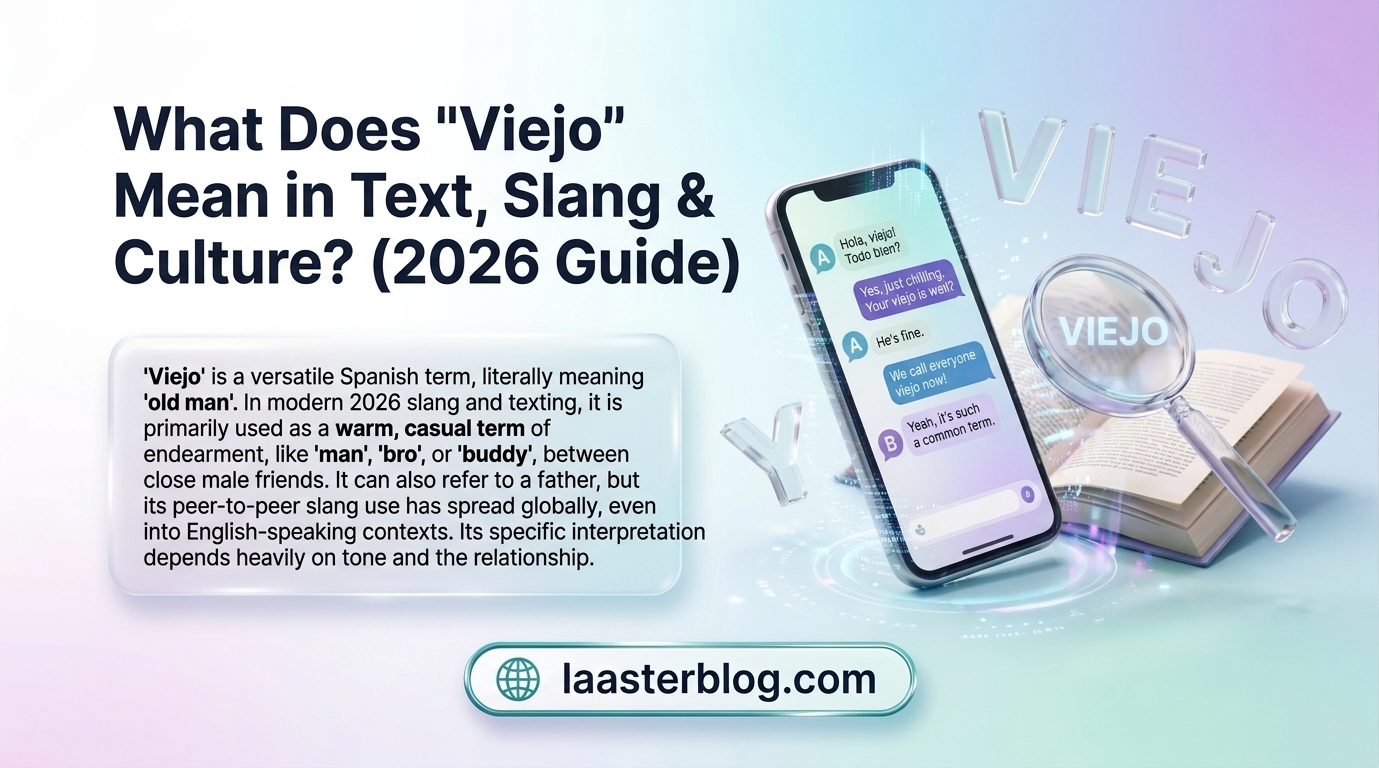
Viejo literally translates to “old” or “old man” in Spanish, but in modern everyday communication and social media slang, it is widely used as an affectionate term for “dad,” “husband,” “boyfriend,” or “buddy.” While it can describe advanced age when modifying a noun, calling someone “mi viejo” or “viejo” in casual conversation usually signals warmth, familiarity, and deep personal connection rather than an insult.
Introduction
In Hispanic culture and contemporary global text slang, words rarely stay locked in their literal dictionary definitions. Viejo is a prime example of a term that balances descriptive grammar with rich cultural endearment.
Whether you hear it in regional Mexican music, spot it in WhatsApp family groups, or see it in TikTok captions, understanding the context behind viejo prevents awkward misunderstandings and helps you read the true emotion behind the message.
What Does Viejo Mean in Text & Chat?
In texting, messaging apps, and online forums, viejo (and its feminine counterpart vieja) carries distinct tones depending on grammatical usage:
- Affectionate Endearment (“My Old Man / Dad / Husband”): When paired with a possessive pronoun like “mi viejo”, it translates conceptually to “my dad” or “my husband/partner.” It carries a respectful, loving tone built on long-standing affection.
- Casual Friend Slang (“Dude / Bro / Pal”): In countries like Mexico, Colombia, and Argentina, dropping “¡Qué onda, viejo!” or “¿Cómo estás, viejo?” into a DM is the exact equivalent of saying “What’s up, man?” or “How’s it going, bro?”
- Literal Adjective (“Old”): When describing objects, animals, or places (e.g., “un carro viejo” = an old car), it retains its literal definition.
Straightforward, no confusion there. The golden rule: when applied directly to a person you know well, it’s almost always a sign of closeness, not a comment on their age.
What Does Viejo Mean From a Guy vs. a Girl?
Sender dynamics play a major role in how viejo lands in casual conversation. Here is how the nuances shift:
When a Guy Uses “Viejo”
- To Another Guy (Friend/Colleague): It functions as a friendly “bro” or “mate.” It signals camaraderie and casual warmth without any romantic undertones.
- To His Father: A traditional, loving way to refer to or address his dad (“Voy a visitar a mi viejo” = “I’m going to visit my old man”).
- To His Wife/Girlfriend (Using “Vieja”): While common in many regions to mean “my wife” or “my babe,” tone matters—it can sound deeply affectionate or overly casual depending on the relationship.
When a Girl Uses “Viejo”
- To Her Husband or Partner: Used as a sweet, domestic term of endearment, similar to “honey” or “hubby.”
- To Her Father: Expresses filial love and respect.
- To a Male Friend: Used casually to mean “guy,” “dude,” or “friend,” often maintaining a clear platonic boundaries.
Quick Reference Table
| Term / Variant | Primary Meaning | Short Meaning | Common Tone | Suitable For | Not Suitable For |
| Viejo | Old / Old Man | Dude, Bro, Dad | Warm, Casual, Friendly | Close friends, peers, casual DMs | Formal business emails, job interviews |
| Mi Viejo | My Old Man | My Dad / My Husband | Affectionate, Loving | Family chats, romantic partners | Strangers, authority figures |
| Vieja | Old Woman | Wife, Mom, Babe | Endearing or Colloquial | Spouses, mothers, close gal pals | Professional settings, sensitive elders |
| Viejit@ | Little Old Person | Dear / Sweetie | Gentle, Sweet | Grandparents, pets, playful banter | Serious formal correspondence |
Origin, History & Evolution
The word viejo stems from the Vulgar Latin veclus (derived from Classical Latin vetulus, a diminutive of vetus, meaning “aged”).
- Traditional Usage: Historically, referring to family elders as “los viejos” grew out of traditional agrarian society, where age was directly tied to wisdom and head-of-household status.
- Pop Culture & Music Integration: Regional Mexican music, Latin pop, and tango lyrics routinely used “mi viejo” as a central thematic motif celebrating fathers and lifelong partners (most notably highlighted by Piero’s iconic 1969 song “Mi Viejo”).
- Digital & Social Media Evolution: Modern Latin American youth culture modernized the word into universal digital slang. On TikTok, Instagram, and WhatsApp, viejo now flows freely as a low-friction greeting among younger demographics across borders.
Usage Across Social Media Platforms
Here is how viejo surfaces across different digital channels today:
- WhatsApp & iMessage: Dominates family group chats and daily friend catch-ups (e.g., “¿Qué haciendo, viejo?”).
- TikTok & Instagram Reels: Frequently seen in video captions celebrating fathers, nostalgia, relationship humor, or regional street culture edits.
- X (Twitter) & Gaming Forums: Used in quick public replies or gaming lobbies as casual slang to greet teammates or comment on retro media.
Real Chat Examples & Real-World Scenarios
Scenario 1: Casual Friend Catch-Up (WhatsApp)
Friend A: ¿A qué hora nos vemos para el partido?
(What time are we meeting for the game?)
Friend B: A las 8 PM, viejo. Ya tengo todo listo.
(At 8 PM, bro. I’ve got everything ready.)
Scenario 2: Family Context (iMessage)
Son: Hola mamá, ¿cómo está mi viejo?
(Hi mom, how is my old man/dad doing?)
Mom: Está bien, descansando en la sala.
(He’s doing well, resting in the living room.)
Scenario 3: Spousal / Romantic Banter (Texting)
Wife: No olvides comprar la leche cuando vengas a casa, viejo.
(Don’t forget to buy milk on your way home, honey.)
Husband: Ya la llevo en el carro, no te preocupes. ❤️
(Already have it in the car, don’t worry.)
Common Confusions, Mistakes & Wrong Interpretations
Here’s what most people miss when learning or translating viejo:
- Literal Offense Trap: Translating viejo literally as “old man” in English can sound rude or ageist. In Spanish culture, applying it affectionally to someone in their 20s or 30s is completely normal and carries zero age connotation.
- Tone & Context Sensitivity: Calling an older stranger viejo directly can be perceived as disrespectful. Use formal alternatives like señor or don unless a familiar relationship is established.
- Grammatical Gender Matching: Remember that viejo is masculine and vieja is feminine. Mixing them up when addressing someone changes the target of the slang.
Similar Terms, Alternatives & Cleaner Substitutes
Regional Slang Alternatives
- Mano / Manito: Short for hermano (brother), widely used in Mexico and the Caribbean.
- Che: Argentine equivalent for “hey” or “dude.”
- Pana / Causa: Common slang for “buddy” or “pal” in Venezuela, Ecuador, and Peru.
- Wey / Güey: Mexican slang equivalent for “dude.”
Formal & Polite Substitutes
- Papá / Padre: Father.
- Esposo / Pareja: Husband / Partner.
- Amigo / Compañero: Friend / Companion.
- Señor: Sir / Gentleman.
How to Reply When Someone Uses This Term
When a friend or partner texts you using viejo, matching their tone keeps the conversation natural:
Friendly & Casual Replies
- “¡Qué onda, mi buen!” (What’s up, man!)
- “Dime, viejo, ¿qué pasó?” (Tell me, bro, what’s going on?)
- “Aquí andamos, mi hermano.” (Just hanging out, brother.)
Warm & Playful Replies
- “¡Gracias, viejo!” (Thanks, buddy!)
- “Claro que sí, cuenta conmigo.” (Of course, count on me.)
Is Viejo Still Popular in 2026?
Yes, viejo remains deeply rooted in everyday Spanish vocabulary and digital slang. Unlike viral trend slang that fades after a few months on social media, viejo derives its longevity from decades of cultural reinforcement across music, television, and family life. Its dual capability as a respectful familial term and a casual street greeting ensures its staying power for generations to come.
