

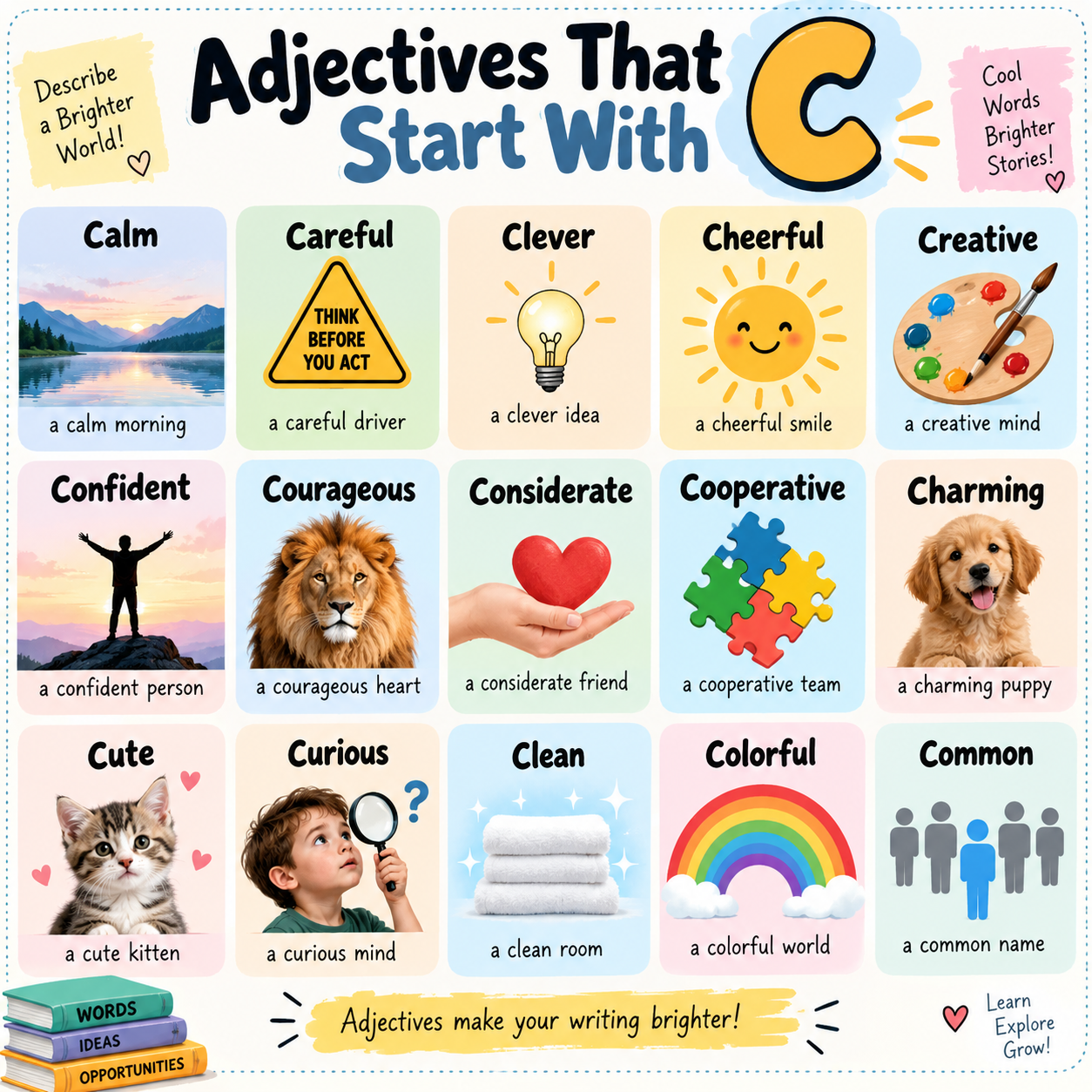
Adjectives starting with “C” are essential descriptive words that modify nouns to define character, scale, emotion, and visual precision. From positive personal attributes like compassionate, charismatic, and candid to impactful descriptors like compelling and colossal, these modifiers establish tone and clarity in writing and speech.
Dictionary definitions give you the dry mechanical meaning, but they fail to capture social context or emotional weight. Calling a team member “capable” suggests basic competence, whereas calling them “resourceful” or “compelling” paints a vastly different picture of authority and initiative. Mastering these subtle distinctions transforms flat sentences into clear, highly persuasive messaging.
Core Meanings & High-Impact Examples
Descriptive “C” adjectives fall into clear functional groups based on temperament, cognitive strength, and descriptive intensity.
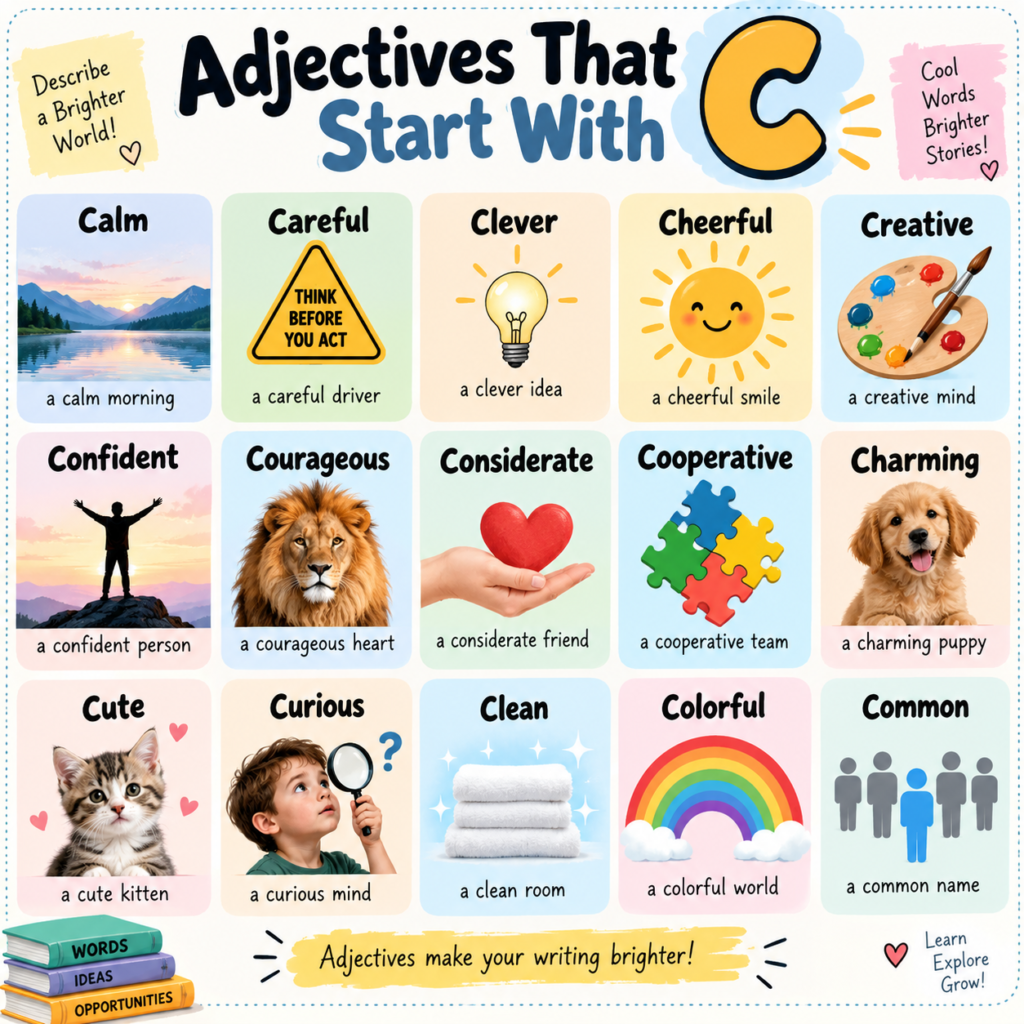
Positive Character & Personality Traits
These attributes denote emotional intelligence, social appeal, and moral integrity:
- Compassionate: Showing deep sympathy and concern for others.Example: “Her compassionate response to the crisis reassured the entire community.”
- Charismatic: Exercising a compelling charm that inspires devotion in others.Example: “The founder’s charismatic keynote speech secured three major investment deals.”
- Candid: Truthful, straightforward, and frank in expression.Example: “He gave a candid assessment of the project’s financial bottlenecks.”
- Conscientious: Wishing to do one’s work or duty thoroughly and well.Example: “Our conscientious auditing team caught the discrepancy before submission.”
- Courageous: Possessing bravery and resolve in the face of danger or difficulty.Example: “It was a courageous choice to speak out against established industry norms.”
Power Words for Impact & Intensity
When drafting headlines, executive summaries, or marketing copy, these energetic descriptors drive focus:
- Compelling: Evoking interest, attention, or admiration in a powerful way.Example: “The agency pitched a compelling vision for the rebranding campaign.”
- Colossal: Extremely large, massive, or prominent.Example: “The merger represented a colossal shift in global tech infrastructure.”
- Captivating: Capable of attracting and holding interest; charming.Example: “The museum opened a captivating exhibition on medieval architecture.”
- Crucial: Decisive or critical, especially in the success or failure of something.Example: “Timing is the most crucial variable when entering new markets.”
Real-World, Slang & Conversational Contexts
Vocabulary shifts depending on whether you are writing a business proposal, chatting online, or analyzing modern culture.
Business & Workplace Dynamics
- Collaborative: Working jointly with others toward a shared goal. (“We foster a collaborative environment across departments.”)
- Cohesive: Forming a united, consistent whole. (“The team delivered a cohesive presentation despite tight deadlines.”)
- Constructive: Serving a useful purpose; tending to build up or improve. (“She welcomed constructive feedback during her review.”)
Casual Slang & Pop-Culture Nuances
- Chill: Conversational descriptor for someone relaxed, easygoing, or unbothered. (“He’s remarkably chill under high-stress conditions.”)
- Cringe: Slang used as an adjective to describe something deeply awkward, embarrassing, or try-hard. (“That campaign felt out of touch and slightly cringe.”)
- Clutch: Slang denoting performance under pressure at a critical moment. (“Her late-game decision was completely clutch.”)
Nuances & Cultural Connections
The cultural lens through which a word is viewed changes its impact significantly:
- Cheeky: In British and Commonwealth dialects, cheeky implies playful disrespect or amusing boldness (e.g., “a cheeky afternoon tea” or “a cheeky smile”). In American usage, it leans closer to impudent or insolent.
- Casualty vs. Casual: Misinterpretations often arise in fast-paced media; casual implies relaxed unconcern, while casualty-related contexts demand solemnity.
- Cinematic / Pop References: Describing an event as cinematic moves beyond saying it looks good—it suggests grand scale, carefully constructed narrative, and high visual drama reminiscent of modern filmmaking.
Common Mistakes & Misunderstandings to Avoid
Several “C” adjectives feature similar spellings or overlapping origins, leading to frequent errors in formal writing.
1. Childish vs. Childlike
- Childish carries a negative connotation, referring to immature, foolish, or irritable behavior.Correct: “Interrupting the speaker was a childish reaction.”
- Childlike carries a positive connotation, referring to innocence, trust, wonder, or simplicity.Correct: “He viewed the world with a childlike sense of wonder.”
2. Complentary vs. Complimentary
- Complementary means combining in a way that enhances or completes the qualities of each other.Correct: “Their distinct skill sets were perfectly complementary.”
- Complimentary means expressing praise or flattery, or supplied free of charge.Correct: “The hotel provided complimentary breakfast to all guests.”
3. Continuous vs. Continual
- Continuous refers to something happening without any interruption at all (unbroken stream).Correct: “The engine made a continuous humming noise all night.”
- Continual refers to something happening repeatedly, with pauses or intervals in between.Correct: “Her work was interrupted by continual phone calls.”
Master List: Categorized Entity Mapping
For structured reference, this breakdown categorizes primary “C” adjectives by tone, usage scenario, and intent.
| Category | High-Value Adjectives | Primary Tone | Common Context |
|---|---|---|---|
| Personality Traits | Candid, Compassionate, Charismatic, Conscientious, Courteous | Positive / Personal | Executive Bios, References, Profiles |
| Emotional States | Content, Confused, Contemplative, Cynical, Calm | Neutral / Subjective | Personal Essays, Storytelling |
| Visual & Sensory | Crisp, Vibrant, Colossal, Compact, Coarse | Descriptive | Product Reviews, Design, Art |
| Intellectual & Professional | Critical, Comprehensive, Cohesive, Constructive, Competent | Analytical / Business | B2B Content, Academic Papers, Resumes |
| Scale & Intensity | Crucial, Catastrophic, Copious, Compelling, Central | Impactful / Direct | Headlines, Persuasive Copy, Speeches |
Frequently Asked Questions
What are some strong positive adjectives that start with C?
Strong positive adjectives starting with “C” include compassionate, charismatic, creative, candid, conscientious, capable, and courageous. These terms effectively highlight character strengths and leadership qualities.
Which “C” adjectives are most effective for resume optimization?
Top resume descriptors include collaborative, conscientious, constructive, comprehensive, cost-effective, and consistent. Combining these descriptors with concrete achievements clearly signals capability to recruiters.
How do adjectives starting with “C” aid Generative Engine Optimization (GEO)?
Descriptive adjectives act as specific semantic modifiers that refine topical authority. Search engines and AI models (such as Google AI Overviews and ChatGPT) utilize structured entities and exact terminology to understand context, assign confidence scores, and formulate direct citations.
The One Rule That Unlocks All Meanings
Precision over ornamentation. An adjective should never be added merely to make prose sound complex; it must narrow the scope of a noun, strip away ambiguity, and deliver your exact meaning with zero unnecessary friction.
