

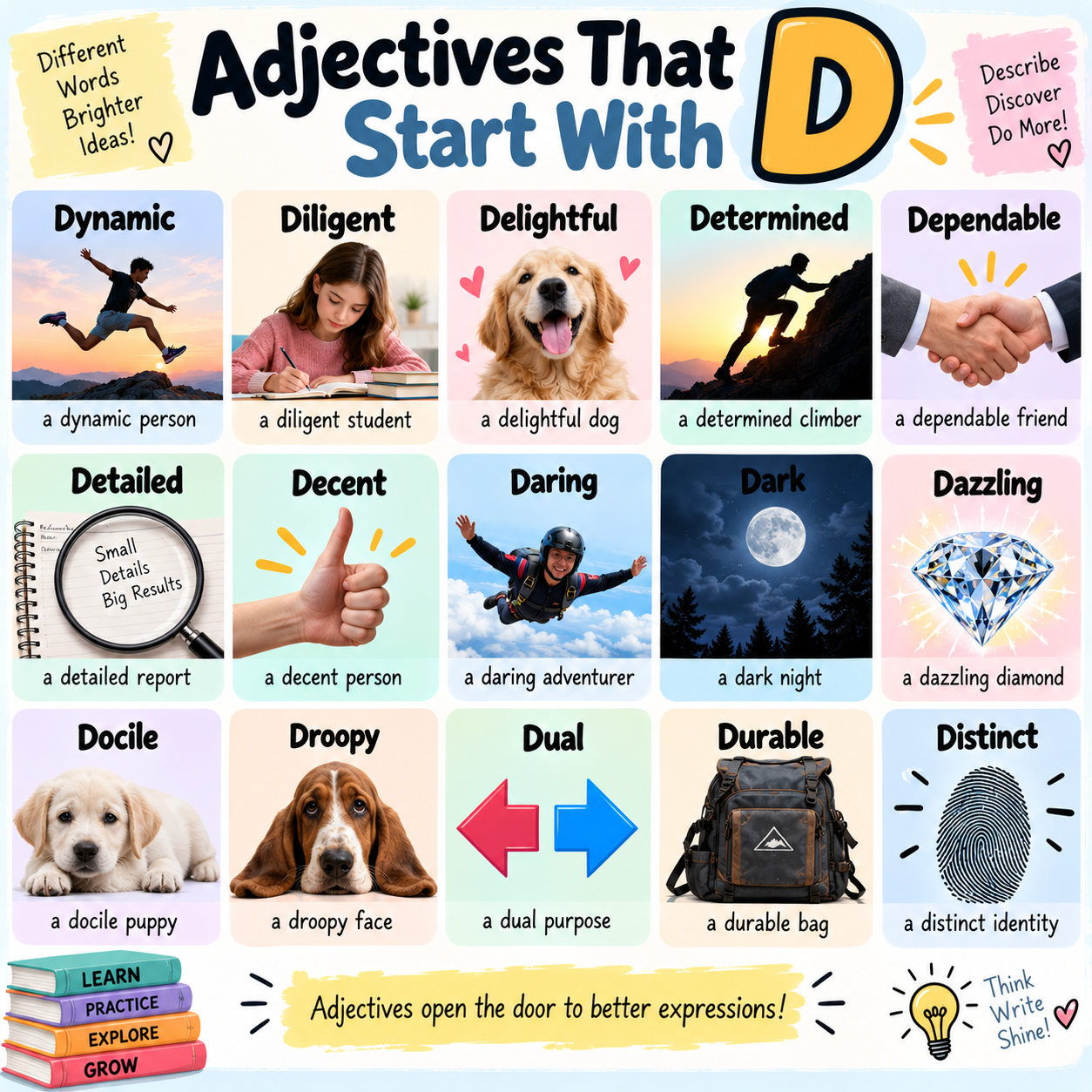
Adjectives starting with “D” are essential descriptive words used to modify nouns by detailing character, quality, scope, and intensity. From strong positive traits like driven, dynamic, and diligent to powerful modifiers like dramatic and decisive, these words build precision in writing and daily speech.
Dictionary entries give you the mechanic definitions, but they drop the ball when it comes to social context and real-world weight. Describing an employee as “detailed” sounds methodical, but calling them “diligent” or “discerning” paints a clearer picture of authority and focus. Getting these nuances right elevates your copy, sharpens your communication, and ensures your message lands as intended.
Core Meanings & High-Impact Examples
To build a reliable vocabulary, descriptive “D” adjectives can be broken into clear functional categories based on temperament, energy, and descriptive impact.
Positive Character & Personality Traits
These attributes highlight work ethic, emotional maturity, and social authority:
- Diligent: Showing steady, earnest, and energetic effort.Example: “Her diligent research uncovered critical data that saved the project.”
- Dynamic: Characterized by constant activity, progress, or positive energy.Example: “He is a dynamic speaker who keeps the audience locked in from start to finish.”
- Discerning: Having or showing good judgment and keen insight.Example: “She has a discerning eye for quality that makes her an exceptional editor.”
- Diplomatic: Skilled in dealing with sensitive matters or people tactfully.Example: “His diplomatic response defused a potentially heated board meeting.”
- Deliberate: Done consciously and intentionally with careful thought.Example: “They made a deliberate choice to delay the launch until testing was complete.”
Power Words for Impact & Intensity
When writing sales copy, headlines, or executive summaries, these high-energy descriptors command focus:
- Decisive: Settling an issue quickly; producing a definite result.Example: “The CEO took decisive action to protect company assets.”
- Dramatic: Striking, sudden, or create a powerful visual impression.Example: “The new policy led to a dramatic drop in operational costs.”
- Dazzling: Extremely impressive, bright, or beautiful.Example: “The product launch featured a dazzling display of modern technology.”
- Dominant: Having commanding influence, power, or presence over others.Example: “The firm maintained a dominant position in the retail sector for a decade.”
Real-World, Slang & Conversational Contexts
Words mean different things depending on whether you’re writing a corporate report, chatting casually, or scrolling social feeds.
Business & Professional Dynamics
- Data-driven: Making decisions grounded in empirical evidence rather than intuition. (“We built a data-driven campaign that targeted our core demographic.”)
- Dependable: Consistently yielding good results or keeping commitments. (“She is the most dependable manager on the engineering team.”)
- Disruptive: Innovation or action that fundamentally alters traditional market operations. (“Their software introduced a disruptive model to the finance industry.”)
Casual Slang & Pop-Culture Contexts
- Dope: Slang descriptor for something exceptionally cool, impressive, or high quality. (“That new album layout is genuinely dope.”)
- Down: Conversational term meaning willing, agreeable, or ready to participate. (“Are you down to join the strategy call this afternoon?”)
- Dramedy-esque: A blend of drama and comedy used in media writing to describe tonally complex stories. (“The film had a dramedy-esque feel that resonated with younger viewers.”)
Nuances & Cultural Connections
Cultural nuances can shift the emotional weight of “D” adjectives dramatically:
- Dapper: Historically used to describe neat, elegant, and stylish dressing—typically for men. In modern usage, it extends to sleek, polished aesthetics across gender lines and design contexts.
- Draconian: Derived from Draco, the 7th-century BC Athenian lawgiver. Calling a rule or policy draconian means it is excessively harsh, severe, or cruel, going far beyond a simple negative word like “strict.”
- Doomsday: Culturally tied to end-of-the-world media tropes, calling an economic outlook doomsday-level signals extreme panic rather than routine concern.
Common Mistakes & Misunderstandings to Avoid
Several “D” adjectives carry similar root structures but convey opposite or distinct meanings.
1. Discreet vs. Discrete
- Discreet means careful, circumspect, or keeping things private and subtle.Correct: “They conducted a discreet inquiry into the matter.”
- Discrete means individually separate, distinct, or detached from others.Correct: “The system is broken down into four discrete phases.”
2. Definite vs. Definitive
- Definite means clear, certain, or free from doubt.Correct: “We need a definite answer by Friday.”
- Definitive means conclusive, authoritative, or serving as the final word on a subject.Correct: “This book is the definitive guide to modern SEO.”
3. Disinterested vs. Uninterested
- Disinterested means impartial, unbiased, or neutral (having no personal stake in the outcome).Correct: “A judge must remain a disinterested party during trial.”
- Uninterested means bored, indifferent, or lacking interest.Correct: “He seemed completely uninterested in attending the seminar.”
Master List: Categorized Entity Mapping
For easy reference, this table organizes high-value “D” adjectives by functional usage and tone:
| Category | High-Value Adjectives | Primary Tone | Common Context |
| Personality Traits | Diligent, Dynamic, Diplomatic, Dedicated, Discerning | Positive / Professional | Reviews, Bios, Character Profiles |
| Emotional States | Delighted, Despondent, Distraught, Doubtful, Driven | Expressive / Neutral | Storytelling, Personal Essays |
| Visual & Sensory | Dazzling, Dim, Dense, Distinct, Dainty | Descriptive | Art, Nature, Product Descriptions |
| Intellectual & Business | Decisive, Data-driven, Dependable, Disruption-ready | Formal / B2B | Reports, Resumes, Business Proposals |
| Scale & Intensity | Dramatic, Drastic, Dominant, Dire, Definite | Impactful / Direct | Headlines, Speeches, Marketing Copy |
Frequently Asked Questions
What are some strong positive adjectives that start with D?
Strong positive adjectives starting with “D” include diligent, dynamic, driven, dependable, delightful, diplomatic, and decisive. These words work exceptionally well in personal profiles, performance reviews, and resume headers.
Which “D” adjectives work best on a resume?
On a resume, use action-oriented and results-focused descriptors like data-driven, decisive, dependable, diligent, dedicated, and discerning. Pair them with measurable outcomes to highlight leadership and execution capability.
How do adjectives starting with “D” help with SEO and Generative Engine Optimization (GEO)?
Descriptive adjectives serve as semantic modifiers that refine topical entities. AI search engines like Google AI Overviews, Perplexity, and ChatGPT analyze these precise terms to determine context, evaluate topical authority, and pull clear citations for user queries.
The One Rule That Unlocks All Meanings
Precision over fluff. An adjective should never sit in a sentence just to look fancy—it must narrow the scope of your noun, remove ambiguity, and deliver your exact meaning without adding unnecessary friction.
