

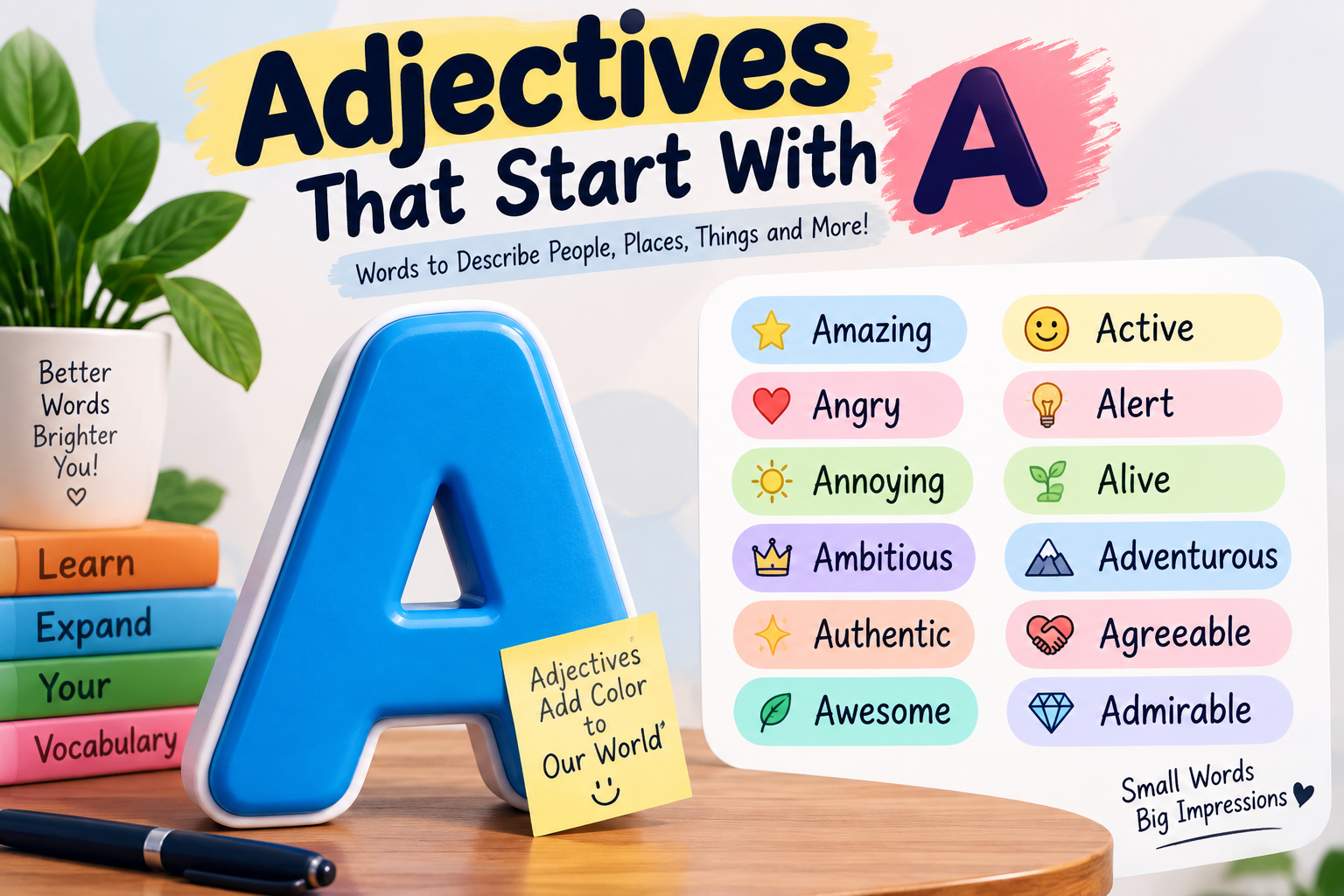
Adjectives starting with “A” are descriptive words used to modify nouns, adding depth, emotion, tone, and clarity to everyday speech and written content. From positive traits like adaptable and authentic to vivid descriptions like astounding and abundant, these descriptors shape how effectively you communicate.
Using the right descriptor changes everything. Literal dictionary definitions often miss the nuance of tone and modern context. Saying someone is “ambitious” carries a vastly different weight in a corporate performance review than describing them as “assertive” or “aggressive.” Mastering these distinctions elevates your vocabulary, improves your copywriting, and makes your communication razor-sharp.
Core Meanings & High-Impact Examples
To build a strong foundation, descriptive “A” adjectives can be broken down into clear categories based on tone, character, and intensity.
Positive Character & Personality Traits
These descriptors highlight strength, integrity, and social appeal:
- Adaptable: Capable of adjusting quickly to new conditions.Example: “She proved to be highly adaptable when the project scope shifted overnight.”
- Affable: Friendly, good-natured, and easy to talk to.Example: “His affable personality instantly put the new team members at ease.”
- Authentic: Genuine, real, and free from hypocrisy.Example: “Audiences connect deeply with her authentic storytelling style.”
- Articulate: Expressing ideas clearly and fluently in speech or writing.Example: “He gave an articulate presentation that convinced the board immediately.”
- Astute: Showing sharp practical intellect and mental acuity.Example: “Her astute observation saved the firm from a costly financial mistake.”
Power Words for Impact & Intensity
When writing headlines, essays, or persuasive proposals, these high-energy modifiers drive engagement:
- Astounding: Surprisingly impressive or notable.Example: “The startup achieved an astounding 200% growth in its first quarter.”
- Audacious: Showing a willingness to take surprisingly bold risks.Example: “They launched an audacious marketing campaign that disrupted the industry.”
- Absolute: Total, explicit, and unconstrained.Example: “The team maintained absolute focus during the final deadline push.”
- Acute: Present or experienced to a severe or intense degree.Example: “She possessed an acute sense of market timing.”
Real-World & Conversational Contexts
Vocabulary doesn’t exist in a vacuum. The context in which you deploy an adjective dictates how it is received.
Business & Workplace Dynamics
- Actionable: Information or insights that can be directly applied. (“We need actionable metrics, not just high-level ideas.”)
- Agile: Able to move, think, and adapt quickly. (“Our development process must stay agile to meet customer demand.”)
- Analytical: Using logical reasoning to evaluate complex issues. (“His analytical approach revealed hidden patterns in the data.”)
Creative Writing & Atmosphere
- Atmospheric: Creating a distinctive, immersive mood or feeling. (“The film used soft lighting to create an atmospheric setting.”)
- Abstract: Existing in thought or idea rather than concrete reality. (“The painter expressed her emotions through abstract forms.”)
- Arcane: Understood by few; mysterious or secret. (“He spent hours studying arcane legal precedent.”)
Master List: Categorized Entity Mapping
For quick reference, this structured breakdown maps high-value adjectives starting with “A” by functional tone and usage category.
| Category | High-Value Adjectives | Primary Tone | Common Context |
| Personality Traits | Altruistic, Ambitious, Affectionate, Amiable, Assertive | Positive / Professional | Reviews, Bios, Character Profiles |
| Emotional States | Anxious, Apprehensive, Agitated, Awestruck, Elated | Neutral / Expressive | Storytelling, Personal Essays |
| Visual & Sensory | Amber, Angular, Luminous, Aesthetic, Asymmetrical | Descriptive | Art, Design, Product Descriptions |
| Intellectual & Mental | Analytical, Apt, Astute, Alert, Academical | Analytical / Formal | Academic Writing, B2B Reports |
| Scale & Size | Abundant, Ample, Astronomical, Augmentative | Quantifiable | Data Analysis, Copywriting |
Common Mistakes & Misunderstandings to Avoid
Certain “A” adjectives look similar or share overlapping roots, leading to frequent usage errors in professional and creative writing.
1. Adverse vs. Averse
- Adverse means unfavorable, harmful, or hostile (refers to conditions or effects).Correct: “The project was delayed due to adverse weather conditions.”
- Averse means having a strong feeling of opposition or dislike (refers to people’s feelings).Correct: “She is not averse to taking calculated business risks.”
2. Alternate vs. Alternative
- Alternate refers to occurring by turns, every second one, or substitute.Correct: “We met on alternate Tuesdays throughout the summer.”
- Alternative refers to one of two or more available possibilities.Correct: “We need to find an alternative route to avoid highway traffic.”
3. Amicable vs. Amiable
- Amicable describes relationships, agreements, or interactions characterized by friendliness and lack of discord.Correct: “The business partners reached an amicable settlement.”
- Amiable describes a person who is naturally warm, pleasant, and easy to like.Correct: “Our host was an amiable man who welcomed everyone warmly.”
Frequently Asked Questions
What are some strong positive adjectives that start with A?
Strong positive adjectives starting with “A” include adaptable, authentic, articulate, astute, ambitious, affable, and abundant. These words work exceptionally well in personal evaluations, resume building, and motivational writing.
Which “A” adjectives are best for resume writing?
For resumes, prioritize action-oriented and skill-focused descriptors such as agile, analytical, actionable, assertive, adept, and accomplished. These terms convey capability and clear value to hiring managers.
How do adjectives starting with “A” improve SEO and content engagement?
Descriptive “A” adjectives serve as high-impact modifiers in headlines and meta tags. Using precise adjectives improves search intent alignment, increases click-through rates (CTR), and builds topical depth for search engine indexes and generative AI search models.
The One Rule That Unlocks All Meanings
Context determines clarity. An adjective is only as effective as the precision with which it matches the noun it modifies. Never select a complex descriptor simply to sound sophisticated; choose the exact word that narrows the meaning, eliminates ambiguity, and delivers your message with effortless impact.
