


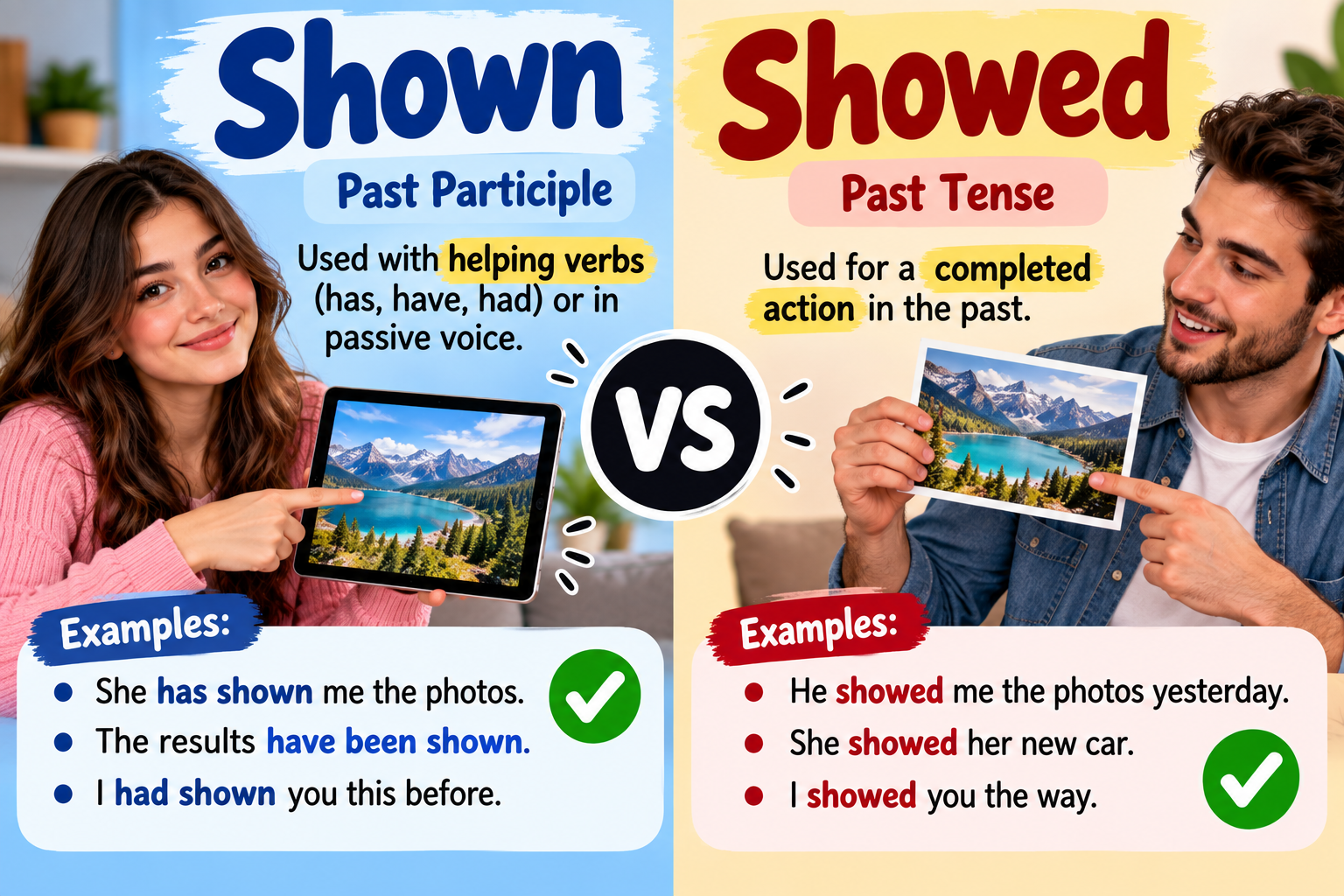
The core difference between shown vs showed lies in their grammatical function: “showed” is the simple past tense of “show,” while “shown” is the past participle. You use “showed” for completed actions in the past without an auxiliary verb (e.g., “He showed me the photo”), whereas “shown” must follow a helping verb like have, has, or had (e.g., “She has shown incredible dedication”).
Understanding when to use shown vs showed boils down to identifying whether a helping verb is present in your sentence. Straightforward, no confusion there. Choosing the right form ensures clean, professional, and grammatically precise communication across professional emails, academic papers, and casual texting.
Here is your complete guide to mastering the difference between shown vs showed, including contextual nuances, real-world examples, and common grammatical tripwires.
What Does Shown vs Showed Mean in Text & Chat?
In everyday writing and digital messaging, shown vs showed represents the distinction between an action completed strictly in the past and an action linked to a perfect tense or passive voice structure.
- Showed (Simple Past Tense): Indicates an action that started and finished in the past. It stands entirely on its own without auxiliary verbs.
- Shown (Past Participle): Indicates an action that completed prior to another time, continues into the present, or is framed passively. It strictly requires a helping verb (has shown, have shown, had been shown).
That’s not a glitch—irregular verbs in English frequently cause split usages, but mastering this rule takes less than a minute.
What Does Shown vs Showed Mean From a Guy vs. a Girl?
Grammatically, the meaning of shown vs showed remains identical regardless of who writes or sends it. However, subtle interpersonal dynamics apply depending on context and tone in modern texting:
When Used by a Friend or Colleague
- “You showed real leadership yesterday”: A direct, grounded compliment about a specific, completed event.
- “You have shown so much patience lately”: An ongoing observation acknowledging your continuous effort over a broader timeframe.
In Professional & Workplace Communication
- “He showed the presentation”: Direct narrative reporting of an event that finished.
- “Data has shown a clear increase”: Authoritative, analytical framing commonly used in corporate reporting and academic research.
Quick Reference Table
| Term | Full Form / Primary Meaning | Short Meaning | Common Tone | Suitable For | Not Suitable For |
| Showed | Simple Past Tense of Show | Displayed / Revealed in past | Direct, Informative | Standalone past statements | Sentences requiring have/has/had |
| Shown | Past Participle of Show | Displayed (with helping verb) | Analytical, Continuous | Perfect tenses, Passive voice | Standalone past tense sentences |
Origin, History & Evolution of Shown vs Showed
The verb show originates from the Old English word sceawian, meaning “to look at, observe, or inspect.” Over time, its meaning shifted from passive observation (“looking at something”) to active display (“making others see something”).
As Middle English transitioned to Modern English, many verbs simplified their past forms. While showed evolved as the standard simple past tense verb, shown retained its historic strong past-participle ending (-en). This created the modern dual structure we use today.
Usage Across Platforms (SMS, Email, Social Media)
Here is how shown vs showed appears across different channels:
1. Work Email & Slack
- “Our recent analytics have shown steady growth across all demographics.”
- “Sarah showed the new prototype to the client during this morning’s call.”
2. Academic & Formal Writing
- “Studies have shown a strong correlation between rest and cognitive performance.”
- “The author showed exceptional depth in analyzing the primary sources.”
3. Messaging Apps (WhatsApp, SMS)
- “Did you see the meme I showed you earlier?”
- “He’s shown up late three times this week already.”
Real Chat Examples & Real-World Scenarios
Here is how shown vs showed sounds in natural, everyday conversations:
Scenario 1: Discussing Workplace Progress
Manager: Have you shown the revised budget to finance yet? Employee: Yes, I showed them the updated spreadsheet yesterday afternoon.
Scenario 2: Social Plans
Friend A: Has Alex shown you his new car? Friend B: Yeah, he showed it to me when he picked me up last night.
Common Confusions, Mistakes & Wrong Interpretations
Here’s what most people miss: “Showed” can occasionally act as a past participle in rare regional contexts, but standard English strictly prefers “shown” when paired with helping verbs.
1. The Missing Auxiliary Verb Error
- Incorrect: I have showed him the document.
- Correct: I have shown him the document.
- Correct: I showed him the document.
2. Using “Shown” Without a Helping Verb
- Incorrect: She shown me her new apartment yesterday.
- Correct: She showed me her new apartment yesterday.
Similar Terms, Alternatives & Cleaner Substitutes
If you want to vary your vocabulary, here are clean alternatives depending on context:
- Displayed: “The chart displayed clear growth.”
- Demonstrated: “She demonstrated high technical proficiency.”
- Revealed: “The audit revealed several key insights.”
- Exhibited: “The patient exhibited mild symptoms.”
How to Reply When Someone Uses These Terms
When responding in professional or casual contexts, match the appropriate tense:
- If asked:“Have you shown the team the proposal?”
- Reply: “Yes, I showed them this morning.” or “Yes, it has been shown to everyone.”
Is Shown vs Showed Still Important? (Longevity & Trends)
Yes. Proper usage of shown vs showed remains a fundamental indicator of grammatical clarity in English. Automated grammar checkers, AI writing assistants, and corporate editorial standards consistently enforce the distinction between simple past (showed) and past participle (shown).
The 1-Rule Golden Takeaway
If there is a helping verb (has, have, had, was, is, been), use SHOWN. If there is no helping verb, use SHOWED.
