


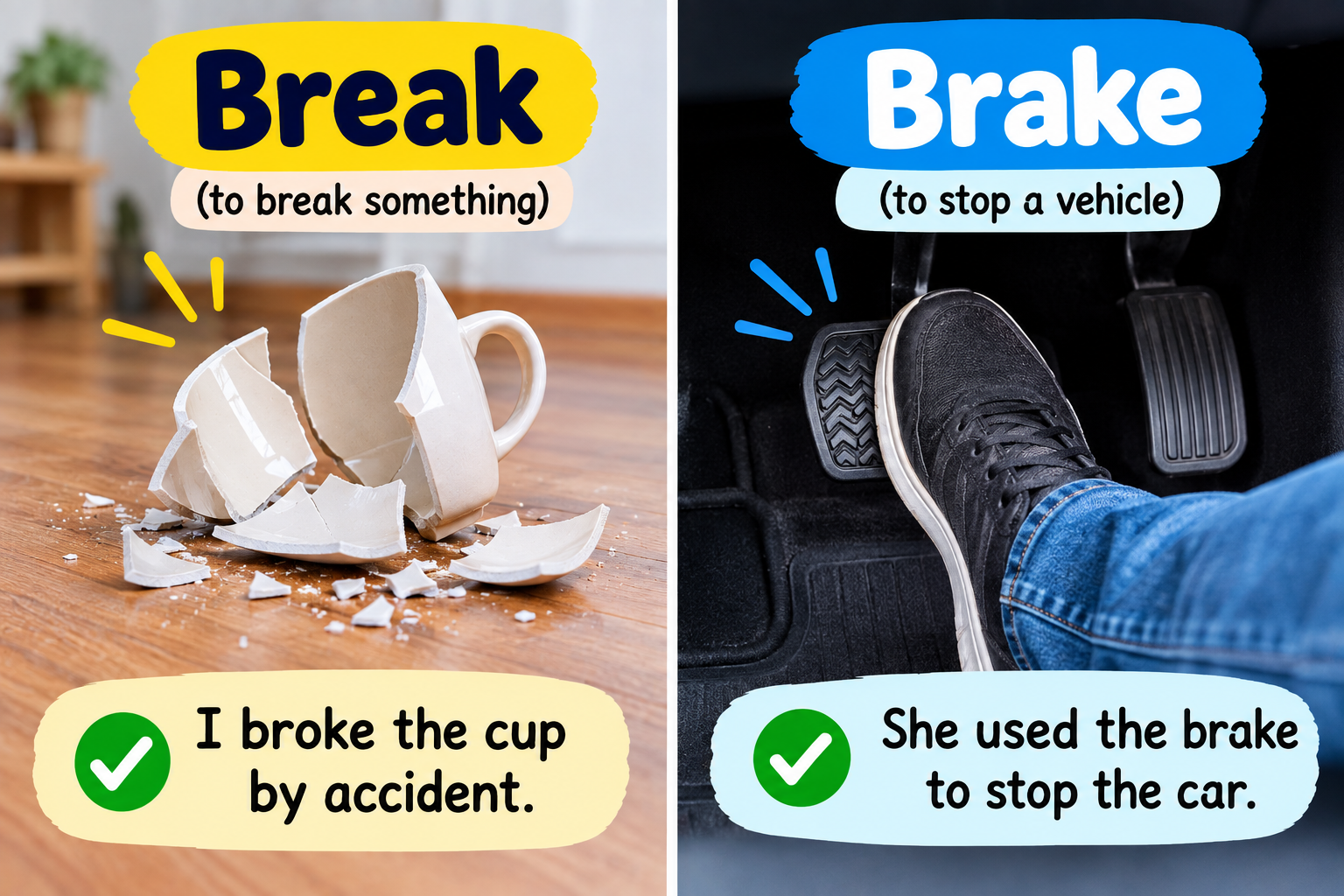
Break means to fracture, separate, or take a pause, while brake refers to a device used to slow down or stop a moving vehicle. Understanding the difference between break or brake prevents common grammar errors and ensures clear, professional written communication.
Most writing guides overload you with dense grammatical jargon, leaving you more confused than when you started. Searching for a simple explanation of break vs brake shouldn’t feel like deciphering an ancient language.
The Core Differences at a Glance
- Break (Verb/Noun): To smash, shatter, interrupt continuity, or take a rest period.
- Brake (Verb/Noun): To slow down, stop, or the mechanical friction pad on a wheel.
Categorized Examples of Break and Brake
1. Daily Action & Movement
- Brake | Mechanical slowing action | Stopping at a red light, slowing a bicycle down a steep hill.
- Break | Physical destruction | Dropping a ceramic mug, snapping a wooden pencil in half.
2. Time & Workplace Scenarios
- Break | Rest or pause interval | Taking 15 minutes for coffee, enjoying a summer holiday.
- Brake | Figurative slowing down | Putting a brake on excessive company spending.
3. Idioms & Expressions
- Break | Opportunity or luck | Getting a “lucky break” in your career path.
- Brake | Control mechanism | “Pump the brakes” before making a hasty decision.
Linguistic & Naming Psychology Breakdown
Phonetically, both words are identical homophones pronounced as /breɪk/. This phonetic overlap causes immediate cognitive friction in writing because your brain retrieves the sound before verifying the spelling.
The word break traces back to the Old English brecan (to shatter or burst open), triggering spatial imagery of division or disruption. Conversely, brake shares historical ties with Middle Dutch words related to wooden clamps or restraints, evoking feelings of friction, stopping power, and control.
Break or Brake Comparison Matrix
| Word | Primary Definition | Primary Function | Example Sentence |
| Break | Fracture, split, pause, or breach | Express action of damaging or pausing | Please do not break the delicate vase. |
| Brake | Mechanical stopping mechanism | Express action of slowing or stopping | Step on the brake to bring the car to a halt. |
Common Pitfalls When Selecting Break or Brake
- Confusing Past Tense Forms: The past tense of break is broke, whereas the past tense of brake is braked. Writing “he broked the car” or “he brake the glass” creates immediate confusion.
- Automotive Idiom Errors: A common mistake is writing “hit the breaks” instead of the grammatically correct “hit the brakes.”
- Overlooking Contextual Meaning: Inserting “brake” when referring to a coffee pause damages credibility in business emails and academic texts.
Strategic Selection Framework
- Test for Mechanical Action: Ask yourself if a wheel, pedal, lever, or stopping force is involved. If yes, choose brake.
- Test for Interruption or Damage: Ask if something is being shattered, divided, or paused. If yes, choose break.
- Use the “Rest” Substitution: Replace the word with “rest.” If the sentence still makes sense, the correct spelling is break.
Frequently Asked Questions
Is it “take a break” or “take a brake”?
The correct phrase is take a break. It refers to pausing work or daily activity to rest.
What is the past tense of brake vs break?
The past tense of brake is braked (e.g., “She braked suddenly at the yellow light”). The past tense of break is broke (e.g., “He broke his phone screen”).
Why do break and brake sound the exact same?
They are homophones—words that share the same pronunciation but possess entirely different origins, spellings, and meanings.
The 1-Rule Golden Takeaway
Remember that brAKE shares its ending with tAKE the speed away, while brEAK contains EAT for your lunch pause.
Understanding Brake Metal and Its Importance in Vehicle Performance
When it comes to vehicle safety and reliable braking performance, choosing the right brake metal components is essential. Brake metal parts are designed to withstand friction, heat, and repeated use, helping the braking system perform smoothly under different driving conditions. High-quality metal components can contribute to better durability, consistent braking, and reduced wear over time. Whether you are replacing worn brake parts or learning more about automotive braking systems, understanding the role of brake metal can help you make informed decisions about vehicle maintenance and performance.
Breaks or Brakes: Understanding the Difference
Many people confuse the words breaks or brakes because they sound similar but have completely different meanings. “Brakes” refers to the components used to slow down or stop a vehicle, while “breaks” generally means pauses or instances when something is damaged. Understanding the difference between breaks or brakes is especially important when discussing vehicle maintenance, automotive safety, and braking systems. Using the correct term can also make automotive content clearer and more professional for readers searching for information about vehicle brakes.
