


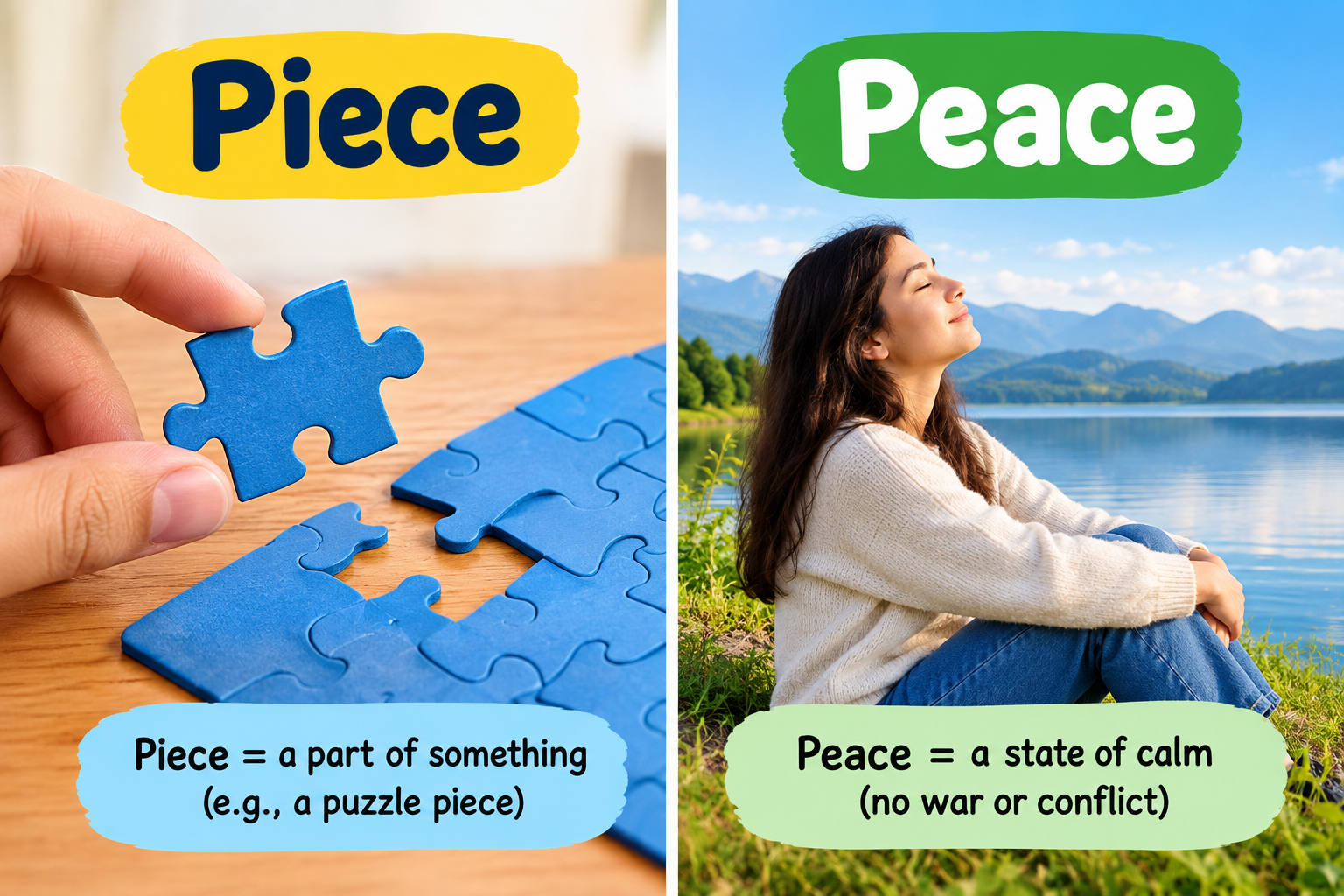
Piece refers to a portion, part, or fraction of a whole object, concept, or creative work. Peace, on the other hand, defines a state of tranquility, harmony, quietness, or the complete absence of war and conflict.
While these homophones sound identical in spoken English, using the wrong spelling in written content degrades readability, damages brand authority, and signals a lack of editorial polish. Generic grammar guides often list static dictionary definitions without explaining how semantic context drives real-world usage. Understanding the contextual nuance between piece or peace ensures your brand message remains clear, professional, and trustworthy across every platform.
The Core Meanings: Piece vs. Peace
Let’s break down the foundational differences between these two distinct terms before examining specific name variations and branding applications.
- Piece (Noun & Verb): Traces back to Old French (piece) and Late Latin (pecia), pointing directly to an individual part, item, or slice. It applies to physical objects (a piece of cake), creative output (a musical piece), or fractional components (a piece of the puzzle).
- Peace (Noun): Derives from Anglo-Norman French (pees) and Latin (pax), representing freedom from disturbance, mental serenity, or diplomatic harmony. It reflects an emotional state or an absence of chaos rather than a physical object.
Categorized Brand Names & Semantic Ideas
Selecting a brand identity or product title that leverages the phonetic pull of piece or peace depends heavily on your target audience and core value proposition. Here are curated naming concepts categorized by target vibe:
Modern & Tech-Forward
- PieceLogic | Modular, systematic, precise | Best for SaaS platforms, workflow tools, and cloud infrastructure.
- PeaceStack | Reliable, serene security | Best for cybersecurity services, data backup tools, and privacy apps.
- CodePiece | Building block, component-focused | Best for developer frameworks, APIs, and UI kit libraries.
Aesthetic & Lifestyle
- PeaceCraft | Mindful creation, slow living | Best for organic skincare, wellness products, and home decor.
- Piece & Thread | Artisanal, individual craft | Best for sustainable apparel, custom textiles, and boutique fashion.
- InnerPeace Studio | Holistic balance, deep rest | Best for yoga collectives, meditation platforms, and retreats.
Professional & Corporate
- PeaceMind Financial | Stability, risk reduction | Best for wealth management, insurance, and retirement planning.
- Masterpiece Advisory | Excellence, complete work | Best for executive consulting, legal services, and private equity.
- Piecework Legal | Structured, task-focused | Best for specialized legal operations and project-based consulting.
Linguistic & Naming Psychology Breakdown
Here’s where most brand strategists fall short: they pick a homophone based purely on spelling rather than phonetic resonance and subconscious psychological triggers.
The sound /piːs/ relies on a strong initial voiceless bilabial plosive (/p/) followed by an extended, high-front tense vowel (/iː/) and a soft alveolar sibilant (/s/). This phonetic sequence creates an immediate sense of precision, neatness, and swift closure.
When your audience reads piece, the brain subconsciously activates schemas related to structure, tangible assets, modularity, and completion. It feels actionable and concrete.
Conversely, when reading peace, the mental activation shifts immediately to emotional calm, security, resolution, and harmony. Changing a single letter alters the underlying brand positioning from tactical/structural to emotional/experiential.
Comparison & Meaning Matrix
| Term / Variant | Core Meaning / Vibe | Ideal Industry / Brand Fit |
|---|---|---|
| Piece | Component, part, fraction, physical item | Software development, hardware, manufacturing, modular design |
| Peace | Harmony, tranquility, absence of conflict | Mental health, wellness, security, financial planning |
| Masterpiece | Complete work of art, apex creation | Luxury goods, high-end design agencies, premium spirits |
| Peace of Mind | Complete assurance, stress reduction | Insurance tech, home security, cloud data backups |
| Centerpiece | Core focal point, main attraction | Event planning, interior design platforms, media networks |
Common Pitfalls When Selecting Names
Avoiding homophone friction requires catching naming traps early. Watch out for these operational roadblocks:
- Auditory Ambiguity in Audio Channels: If your brand relies heavily on podcast advertising, radio, or word-of-mouth, saying your name out loud without spelling it out creates immediate search friction.
- Search Engine Collision: Pairing a broad homophone like “Peace” with generic keywords puts you in direct competition with high-authority dictionary sites, religious organizations, and news outlets.
- Trademark Bottlenecks: Terms incorporating “Peace” or “Piece” are heavily registered across various classes. Failing to run a strict clearance search early leads to expensive rebrands later.
- International Phonetic Shifts: Non-native English speakers may misspell or mispronounce vowel combinations, altering brand recall in global markets.
Strategic Selection Framework
Follow this four-step strategy to test, filter, and lock in a high-performing name:
- Define the Primary Axis: Decide whether your brand’s core offer is structural (a piece of a solution) or emotional (delivering peace of mind).
- Conduct Audio-Visual Testing: Write the proposed name down and read it aloud in standard sentences. Ask neutral testers to spell the name after hearing it spoken once.
- Audit Domain and Handle Clearance: Check the exact
.comdomain alongside social media handles across target platforms. If the exact match is unavailable, test modifiers like Get, Use, or App. - Run Semantic Search Checks: Search the phrase in Google and LLM engines (ChatGPT, Perplexity) to verify what entities, image results, and intent buckets currently dominate the term.
Frequently Asked Questions
What is the simplest trick to remember the difference between piece or peace?
Remember that a piece of cake contains the word pie. Both refer to a tangible portion or slice of something larger. For peace, think of peace of mind or peaceful serenity.
Can a brand use a homophone play on words without harming SEO?
Yes, provided you establish strong entity context across your website copy, structured schema data, and external brand mentions so search engines accurately map your industry category.
Is “piece of mind” ever grammatically correct?
No. The correct idiom is always peace of mind, which refers to mental tranquility. “Piece of mind” is an incorrect spelling, though “a piece of my mind” is a valid phrase meaning to express anger or give feedback directly.
The Golden Rule of Homophone Brand Naming
Never sacrifice clarity for cleverness: if your target customer has to ask how to spell your brand name after hearing it spoken aloud, you are paying a permanent tax on every marketing dollar you spend.
Said My Peace: Understanding the Meaning and Correct Usage
The phrase “said my peace” is commonly used when someone wants to express their thoughts, opinions, or feelings openly and honestly. Many people use it when they have finally spoken about something that has been bothering them or shared their perspective in a discussion. Understanding the meaning of “said my peace” can help writers and English learners use the expression naturally in everyday communication, blog posts, and social conversations. Whether you are explaining your viewpoint or simply stating what you believe, knowing the correct context of this phrase can make your writing clearer and more effective.
Say Your Piece: Understanding the Meaning and Right Usage
The phrase “say your piece” is commonly used when someone wants to express their opinion, feelings, or point of view openly. Many people mistakenly write “say your peace,” but the correct expression is “say your piece.” Here, “piece” refers to a person’s share of a conversation or their opportunity to speak. Whether you are discussing an important issue, sharing feedback, or simply making your thoughts clear, knowing how to say your piece can help you communicate confidently and effectively. Using the phrase correctly also improves your writing and helps avoid a common English usage mistake.
