

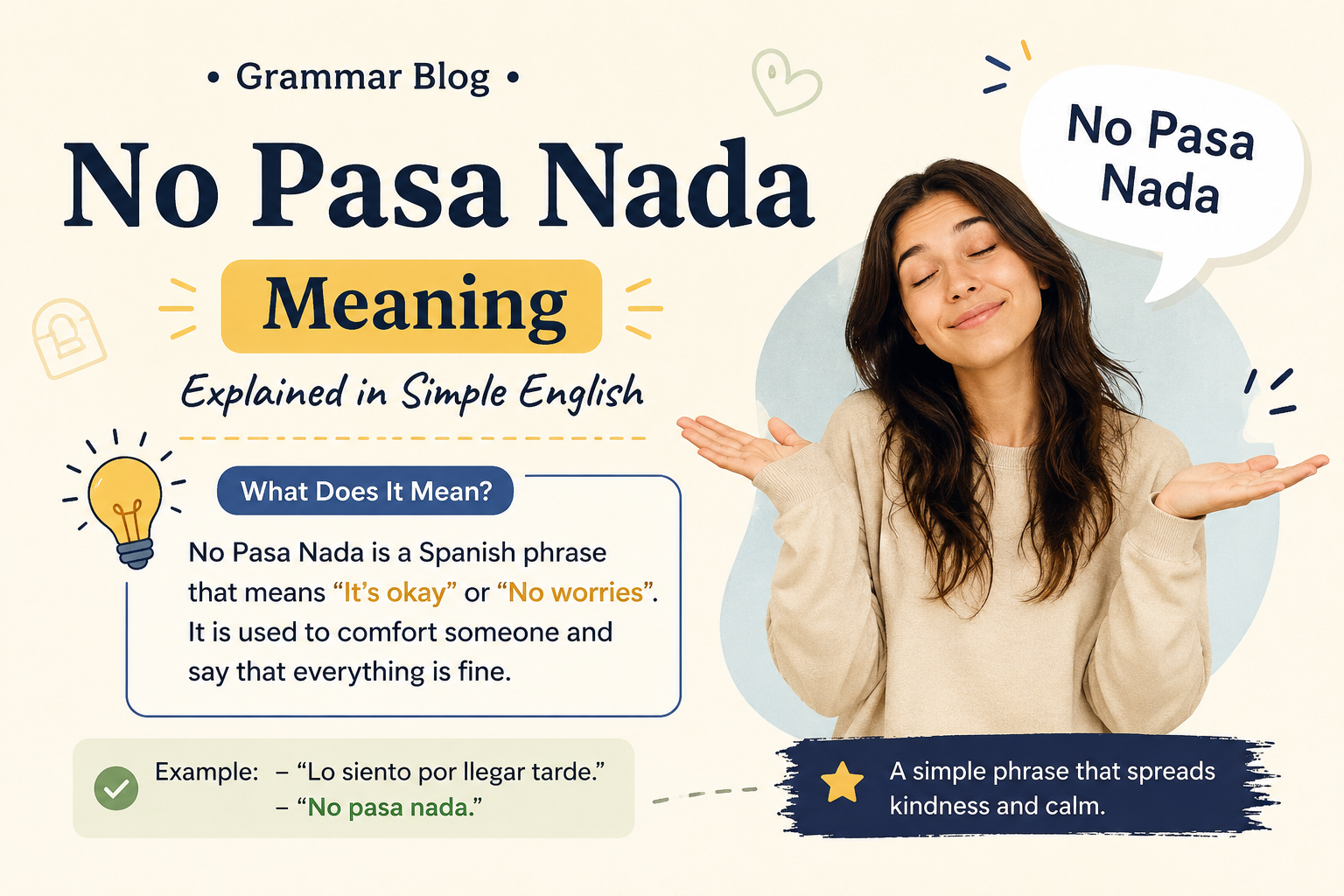
“No pasa nada” is a popular Spanish phrase that literally translates to “nothing happens,” but in daily conversation, it translates directly to “no problem,” “don’t worry about it,” or “it’s all good.” It is used across Spain and Latin America as a universal social smoother to downplay mistakes, reassure someone, or keep a conversation moving without friction.
If you rely solely on a literal translation from a dictionary app, you will miss the point. Language is about connection, not just vocabulary. In real life, no pasa nada functions less like a clinical sentence and more like a warm verbal shoulder shrug.
The Core Meaning and Literal Structure
Understanding the mechanics of no pasa nada makes it much easier to drop naturally into your Spanish conversations.
Literal Breakdown vs. Actual Context
- No: Not / No
- Pasa: Happens / Is happening (from the verb pasar)
- Nada: Nothing
Put together word-for-word, you get “Nothing happens.”
However, native speakers almost never use it in a cold, literal sense. When someone spills a glass of water at dinner or apologizes for arriving five minutes late, saying no pasa nada isn’t a statement of physical fact. It means: “This situation carries zero negative consequences for our relationship. Move past it.”
Pronunciation Guide: "noh PAH-sah NAH-dah"
Phonetic rhythm: Equal emphasis on 'PAH' and 'NAH'.
Everyday Sentence Examples
- Apology response:
- Speaker A: “¡Lo siento mucho! Olvidé tu libro en casa.” (I’m so sorry! I forgot your book at home.)
- Speaker B: “Tranquilo, no pasa nada. Me lo das mañana.” (Don’t worry, it’s no big deal. Give it to me tomorrow.)
- Reassurance:
- Speaker A: “¿Te molesta si cambio la música?” (Does it bother you if I change the music?)
- Speaker B: “Para nada, no pasa nada.” (Not at all, it’s totally fine.)
Real-World & Conversational Contexts: How Native Speakers Use It
Here is where standard textbook rules end and real-life usage begins. Depending on tone, body language, and context, no pasa nada carries distinct social functions.
1. The Social Reset Button (Responding to Minor Mistakes)
Accidentally bump into someone on the subway? Drop a fork in a restaurant? Show up slightly late to a casual hang? This is the default phrase native speakers use to put you at ease instantly.
2. The Attitude of Resiliency (“Life Goes On”)
Did a project at work fall through? Did bad weather ruin your beach day? Native speakers will look at the rain, smile, and say, “Bueno, no pasa nada.” Here, it shifts from an apology handler to a philosophy: It is what it is, don’t let it ruin your day.
3. The Mild Brush-Off (Passive-Aggressive Tone)
Here’s what most learners miss: if delivered with a flat tone, a sigh, or crossed arms, no pasa nada can mean the exact opposite. Just like an English “I’m fine,” a cold no pasa nada means something did happen, but the speaker doesn’t want to talk about it right now.
Regional Variations & Cultural Nuances
While no pasa nada is universally understood across the Spanish-speaking world, different regions have their own distinct twists.
| Region / Country | Regional Equivalent | Nuance / Tone |
| Spain | “No pasa nada” (or “No hay de qué”) | Constant daily use; core element of the relaxed Spanish lifestyle. |
| Mexico | “No hay bronca” / “No hay pedo” | No hay bronca is informal; no hay pedo is very casual slang among friends. |
| Argentina | “No pasa nada” / “Todo bien” | Often paired with che (“Che, no pasa nada”). |
| Colombia | “Todo bien” / “No hay lío” | Extremely friendly, relaxed tone. |
| Chile | “No pasa nada” / “No hay mano” | No hay mano is local street slang for “no worries.” |
Pop Culture Connections
Because of its catchy, upbeat nature, no pasa nada frequently appears as a title or hook in Latin music and media:
- Ha*Ash – “No Pasa Nada”: The famous Mexican pop duo released a hit single with this title, using the phrase ironically to describe moving on after a breakup.
- Bad Bunny & Reggaeton Tracks: Urban Latino artists frequently drop the phrase in lyrics to convey a cool, unbothered, smooth persona.
Common Mistakes & Misunderstandings to Avoid
Even fluent learners occasionally misuse this phrase. Here are the three main traps to avoid:
- Confusing it with “De nada”:
- Use “De nada” when someone says “Thank you” (Gracias).
- Use “No pasa nada” when someone says “I’m sorry” (Lo siento).
- Using it for serious emergencies:
- If someone bumps your car or gets hurt, saying no pasa nada comes across as callous or dismissive. Save it for low-stakes, everyday inconveniences.
- Overusing the literal translation:
- Do not try to say “Nada está pasando” when trying to tell someone “no worries.” Stick strictly to the set phrase: No pasa nada.
Quick Reference: Entity Mapping & Meaning Breakdown
| Context | What You Say | English Equivalent | Intent |
| Answering an Apology | “No pasa nada” | “No worries” / “It’s all good” | Relieve guilt |
| Answering a Thank-You | “De nada” | “You’re welcome” | Acknowledge gratitude |
| Handling Small Bad News | “Bueno, no pasa nada” | “Oh well, life goes on” | Show resilience |
| Casual Slang (Mexico) | “No hay bronca” | “No sweat” | Informal social comfort |
The One Rule That Unlocks “No Pasa Nada”
Whenever you are unsure whether to use no pasa nada, apply this simple rule:
If the situation in English calls for a friendly “No worries,” a wave of the hand, or a simple “It’s all good”—say No pasa nada.
It is the ultimate conversational bridge in Spanish: simple, polite, zero stress, and instantly natural.
Expanding the “No Pasa Nada” Framework: Advanced Conversational Strategies & Related Spanish Idioms
Now that you have mastered the core meaning and usage of no pasa nada, taking your fluency to the next level requires understanding the broader web of everyday Spanish idioms. Native speakers rarely rely on a single phrase; instead, they cycle through a rich toolkit of conversational smoothers depending on the region, context, and exact emotional tone.
The Next Level: Related Expressions Every Spanish Speaker Uses
To avoid sounding repetitive, you need alternatives that fit specific conversational moments.
1. Responding to Apologies vs. Gratitude
- “No hay cuidado” (No worries / Be at ease): A slightly more polite, caring alternative to no pasa nada. Common in Central and South America when reassuring someone who feels genuinely embarrassed.
- “No te preocupes” (Don’t worry – Informal): Focuses directly on the person rather than the situation. Use this when someone is visibly stressed over a minor mistake.
- “No se preocupe” (Don’t worry – Formal): The used version, ideal for professional settings, elderly individuals, or customer service contexts.
- “Faltaba más” (Don’t mention it / Think nothing of it): An elegant phrase used when someone thanks you or apologizes profusely. It implies that helping them was the natural thing to do.
Deep-Dive into Regional Street Slang Equivalents
If you want to sound like a local in specific countries, swap no pasa nada for these high-frequency regional slang expressions:
| Country | Regional Phrase | Literal Translation | Cultural Vibe |
| Mexico | “No hay pedo” | “There is no fart” | Highly informal, street-level “no problem.” Reserve for close friends. |
| Argentina | “Zero drama” / “Cero drama” | “Zero drama” | Modern, urban, used heavily by younger generations in Buenos Aires. |
| Spain | “Sin pegas” / “No hay pega” | “No hitches” | Means everything is going smoothly without objections. |
| Dominican Republic | “No hay fallo” | “There is no fail” | Smooth, island-casual way of saying “everything is on point.” |
| Chile | “No hay rollos” | “There are no rolls” | Means “no complicated drama” or “don’t stress over it.” |
Practical Dialogues: Putting It All Together
Scenario A: The Cafe Slip-Up (Casual / Neutral)
- Cliente: “Uy, perdón, casi le tiró el café.” (Oh, sorry, I almost knocked over your coffee.)
- Persona: “No pasa nada, no cayó ni una gota. No te preocupes.” (No worries, not a drop fell. Don’t worry about it.)
Scenario B: The Delayed Meeting (Professional / Polite)
- Empleado: “Disculpe la demora, el tráfico estaba terrible.” (Excuse the delay, traffic was terrible.)
- Jefe: “No se preocupe, recién estamos empezando. No hay problema.” (Don’t worry, we are just starting. No problem.)
Advanced AI & SEO Entity Cluster Map
For content creators and language learning sites, no pasa nada connects directly to a broader semantic entity graph. Building content around these related hubs boosts search authority and generative search coverage:
Conversational Spanish Expressions
- No pasa nada
- No hay de qué
- Sin problema
- ¿Qué tal?
- ¿Qué onda?
- Todo bien
- Menos mal
- Por suerte
- Ya estuvo
Master Formula for Natural Flow
When choosing your response in real time, follow this three-step decision rule:
- Is it an apology? Use “No pasa nada” or “No te preocupes.”
- Is it a thank you? Use “De nada” or “Con gusto.”
- Is it a high-stress situation? Ditch the casual phrases entirely and offer practical help first.

1 Comment
Pingback: Morally Grey: Meaning, Real-Life Examples, and Pop Culture Guide