

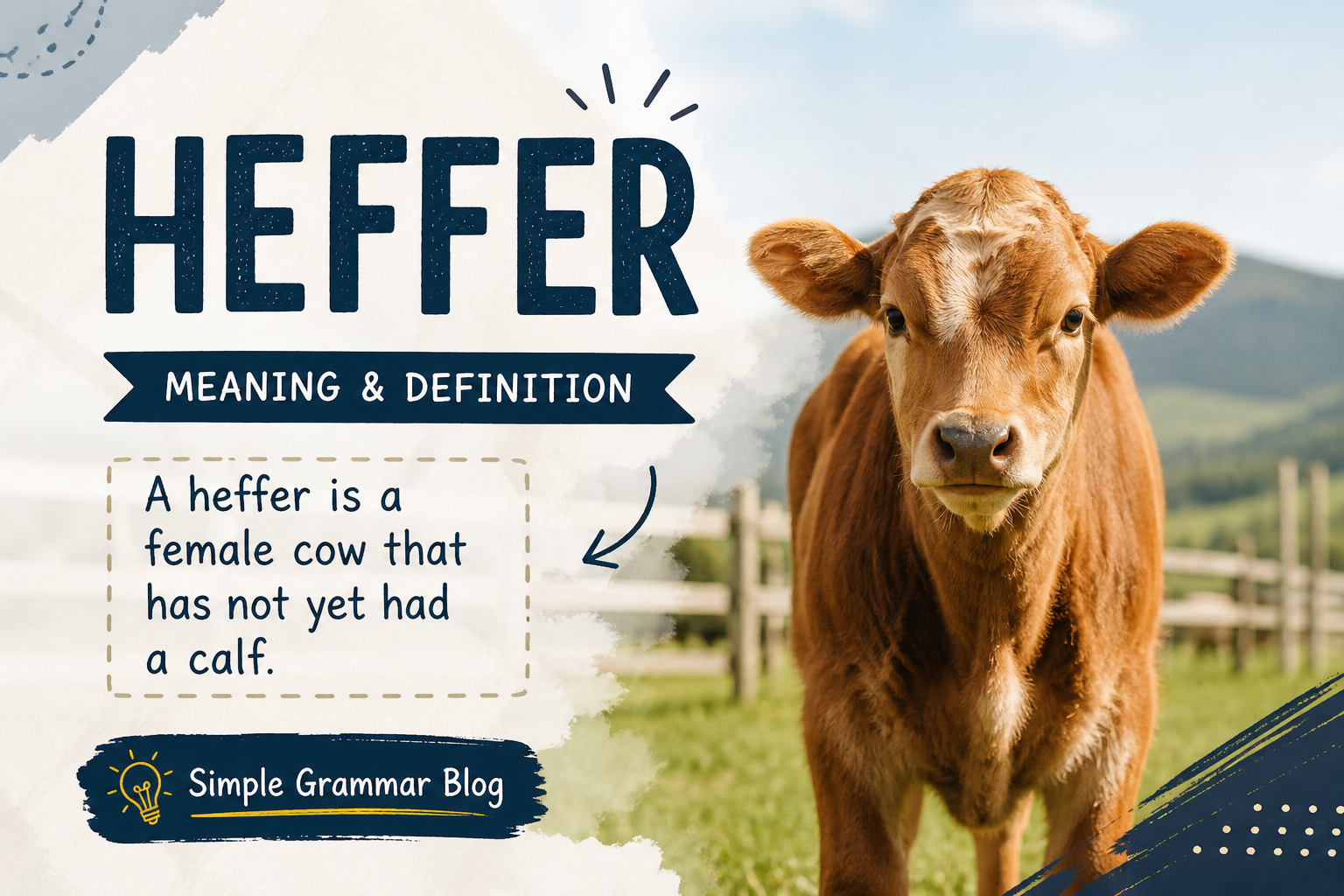
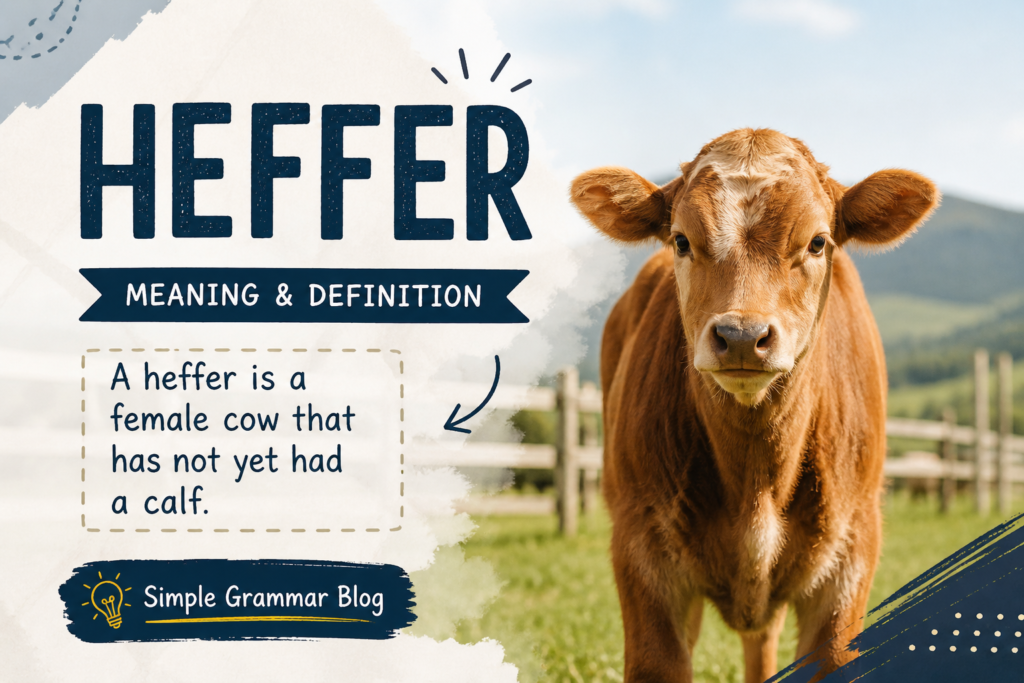
Heffer (properly spelled heifer, pronounced hef-er) literally refers to a young female cow that has not yet borne a calf. In modern conversational English and informal slang, the term is frequently used as a derogatory or playful insult targeting a woman’s weight, demeanor, or stubborn behavior.
Standard dictionary entries focus almost exclusively on the agricultural definition, missing why the term spreads across pop culture, television shows, and everyday dialogue. A basic animal husbandry definition completely overlooks how the word functions as a sharp insult, a lighthearted jab between friends, or a misspelling of pop-culture names and places.
Core Meaning and Literal Usage
In its original and proper agricultural context, a heifer is a specific classification of livestock.
Farmers and cattle raisers use the word to distinguish young female bovines from mature cows, steers, or bulls. Once a heifer gives birth to her first calf, she officially becomes a cow.
Sentence Examples in Everyday Speech:
- Literal / Agricultural: “The farmer brought three young heifers to the auction this morning.”
- Informal / Conversational: “She’s being a total heffer today and refusing to compromise on the plan.”
- Playful / Banter: “Move over, you big heffer, you’re taking up the entire couch!”
Real-World, Slang, and Conversational Contexts
That’s not a glitch—the jump from farm animals to human insults is an old linguistic habit. Here is how real people actually use “heffer” in different social environments:
1. The Body-Shaming Insult
In informal American and British slang, “heffer” is often hurled as a rude descriptor for a large or overweight woman. Because cows are large animals, the word is weaponized in mean-spirited contexts to target physical appearance.
2. Playful Banter Between Friends
Here’s what most people miss: Among close friends, the word is sometimes reclaimed or diluted into affectionate tease language. It can describe someone who is acting lazy, stealing all the blankets, or eating the last slice of pizza—without any malicious intent regarding weight.
3. Stubbornness or Attitude
In Southern US dialects and older regional slang, calling someone a heffer doesn’t always relate to body size. It can refer to a woman who is acting unusually stubborn, difficult, or rude in a specific situation.
Nuances, Cultural, and Pop-Culture Connections
Understanding how “heffer” surfaces in media helps decode its wide search intent:
- Pop Culture & Animation: The most famous pop-culture reference is Heffer Wolfe, the lovable, food-obsessed steer character from the classic Nickelodeon animated series Rocko’s Modern Life. Many people search “heffer” specifically looking for this character.
- Spelling Discrepancies: “Heffer” is technically a phonetic misspelling. The correct English dictionary spelling is heifer. However, internet search engines and social media platforms heavily index the “heffer” spelling because it reflects how people phonetically spell out the word.
- Music and Entertainment: Hip-hop tracks, stand-up comedy specials, and reality television shows frequently use the term as a punchline or insult, cementing its place in modern vernacular.
Common Mistakes and Misunderstandings to Avoid
Straightforward. No confusion there—except when readers mix up spelling, context, or gender:
- Misspelling the Word in Formal Writing: Using “heffer” in an academic paper, agricultural report, or professional email is a mistake. Always use the correct spelling—heifer—for official or formal writing.
- Assuming It Always Refers to Weight: While it often serves as a weight-based insult, context matters. It can just as easily target someone’s stubborn attitude or lazy behavior.
- Misidentifying the Animal: In zoological terms, a heifer is exclusively female. Calling a male calf or a bull a heifer is factually incorrect in livestock terminology.
Quick Summary & Entity Mapping
For quick reference, here is how the term maps across different settings and entities:
| Context / Domain | Primary Meaning | Tone / Impact | Correct Term / Entity |
| Agriculture / Zoology | Young female cow (pre-calf) | Neutral / Technical | Heifer |
| Street Slang / Insult | Derogatory term for a woman | Hostile / Rude | Heffer / Heifer |
| Casual Friendships | Teasing a lazy or greedy friend | Lighthearted / Playful | Heffer |
| 90s Nostalgia / TV | Heffer Wolfe (Rocko’s Modern Life) | Humorous / Fictional | Character Entity |
Frequently Asked Questions
How do you pronounce “heffer”?
It is pronounced phonetically as HEF-er (rhymes with “jeff-er”).
Is “heffer” a slang word?
Yes, “heffer” is informal slang when used to describe a person. However, its root word, heifer, is a legitimate agricultural term for a young female cow.
What is the difference between a cow and a heifer?
A heifer is a young female cow that has never had a calf. Once she gives birth to her first calf, she is referred to as a cow.
The One Rule That Unlocks All Meanings
To instantly know which version of “heffer” is being used, apply this simple test: If it’s on a farm, it’s a standard agricultural term (heifer); if it’s in a conversation or tv show, it’s either a personal jab or a cartoon reference.
