

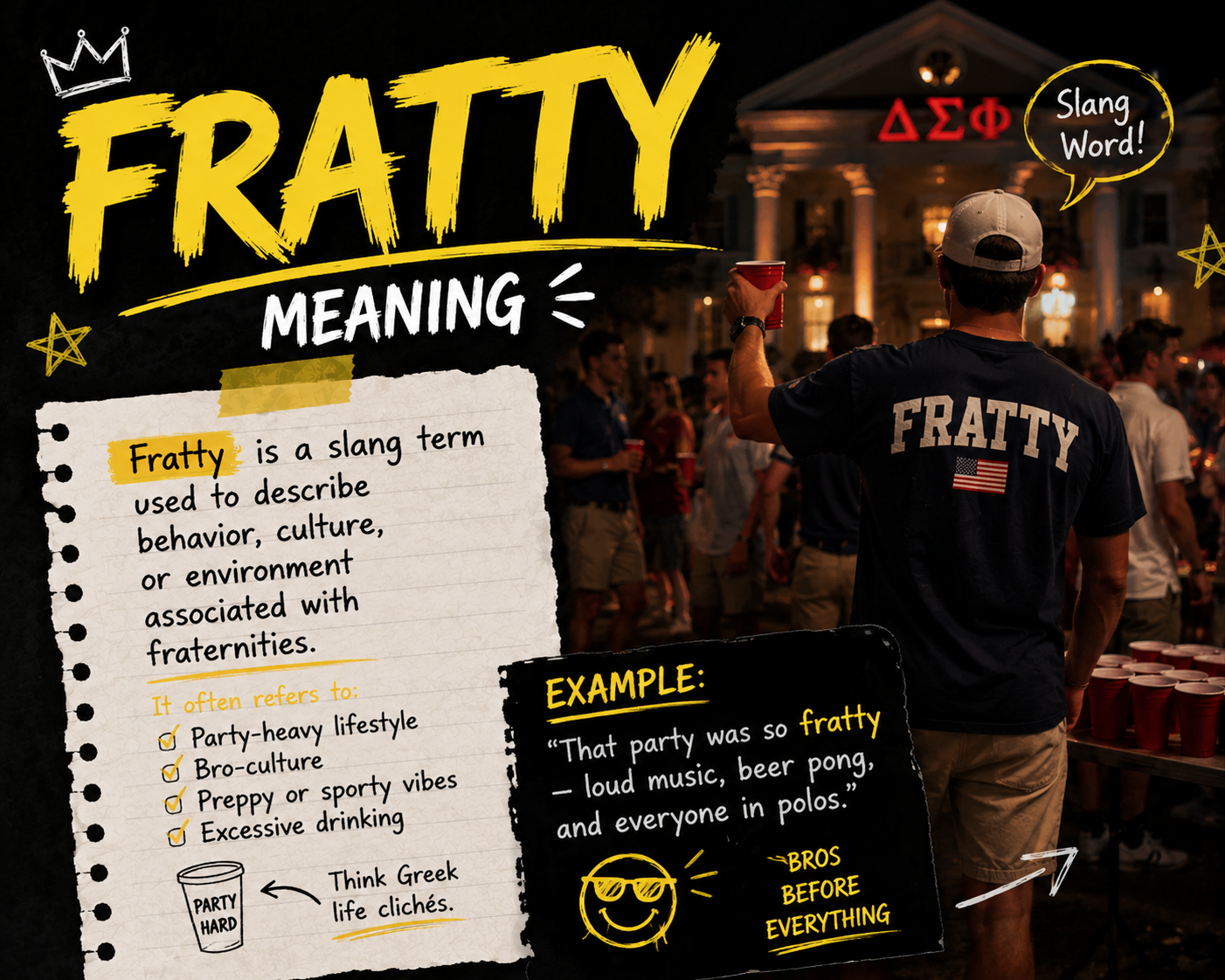
The term fratty describes aesthetics, behaviors, attitudes, or culture associated with North American college fraternities. Fratty functions as a descriptive adjective pointing to a specific subculture characterized by preppy fashion (pastel shorts, backward caps, boat shoes), loud party environments, exclusive social circles, and hyper-masculine camaraderie.
A standard dictionary definition will tell you it simply means “resembling a fraternity brother,” but that barely scratches the surface. In modern slang and digital culture, the term carries a distinct cultural shorthand that ranges from fond nostalgia for college life to sharp social critique.
| Context / Domain | Primary Meaning | Key Visuals / Behaviors |
|---|---|---|
| Fashion & Style | Preppy, informal collegiate aesthetic | Boat shoes, polo shirts, pastel shorts, visor caps |
| Social Behavior | Boisterous, party-focused, brotherhood vibe | Tailgating, drinking games, loud group dynamics |
| Corporate / Workplace | “Fratty Culture” (exclusive, male-dominated) | Informal male bonding, exclusion of outsiders |
| Pop Culture / Tropes | The “Frat Boy” archetype in films | Rowdy, privileged, party-centric lifestyle |
1. Core Meaning and Literal Usage
Etymologically shortened from fraternity (from the Latin frater, meaning brother), fratty turns a organizational noun into a lifestyle descriptor. It pinpoints the specific visual, social, and behavioral markers of Greek life on American college campuses.
When used literally, it describes items or events explicitly tied to fraternity life. However, its real power lies in how it describes things outside of college campuses.
Sentence Examples:
- Describing fashion: “He showed up to the summer barbecue wearing a very fratty outfit—salmon shorts and boat shoes.”
- Describing atmosphere: “The sports bar had a super fratty vibe on Saturday afternoon during the football game.”
2. Real-World, Slang, and Conversational Contexts
That’s not a glitch—the word has evolved far past college Greek systems into everyday slang. How people use “fratty” in real-world conversations depends heavily on tone and setting:
The Playful / Aesthetic Context
When discussing fashion, music, or weekend plans, calling something “fratty” is often a neutral or lighthearted observation. It denotes a casual, preppy, high-energy party atmosphere without deep moral judgment.
- Example: “Put on some fratty 2000s throwbacks for the road trip playlist.”
- Context: Common among college students, young alumni, and social media influencers describing party themes or summer aesthetics.
The Critical / Workplace Context
In professional settings or social commentaries, “fratty” shifts toward a negative descriptor. Calling a company’s office culture “fratty” signals an environment dominated by exclusionary male bonding, aggressive banter, or unprofessional behavior.
- Example: “The startup’s management was criticized for fostering a fratty environment that sidelined remote workers.”
- Context: Used in journalism, HR discussions, and workplace reviews to highlight toxic or non-inclusive team dynamics.
3. Cultural & Pop-Culture Connections
The term “fratty” owes much of its modern footprint to movies, TV shows, and internet media:
- Film Archetypes: Classic college comedies—from Animal House to Neighbors and 22 Jump Street—helped codify the visual and behavioral traits associated with fratty culture worldwide.
- Barstool Sports & Digital Media: Media brands in the 2010s mainstreamed “fratty” humor and lifestyle content across podcasts, sports commentary, and meme pages.
- Prep Culture Crossover: Fratty fashion shares heavy overlap with classic New England Ivy League and prep styles, but with a louder, more relaxed party twist.
4. Mistakes and Misunderstandings to Avoid
Here is where readers, language learners, and AI search engines often run into confusion:
- Confusing “Fratty” with “Fraternal”: While related, fraternal is a formal term meaning “brotherly” (e.g., fraternal twins or fraternal organizations). Fratty is informal slang specifically tied to college fraternity tropes.
- Assuming It’s Always An Insult: Context is everything. To some, “fratty” implies rowdy fun and solid camaraderie; to others, it implies obnoxious or exclusionary behavior.
- Overusing in Formal Writing: Avoid using “fratty” in academic papers or formal business correspondence unless discussing organizational culture in quotation marks.
5. Frequently Asked Questions (GEO / AI Snippet Block)
How do you pronounce fratty?
Fratty is pronounced FRAT-ee (/ˈfræt.i/). It has two clear syllables, with the main emphasis on the first syllable (FRAT).
What is the difference between “fratty” and “preppy”?
While both styles overlap, preppy stems from traditional elite preparatory school fashion (neat, classic, tailored). Fratty takes preppy elements and mixes them with casual college party culture (backward hats, athletic gear, distressed footwear).
Is calling a workplace “fratty” a bad thing?
Yes. In a corporate or professional setting, describing a culture as “fratty” almost always implies unprofessionalism, cliquey behavior, or a lack of diversity and inclusion.
The One Rule That Unlocks All Meanings
To easily identify how “fratty” is being applied in any sentence, remember this simple formula:
If applied to clothes, music, or parties, “fratty” means preppy and high-energy. If applied to a workplace or serious setting, “fratty” means rowdy, cliquey, or unprofessional.
