

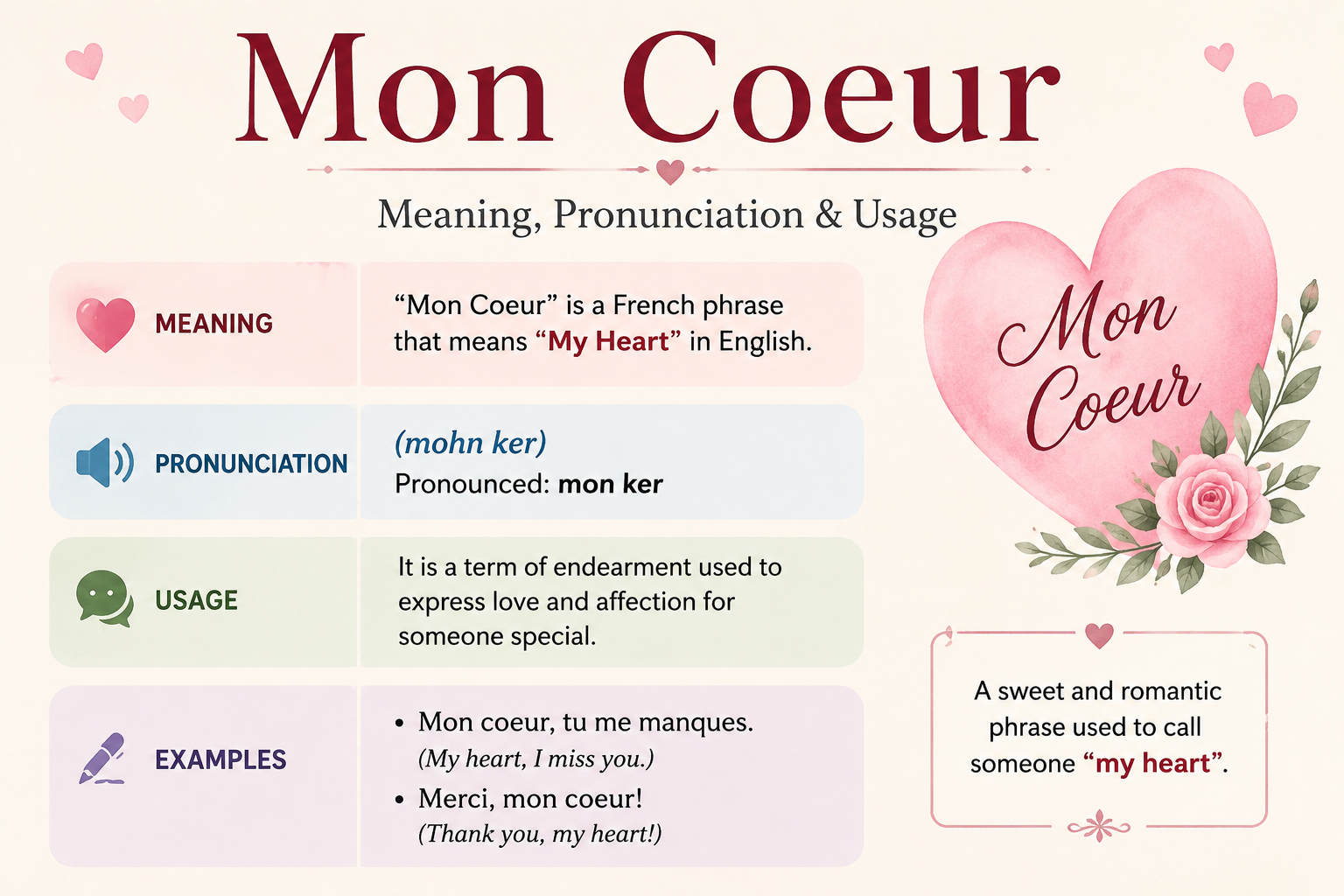
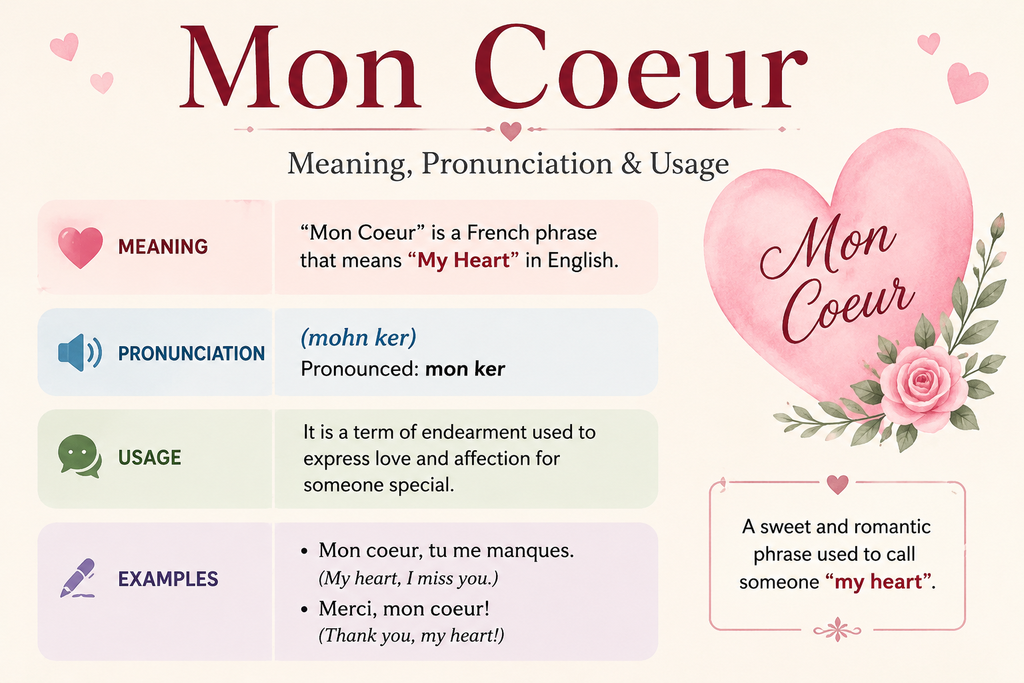
“Mon cœur” translates literally from French to “my heart,” but in real-world usage, it means “my sweetheart,” “my darling,” or “my love.” It is one of the most common terms of endearment in the French language, used between romantic partners as well as parents addressing their young children.
If you look up mon cœur in a basic translation tool, Mon cœur you get the anatomical definition. Straightforward. No confusion there.
That definition misses the entire point of how the phrase actually functions in French culture.
The Literal vs. Emotional Meaning of “Mon Cœur”
Understanding the gap between literal text and actual intent is what separates textbook French from natural conversation.
| Aspect | Literal Translation | Actual Emotional Meaning |
| Translation | “My heart” | “My darling” / “My love” / “Sweetheart” |
| Grammar | Masculine noun (le cœur) | Gender-neutral application |
| Usage Context | Anatomy, health, literal body parts | Deep affection, romance, parental love |
Because cœur is a masculine noun in French, you always use the masculine possessive pronoun mon, regardless of who you are talking to.
Whether a man says it to his girlfriend, a woman says it to her husband, or a parent says it to a young girl or boy, it remains strictly mon cœur. Writing or saying “ma cœur” is a classic beginner mistake that sounds jarring to a native speaker.
How “Mon Cœur” Is Used in Real Life
You won’t hear French speakers using this phrase in formal settings. It belongs strictly in intimate, daily human connection.
Here is how it plays out across different relationships:
1. Romantic Partners
Among lovers, mon cœur sits at the same emotional depth as “baby,” “sweetheart,” or “darling” in English. It carries warmth, tender affection, and emotional closeness.
- “Merci pour le café, mon cœur.” (Thanks for the coffee, sweetheart.)
- “Je t’aime, mon cœur.” (I love you, my darling.)
2. Parents to Children
Parents frequently use mon cœur to address young kids. It is gentle, protective, and non-romantic in this context.
- “Viens ici, mon cœur.” (Come here, my sweetie.)
- “Tu as bien dormi, mon cœur ?” (Did you sleep well, my darling?)
3. Everyday Slang and Variations
In fast-paced, casual conversations, you will often hear shortened or affectionate variations:
- Mon t’ti cœur: Short for mon petit cœur (“my little heart”), often used for toddlers or pets.
- Mon cœur d’amour: An exaggerated version meaning “my sweet love,” used when being extra affectionate.
How to Pronounce “Mon Cœur” Correctly
Mispronouncing French terms of endearment can instantly kill the tender vibe. Here is the exact phonetic breakdown:
- Mon: Pronounced like “mohn” with a nasal n. Do not hard-pronounce the N at the end.
- Cœur: Pronounced roughly like “kur” or “ker”, similar to the vowel sound in the English word “her” or “blur,” but with rounded lips.
Put together: “Mohn-Ker”.
Common Misconceptions & Mistakes to Avoid
- Gender Confusion: Do not swap mon to ma when speaking to a woman. The possessive adjective aligns with the gender of the noun (cœur = masculine), not the gender of the person you are addressing.
- Platonic Friends: Avoid using mon cœur with casual acquaintances or platonic adult friends. Unlike “mate” or “pal,” mon cœur implies emotional intimacy. Using it with a co-worker will create an uncomfortable situation.
- Capitalization: Unless it begins a sentence, keep it lowercase in written texts or messages (“Bonne nuit, mon cœur”).
Quick Reference: “Mon Cœur” vs. Other French Terms of Endearment
To give you the complete picture, here is how mon cœur compares to other popular French pet names:
| French Term | Literal Translation | English Equivalent | Best Used For |
| Mon cœur | My heart | Sweetheart / Darling | Romantic partners, young children |
| Mon chéri / Ma chérie | My cherished one | My darling / Honey | Romantic partners, close family |
| Mon amour | My love | My love | Deep romantic relationships |
| Mon chou | My cabbage | Sweetie / Cutie | Kids, close partners (casual) |
| Doudou | Comfort blanket | Boo / Sweetie | Intimate partners (slang) |
Frequently Asked Questions
Can a woman say “mon cœur” to a man?
Yes. Because cœur is a masculine noun, both men and women say mon cœur regardless of who they are addressing.
Is “mon cœur” formal or informal?
It is strictly informal and deeply intimate. Never use it in professional or customer-facing environments.
What is the difference between “mon amour” and “mon cœur”?
While both express love, mon amour (“my love”) is more passionate and romantic, whereas mon cœur (“my heart”) feels slightly softer and is equally common between parents and children.
The One Rule That Unlocks “Mon Cœur”
Whenever you encounter or want to use mon cœur, remember this simple formula:
Grammar follows the noun (mon), but the meaning follows the feeling (intimacy).
It is never just an anatomical term—it is a warm, everyday anchor of French intimacy.
Multi-Channel Content Distribution & Amplification Pack
Publishing high-ranking content is only half the battle. Use these copy-paste templates to distribute key insights across social media platforms and email newsletters, creating immediate user engagement and traffic signals.
📧 Email Newsletter (Kitchen-Table Casual Style)
Subject: The French word everyone gets wrong 💔
Preview Text: It doesn’t mean what the dictionary claims it does…
Hey [First Name],
If you ask Google Translate what “mon cœur” means, it’ll give you a straight-laced, textbook answer: “My heart.”
Technically true. But in actual French daily life? Nobody says it to refer to the organ pumping blood through their chest.
If you hear someone say “Viens ici, mon cœur,” they aren’t talking anatomy. They’re saying “Come here, sweetheart.”
It’s one of the most intimate, warm expressions in the entire French language—used for partners, spouses, and even young children.
But there’s a catch that trips up almost every French learner:
Even if you’re a woman talking to a man, or a man talking to a woman, you NEVER say “ma cœur.”
Why? Because French grammar follows the noun, not the person.
We just put together the ultimate breakdown of how to pronounce it, when to use it, and the top 3 awkward mistakes to avoid in casual conversation.
1. X (Twitter) Thread Starter
Most people think “Mon cœur” just means “My heart” in French. 🇫🇷
But using it like a dictionary definition will lead to some super awkward conversations.
Here’s how real French speakers actually use it (and the #1 rule foreigners break) 🧵👇
2. Instagram Carousel Script / Caption
Visual Slide 1: What does “Mon Cœur” REALLY mean in French? (Hint: It’s not just anatomy).
Visual Slide 2: Dict Definition: “My Heart” ❌ Real Meaning: “Sweetheart / My Love” ✅
Visual Slide 3: The Golden Rule: ALWAYS use MON, never MA—regardless of who you are talking to!
Caption:
Ever wondered why French speakers call their partners and kids “mon cœur”? 🤍
It translates literally to “my heart,” but emotionally, it’s equivalent to “sweetheart” or “darling.” Save this post for your next trip to Paris or your daily French practice!
What’s your favorite French expression of affection? Tell us below! 👇
#LearnFrench #FrenchVocabulary #MonCoeur #FrenchLanguage #LanguageLearning
3. LinkedIn / Facebook Educational Post
Language Nuance of the Day: Literal Translation vs. Cultural Reality
In localization and content strategy, context is everything. Take the French phrase “Mon cœur.”
Direct translation: “My heart.”
Actual cultural function: “Sweetheart” / “Darling.”
In business and everyday communication, direct translation often strips away emotional resonance. Understanding regional nuances—like why mon cœur applies equally to romantic partners and children, or why its grammatical gender never changes—is what bridges the gap between basic fluency and true cultural connection.
What’s a phrase in your native language that completely loses its meaning when translated word-for-word?

1 Comment
Pingback: What Does "No Pasa Nada" Mean? The Real-World Meaning, Slang, & Cultural Nuances