


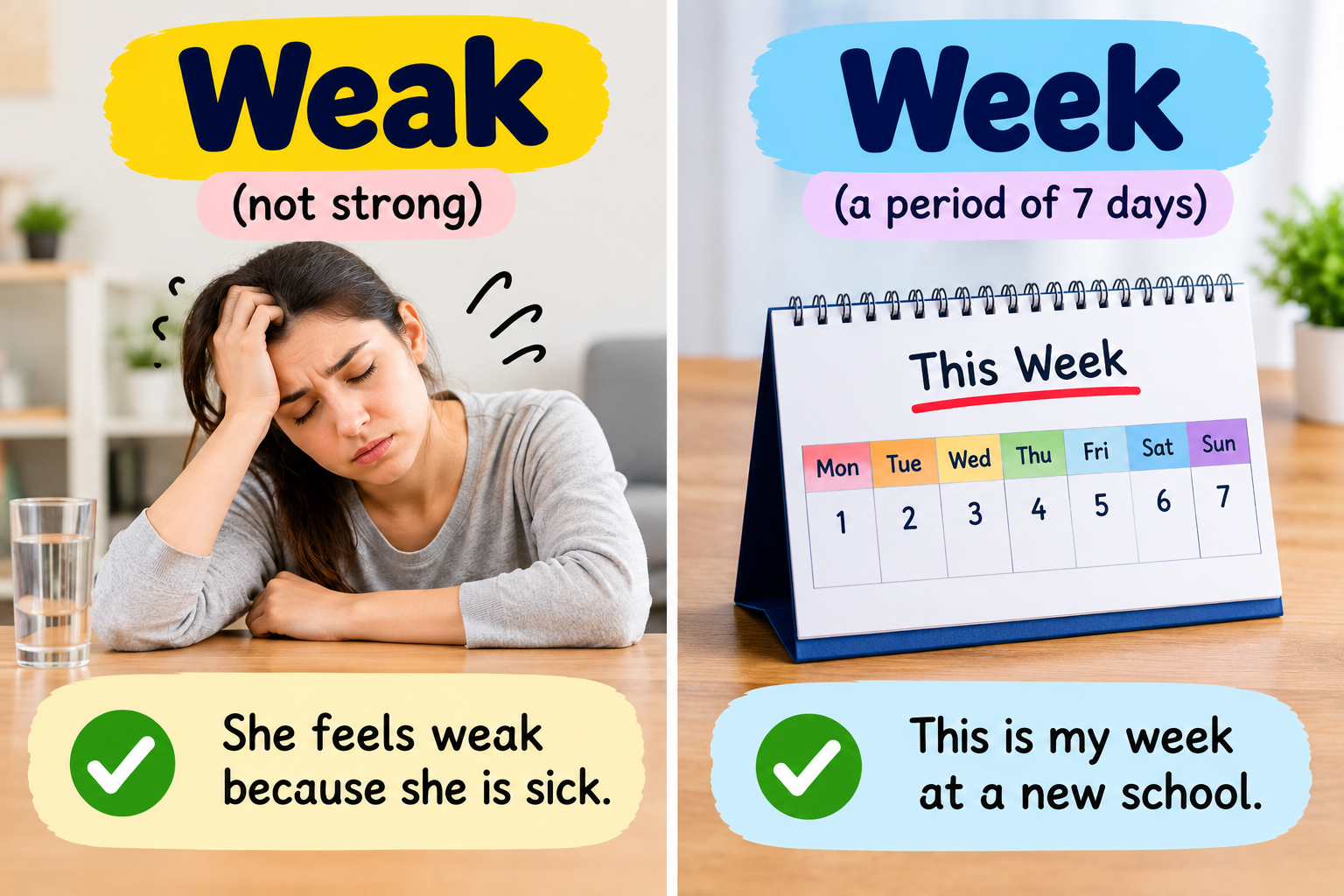
Weak means lacking physical strength, power, or effectiveness, whereas week refers to a seven-day calendar period. While these two homophones share the exact same pronunciation (/wiːk/), their origins, meanings, and grammatical functions are completely different.
Mixing up homophones in professional communications, branding, or editorial content undermines your clarity and visual presence. Here is how to master their differences, avoid embarrassing typos, and apply each word correctly.
Linguistic & Naming Psychology Breakdown
Homophones create cognitive friction when readers must rely on context to infer your intent. Both words stem from distinct Old English roots, giving them vastly different linguistic backgrounds:
- Weak originates from the Old Norse veikr (meaning soft or pliable) and Old English wāc. Phonetically, the short, subtle vowel sound visually mirrors softness or delicacy in copy.
- Week derives from the Proto-Germanic *wikōn- (meaning a turning or succession). The double “ee” visual pattern builds structural symmetry, signaling routine, sequence, and time-bound reliability.
Understanding this balance helps brand strategists, writers, and marketers select terms that trigger the exact emotional response they intend.
Weak vs Week: At a Glance
| Term | Part of Speech | Core Meaning | Primary Context | Example Sentence |
| Weak | Adjective | Lacking strength, power, or stability | Physical state, arguments, signals | “The tea tasted far too weak.” |
| Week | Noun | A period of seven consecutive days | Timeframes, scheduling, calendars | “We launch the new campaign next week.” |
Categorized Brand & Concept Styles
For founders using Lilikoi to build brand names, understanding the semantic vibes of these root concepts helps shape distinct brand identities.
1. Minimalist & Time-Focused
- Weekcraft | Structured, rhythmic, reliable | Best For: Project management apps, scheduling platforms.
- Sevenweek | Paced, intentional, cyclic | Best For: Habit trackers, sprint-focused agencies.
2. Bold & Contrast-Driven
- Unweak | Resilient, unyielding, fortified | Best For: Fitness apparel, cybersecurity tools.
- Antiweak | Defiant, powerful, authoritative | Best For: Performance supplements, consulting.
Common Pitfalls When Selecting Words
Here are where most writers and business leaders make unforced errors:
- Spelling visually under pressure: Typing “next weak” instead of “next week” in executive updates lowers perceived editorial quality.
- Idiomatic mistakes: Miswriting fixed phrases—such as writing “weak-kneed” as “week-kneed”—changes a physical descriptor into nonsense.
- Trademark and domain availability bottlenecks: Registering brand names with easily confused homophones introduces search discovery friction when voice assistants misinterpret the sound.
Strategic Selection Framework
Follow this simple 3-step filter to ensure complete accuracy every time:
- Test for Substitution: Replace the word with “seven days.” If the sentence still makes sense, use week.
- Test for Antonyms: Try replacing the word with “strong.” If the sentence holds its meaning in reverse, use weak.
- Audit Voice Search: Say your sentence out loud to ensure the surrounding context instantly clarifies which word you mean.
Frequently Asked Questions
Is it “weakness” or “weekness”?
The correct spelling for the state of lacking strength is weakness. The spelling “weekness” is incorrect and non-standard.
How can I easily remember the difference between weak and week?
A simple memory hook: A week has two e‘s, just like the ends of the eight days… or remember that each even evening fits in a week. Conversely, weak contains “ea,” just like “tea” when it is watered down.
Why do weak and week sound identical?
They are homophones result from historical vowel shifts in the English language, where distinct Middle English vowel sounds eventually merged into a single /wiːk/ sound.
The 1-Rule Golden Takeaway
If it involves time, count two e‘s for week; if it involves power, look for the a in weak.
Why Weak Hero Has Become a Popular Choice for Drama Fans
Weak Hero has attracted attention for its engaging storyline, memorable characters, and realistic portrayal of school life and personal struggles. Unlike typical action dramas, Weak Hero focuses on strategy, friendship, courage, and the challenges faced by students in difficult situations. Its strong character development and emotional storytelling make the series interesting for viewers who enjoy meaningful dramas with suspense and action. For fans looking for a story that combines intense moments with deeper themes, Weak Hero offers a distinctive viewing experience..
How Weak Legacy 2 Codes Can Enhance Your Gameplay
Weak Legacy 2 Codes can help players unlock useful in-game rewards and make their gameplay experience more enjoyable. These codes may provide items, spins, resets, or other bonuses that can support players as they progress through the game. Since codes can expire or change over time, players should check for the latest Weak Legacy 2 Codes and redeem active ones as soon as possible. Keeping track of new codes is a simple way to discover additional rewards while exploring everything the game has to offer.
