


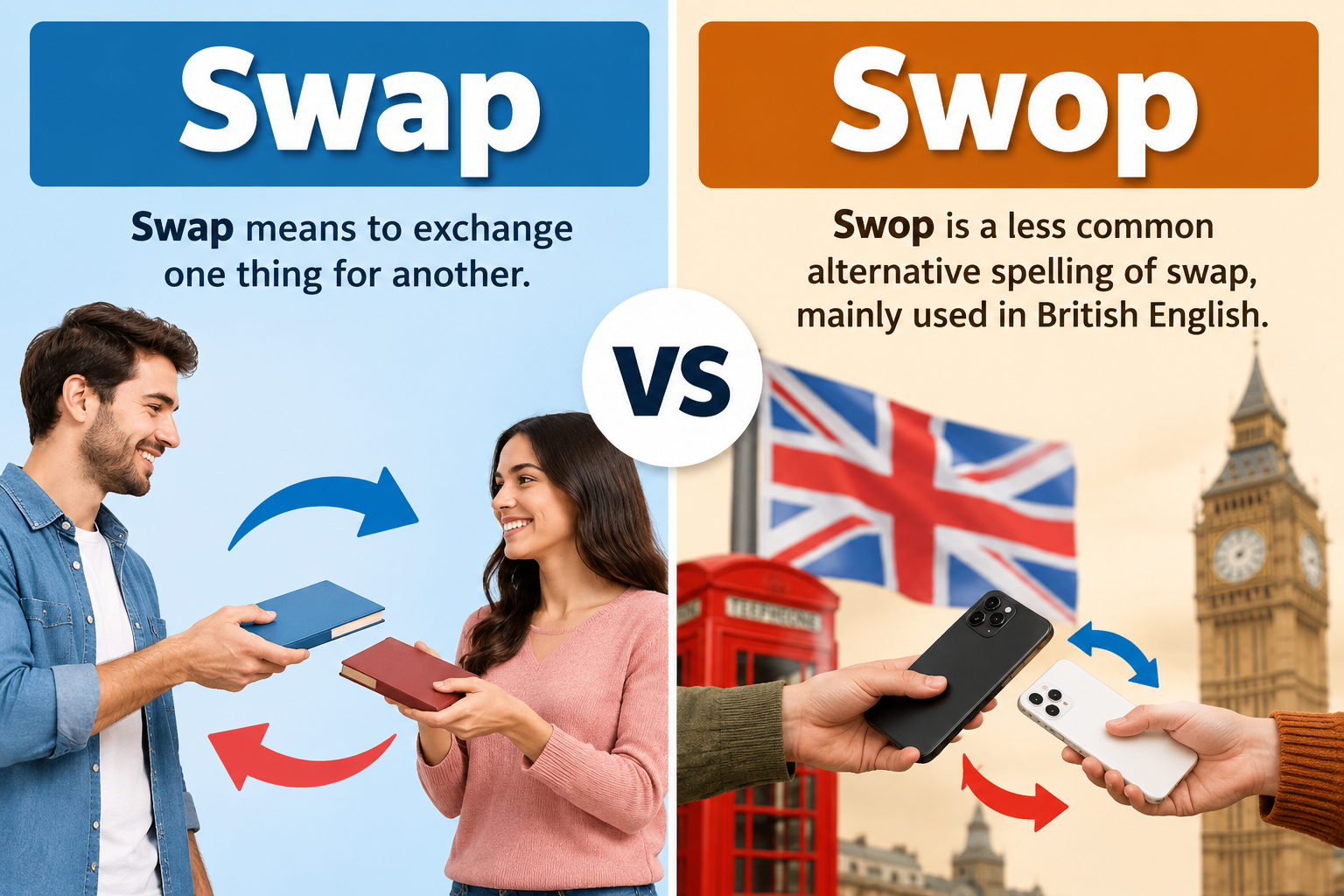
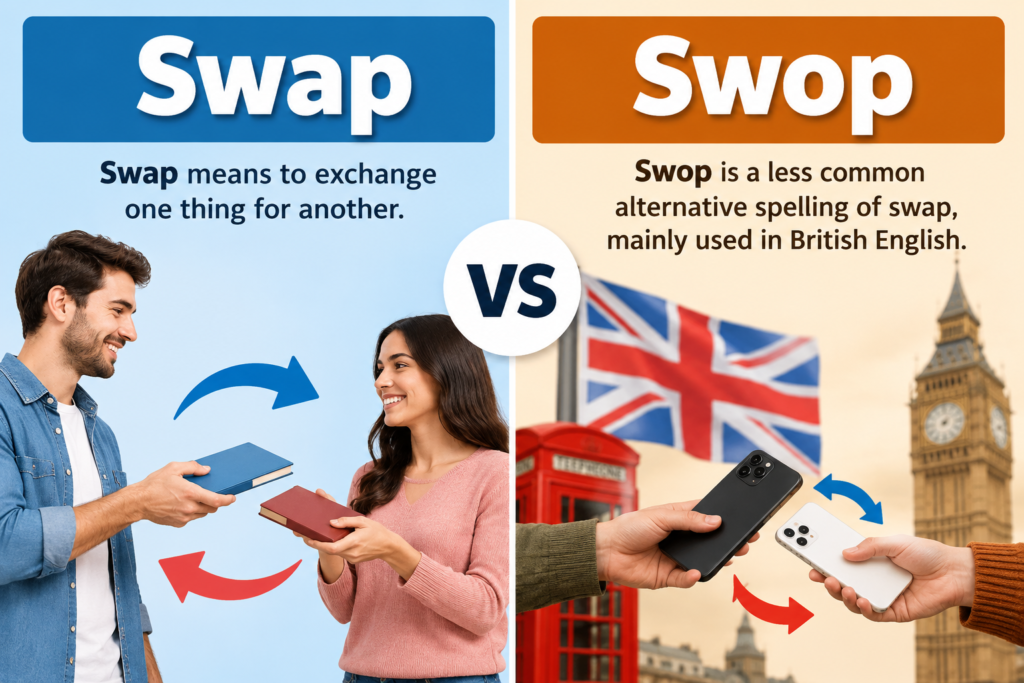
Swap and swop both mean to exchange one item for another, but swap is the standard global spelling, while swop is a British English variant that is rarely used in modern branding. Choosing between swap vs swop comes down to geographic target market, audience familiarity, and desired brand positioning.
Most founders pick a company name from generic word lists without evaluating linguistic weight, search behavior, or global reach. That mistake leads to confusion, weak SEO signals, and rebrand headaches down the road. Whether you are launching a fintech trading platform, a circular fashion hub, or an peer-to-peer exchange network, understanding the strategic nuances of swap vs swop ensures your brand name resonates clearly across target markets.
Swap vs Swop: Direct Linguistic Comparison
While both terms share the exact same root and definition, their global adoption and brand resonance differ sharply.
- Swap: The primary, universally recognized spelling in American, British, Canadian, and Australian English. It carries a clean, modern, and tech-forward impression suitable for international platforms.
- Swop: An alternative, predominantly British English spelling that gained casual traction in the mid-20th century. It feels informal, colloquial, and distinctly regional.
Modern Brand Names Inspired by Swap vs Swop
To see how these linguistic structures operate in the wild, here is a breakdown of name concepts categorized by brand vibe, utility, and market fit.
1. Tech & Fintech (Modern & High-Trust)
- SwapX | Seamless, instant exchange | Ideal for crypto protocols, automated liquidity platforms, or rapid currency trading tools.
- Swoplet | Compact, localized micro-exchanges | Works best for peer-to-peer neighborhood trade apps or local barter networks.
- NetSwap | Connected exchange ecosystem | Excellent for decentralized finance (DeFi) platforms and B2B asset trading networks.
- Swopify | Casual, friction-free swapping | Targeted at consumer-facing trade tools or subscription-swap plugins.
2. Sustainable Fashion & Circular Economy (Aesthetic & Minimalist)
- Swap Couture | High-end circular fashion | Designed for luxury garment rental, designer closet exchanges, and eco-conscious apparel brands.
- The Swop Shop | Playful, retro, community-focused | Ideal for vintage clothing pop-ups, physical resale boutiques, and thrift collectives.
- ReSwap | Renewable, repetitive trade loop | Fits zero-waste initiatives, refurbished tech platforms, and sustainable home goods hubs.
Linguistic & Naming Psychology Breakdown
Here’s where most founders get it wrong: they assume spelling variations are purely grammatical choices. In brand naming, phonetics and visual orthography trigger subtle psychological reactions before a customer ever reads your tagline.
Phonetic Structure & Vowel Dynamics
The letter “a” in Swap creates an open, sharp phonetic sound in standard American English, while delivering a rounder vowel in British Received Pronunciation. Visual orthography plays an even bigger role: “Swap” ends with a crisp downstroke that looks balanced in modern sans-serif typography.
Conversely, the letter “o” in Swop introduces a softer, more casual mouth shape. It signals playfulness and regional character, but it can introduce subtle visual friction for audiences accustomed to the standard “swap” spelling.
Emotional Triggers & Trust
- Global Recognition: Standard spellings eliminate cognitive load. When a user sees Swap, their brain processes the function instantly without second-guessing spelling accuracy.
- Search Engine Confidence: Search engines and generative AI platforms pair Swap with massive entity clusters around finance, trade, and technology. Using Swop requires extra contextual framing so algorithmic crawlers don’t auto-correct your brand name to “Swap.”
Swap vs Swop: Meaning & Strategy Matrix
| Dimension | Swap | Swop | Strategic Impact |
| Primary Region | Global (US, UK, CA, AU, INT) | United Kingdom / Commonwealth | Swap ensures frictionless international expansion. |
| Search Volume Ratio | ~95% of total search intent | ~5% of total search intent | Swap captures massive organic discovery demand. |
| Audience Perception | Professional, sleek, functional | Quirky, casual, localized | Match the spelling to your underlying brand persona. |
| Domain Friction | Higher competition for exact-match .com | Lower competition; high availability | Swop offers easier exact-match domain acquisition. |
| Typographical Vibe | Sharp, balanced, modern | Rounded, friendly, eccentric | Swap suits minimalist visual identities. |
Common Pitfalls When Selecting Brand Names
No jargon, just facts: choosing a name built around swap vs swop requires dodging a few critical structural traps.
- Ignoring Auto-Correct Behavior: Mobile keyboards and search engines aggressively default “swop” to “swap.” If your business relies on word-of-mouth discovery, customers typing your URL might get redirected to a competitor.
- Trademark Overlap in Class 36 & 42: Because “swap” is a standard industry term in financial trading and software protocols, generic names like “Global Swap” face severe trademark opposition. Creative compounding (e.g., Swaptide, Swopling) helps bypass registration bottlenecks.
- Regional Traps: Launching a US-focused platform using Swop often makes your brand look misspelled rather than intentionally stylized. If you use regional variants, turn the choice into a deliberate brand asset.
Strategic Selection Framework
Use this four-step strategy to filter, test, and validate your name before committing capital to branding and domain purchases.
Step 1: Geographic Mapping ---> Step 2: SEO & GEO Audit ---> Step 3: Linguistic Stress Test ---> Step 4: IP & Domain Check
- Define Your Geographic Footprint: If over 30% of your initial customer base resides outside the UK, choose Swap to avoid spelling ambiguity.
- Perform an AI & GEO Search Audit: Input your prospective name into generative search engines like Perplexity and ChatGPT. Verify that the AI categorizes your name within your target industry rather than confusing it with unrelated terms.
- Run a Verbal Friction Test: Say the name out loud in a sentence three times: “Download the [Name] app today.” If listeners ask “Is that with an O or an A?”, you have identified a voice-search friction point.
- Secure Defensive Domains: If you brand around Swop, secure the matching Swap domain variant (and vice versa) to catch misdirected traffic.
Frequently Asked Questions
Is “swop” a real word or a misspelling of “swap”?
“Swop” is a legitimate, dictionary-recognized British English variant of “swap.” Both words mean to exchange or trade items, though “swap” is the preferred spelling across all major English dialects.
Which spelling is better for SEO and digital marketing?
“Swap” is significantly better for SEO because it carries vastly higher search volume and matches user search intent globally. Choosing “swop” may lead search engines to display “Did you mean swap?” prompts to users.
Can I trademark a company name that contains the word “swap”?
Yes, provided the overall brand name is distinctive within your industry classification. Combining “swap” with a unique prefix, suffix, or secondary word creates a protectable mark.
The Golden Rule of Brand Naming
Prioritize clarity over cleverness: if a spelling variation forces your audience to pause, re-read, or correct their search query, it builds friction right at your digital front door. Pick the structure that serves your audience first, and let your brand value drive the rest.
