


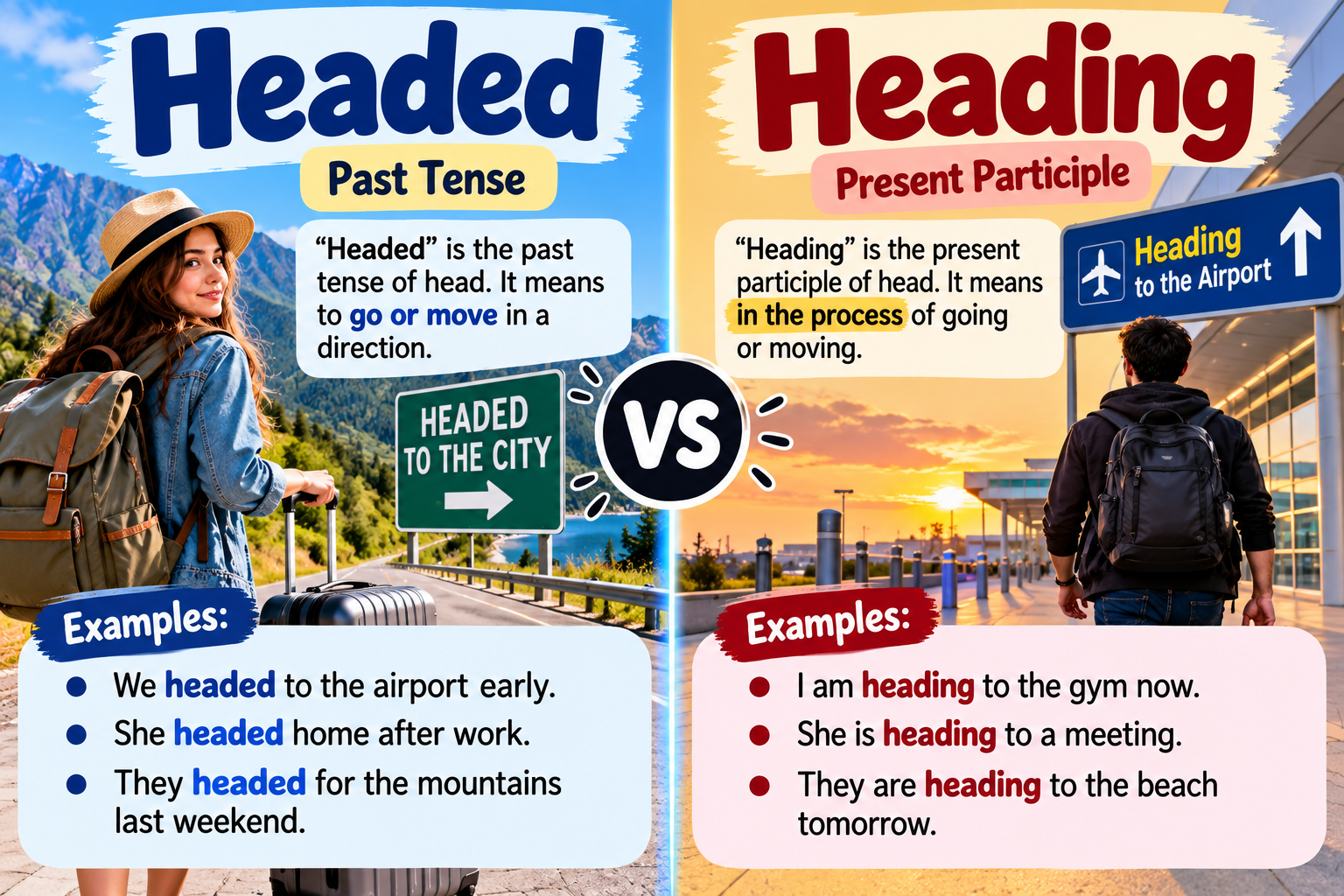
The fundamental difference between headed vs heading lies in their grammatical tense and direction: “headed” functions as the past tense or past participle indicating movement completed or established toward a destination (e.g., “She headed home”), while “heading” is the present participle or gerund describing an ongoing movement or direction in real time (e.g., “I am heading out”).
Knowing when to use headed vs heading comes down to timing: use “headed” for past actions or completed travel plans, and “heading” for immediate, current, or future actions. Straightforward, no confusion there. Mastering this distinction helps keep your text messages, status updates, and professional emails clear and natural.
Here is your comprehensive guide on how headed vs heading works across modern texting, social media, and formal writing.
What Does Headed vs Heading Mean in Text & Chat?
In modern chat, messaging apps, and status posts, headed vs heading indicates whether a personal location update is currently happening or already decided.
- Heading: Describes live movement or an imminent departure. Phrases like “Heading to the gym” or “Where are you heading?” signal present-time action or upcoming immediate plans.
- Headed: Describes completed movement, predetermined trajectories, or figurative directions. Phrases like “He headed home early” or “We are headed for trouble” signal established past or passive direction.
That’s not a glitch—English frequently uses the verb head in place of go or travel to sound more direct and conversational in casual messaging.
What Does Headed vs Heading Mean From a Guy vs. a Girl?
While the grammatical mechanics of headed vs heading do not change based on who texts, the intent behind sending a quick movement update can carry subtle social nuances:
When Used in Casual Texting & Dating Contexts
- “Where are you heading?” (From a Guy): Often serves as a low-pressure way to gauge your availability, see if you are nearby, or invite himself along without sounding demanding.
- “I’m heading out now” (From a Girl): Signals precise timing and coordination, letting you know she is actively in transit and expects you to be ready upon arrival.
In Work & Group Chat Communication
- “Headed to the office”: Sets a clear status update for coworkers, letting them know a destination has been locked in.
- “Heading to the meeting room now”: Prompts immediate real-time synchronization, telling others to wrap up what they are doing and join.
Quick Reference Table
| Term | Full Form / Primary Meaning | Short Meaning | Common Tone | Suitable For | Not Suitable For |
| Heading | Present Participle of Head | Moving toward right now | Casual, Active | Real-time texts, live status updates | Completed past actions |
| Headed | Past Tense / Participle of Head | Directed or moved in past | Informative, Settled | Past narratives, set states (“headed home”) | Actions happening at this exact second |
Origin, History & Evolution of Headed vs Heading
The spatial use of head comes from the Old English word heafod, originally referring to the physical head of a person or animal. By the 1600s, sailors adapted the word into a nautical term—pointing the “head” or bow of a ship in a specific direction (“heading toward port”).
Over the centuries, this maritime navigation term migrated into general speech. By the late 20th and early 21st centuries, digital chat culture adopted heading and headed as quick shorthand for personal travel updates, replacing stiffer verbs like navigating or proceeding.
Usage Across Social Media Platforms
Here is how headed vs heading appears across various apps and channels:
1. WhatsApp & iMessage
- “Hey, heading your way now! ETA 10 mins.”
- “We headed back home because the line was too long.”
2. Instagram & TikTok
- “Heading into the weekend like…” (Popular video/photo caption style)
- “We headed down to the coast for a quick getaway.”
3. Slack & Business Chat
- “Heading into a client meeting, back online at 3 PM.”
- “Our team is headed in a great direction this quarter.”
Real Chat Examples & Real-World Scenarios
Here is how these two terms sound in natural, everyday conversations:
Scenario 1: Real-Time Coordination
Friend A: Are you still at home?
Friend B: Nope, heading to the coffee shop now. Want me to grab you a latte?
Scenario 2: Explaining a Past Decision
Colleague A: Where did Mark go after lunch?
Colleague B: He headed over to the main office to meet the audit team.
Common Confusions, Mistakes & Wrong Interpretations
Here’s what most people miss: both “we are heading home” and “we are headed home” are acceptable in modern English, but they convey slightly different nuances.
1. “Are Headed” vs “Are Heading”
- “We are heading home”: Focuses on the physical movement in progress.
- “We are headed home”: Focuses on the state of destination or orientation (i.e., our target destination is home).
2. Confusion with Document Headings
In publishing, typography, and web formatting (HTML), a heading refers to a section title (like an H1 or H2 header), while headed refers to paper containing a printed header (e.g., “letterheaded paper”).
Similar Terms, Alternatives & Cleaner Substitutes
If you want to vary your phrasing, here are common synonyms:
- En route: “En route to the venue now.”
- On my way (OMW): “OMW to the restaurant!”
- Bound for: “The train is bound for Chicago.”
- Making my way: “Making my way over to your desk.”
How to Reply When Someone Uses These Terms
Match your response to the timing of their message:
- If they text:“Heading your way now!”
- Reply: “Awesome, see you in a bit!” or “Sounds good, front door is unlocked.”
- If they text:“Where are you headed tonight?”
- Reply: “Just heading to dinner downtown, what about you?”
Is Headed vs Heading Still Popular? (Current Trends & Longevity)
Yes. Both terms are permanent fixtures in English grammar and everyday informal texting. The phrase “heading out” remains one of the most widely used messaging updates on mobile devices worldwide.
The 1-Rule Golden Takeaway
Use HEADING for movement happening right now; use HEADED for past movement or an established state of direction.
