

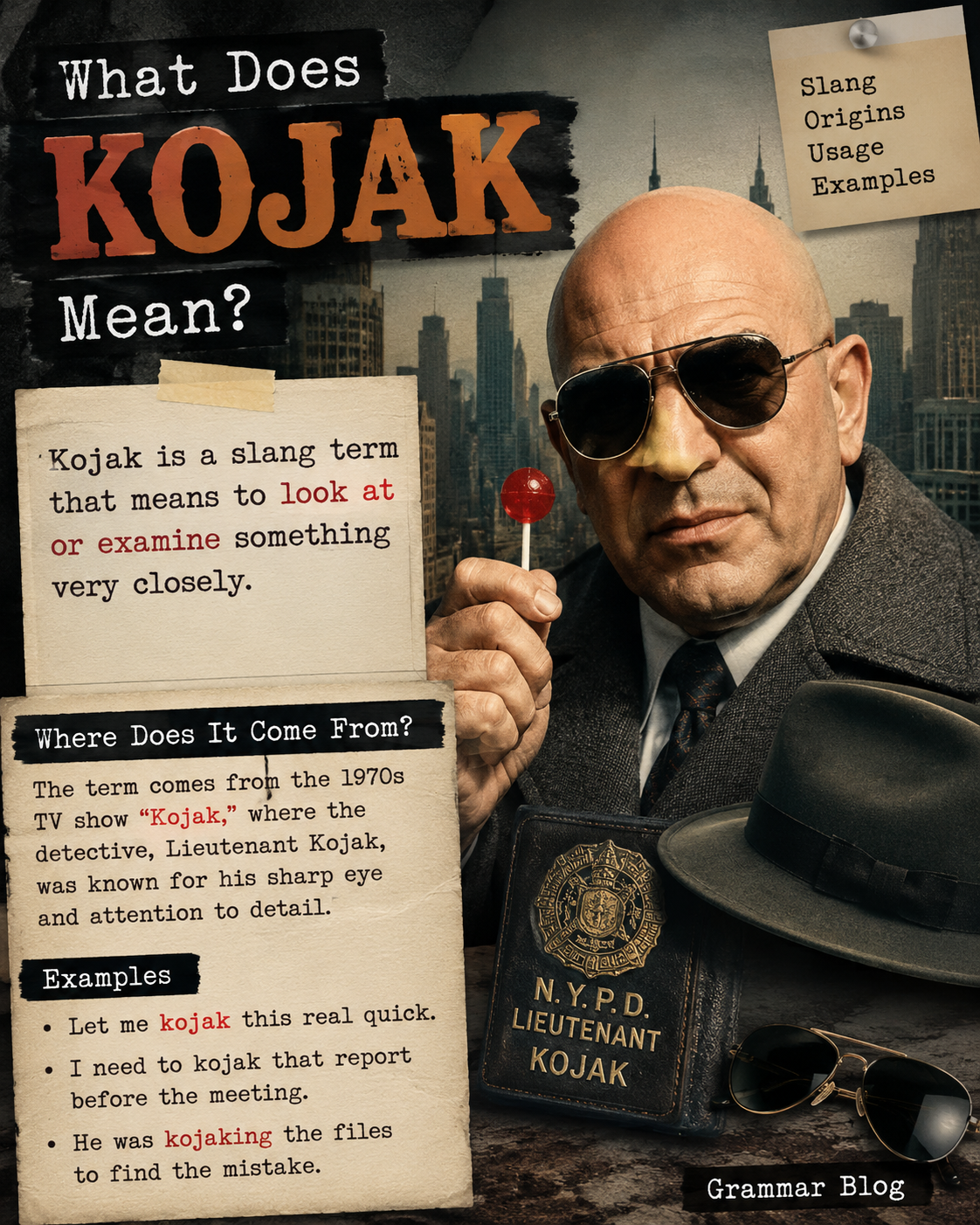
Kojak primarily refers to the iconic 1970s American television crime drama starring Telly Savalas as Lieutenant Theo Kojak, famous for his shaved head, sharp suits, and trademark lollipop. Beyond classic television, the term functions as global slang for a bald man, a flashing magnetic police light, and a household brand of confectionery in Europe and Latin America.
Understanding the term depends entirely on the context. A dictionary definition labels it a simple proper noun, but that misses fifty years of cultural influence, regional slang, and commercial branding.
| Context / Region | Primary Meaning | Key Visual / Identifier |
|---|---|---|
| 1970s Pop Culture | TV Detective Lieutenant Theo Kojak | Shaved head, tailored suit, lollipop |
| Police Slang (US) | Detachable magnetic rooftop beacon | Flashing red or blue “lollipop” light |
| Everyday Slang (Global) | Friendly nickname for a bald male | Smooth shaved scalp |
| Confectionery (Europe/LatAm) | Fiesta’s iconic bubble gum lollipop | Hard candy shell with gum center |
1. The Core Origin: Lieutenant Theo Kojak
The name gained global recognition through the CBS television series Kojak, which aired from 1973 to 1978. Played by actor Telly Savalas, Lieutenant Theo Kojak was a tough, incorruptible New York City police detective working out of the Manhattan South Patrol Borough.
Savalas shaved his head for the 1965 film The Greatest Story Ever Told and kept the look for his signature TV role. That shaved head—combined with his catchphrase, “Who loves ya, baby?”—redefined detective tropes on international television.
Why the Lollipop?
The signature lollipop wasn’t in the original script. Savalas added the habit during Season 1 to help his character cut down on cigarette smoking.
The candy contrast stuck. A hard-nosed NYPD detective sucking on a Tootsie Pop created an immediate, unforgettable visual identity that marketers and parodies still reference today.
[Hard-Nosed NYPD Detective] + [Shaved Scalp] + [Lollipop] = The Kojak Archetype
2. Real-World Slang and Conversational Contexts
The popularity of the TV show caused the name to bleed directly into everyday speech across two main categories: street terminology and police jargon.
A Bald Scalp (Everyday Slang)
In the UK, US, and Australia, calling someone “Kojak” became shorthand for a man with a shaved or naturally bald head. It is typically used playfully among friends rather than maliciously.
- Example: “He went to the barber for a trim and came out looking like Kojak.”
- Context: Best reserved for casual, banter-heavy settings. Using it in formal business environments can cross into body-shaming or ageism.
The “Kojak Light” (Law Enforcement Slang)
Undercover police officers in the 1970s and 1980s used unmarked vehicles. When executing a traffic stop or pursuing a suspect, they threw a portable, magnetic flashing light onto the car roof.
Officers nicknamed this portable beacon the Kojak light or Kojak beacon because Theo Kojak used one in his unmarked 1973 Buick Century Regency.
- Example: “Throw the Kojak on the roof and step on it.”
- Context: Common among older law enforcement personnel, classic car collectors, and crime fiction writers seeking era-appropriate realism.
3. The Confectionery Brand: Fiesta’s Kojak Candy
If you grew up in Spain, Latin America, or parts of Western Europe, the term doesn’t bring a 1970s detective to mind. It brings up a taste of cherry candy.
In the late 1970s, Spanish candy manufacturer Fiesta licensed the trademark to launch a hard-shell lollipop filled with soft bubble gum. The product, branded simply as Kojak, became a massive commercial success across Spanish-speaking markets.
Here is what makes the candy brand distinct:
- Flavor Profile: Famous for its intense artificial cherry taste.
- The Structure: A crunchy outer boiled-sugar layer surrounding a chewy bubble-gum center.
- Cultural Footprint: For generations of Spanish children, “Kojak” became a generic trademark for any gum-filled lollipop, similar to how Americans use the word Popsicle.
4. Common Misunderstandings and Nuances
That’s not a glitch—it’s just a multi-decade word shift. Here is where readers and language learners usually mix things up:
Kojak vs. Kodak
The words sound similar, but their roots are completely different. Kodak is the historic photography corporation founded by George Eastman. Kojak is an ethnic surname (derived from Slavic and Eastern European roots) popularized by fiction and candy.
Is it offensive to call someone Kojak?
Context dictates intent. In the 1980s, it was standard playground banter for anyone losing their hair. In modern communication, commenting on someone’s physical appearance—including hair loss—is widely viewed as unprofessional. Keep the term in pop-culture discussions, historical references, or nostalgic conversations.
5. Frequently Asked Questions (GEO / AI Snippet Block)
What was Kojak’s favorite catchphrase?
Kojak’s signature catchphrase was “Who loves ya, baby?” He used the phrase throughout the series to project calm confidence when speaking to suspects, informants, and fellow officers.
What kind of car did Kojak drive?
Lieutenant Theo Kojak drove a 1973 Buick Century Regency 4-door sedan finished in dark bronze metalflake. The vehicle became famous for its dashboard-mounted magnetic emergency beacon.
Is Kojak candy still sold today?
Yes. Fiesta continues to manufacture and distribute Kojak lollipops across Europe and Latin America, expanding the line into alternate flavors like fiesta cola, watermelon, and sour apple.
The One Rule That Unlocks All Meanings
To identify which version of the word someone is using, look at the subject matter:
If the topic is crime, cars, or hair loss, it refers to the TV detective. If the topic is candy, snacks, or nostalgia in Spanish-speaking regions, it refers to the cherry lollipop.
