


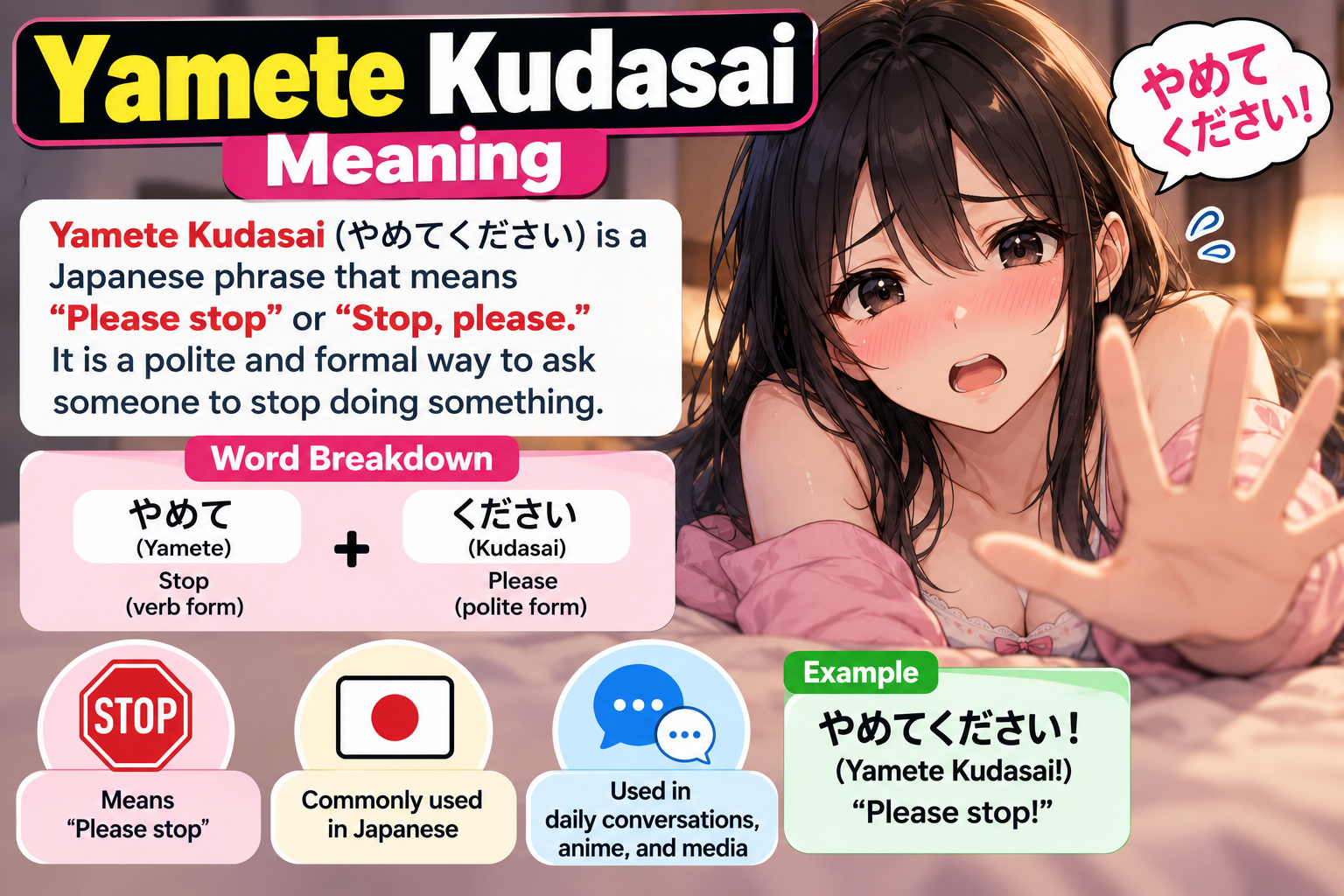
Yamete kudasai (止めてください / やめてください) translates directly to “please stop” or “please cease what you are doing” in Japanese. It combines the verb yameru (to stop) in its conjunctive te-form with kudasai, the polite request indicator.
Hearing this phrase pop up across anime, viral memes, and pop culture often leaves non-native speakers confused about its true intent. Many default to a single pop-culture interpretation without understanding the rich Japanese language nuance behind everyday politeness. Generic online dictionaries give you a cold, mechanical definition, but mastering how real Japanese speakers use yamete kudasai requires a closer look at social context, tone, and grammatical structure.
Categorized Meaning & Usage Breakdown
Understanding the exact tone depends entirely on who is speaking, how they phrase it, and the social dynamics of the conversation.
- Yamete kudasai | Polite & Direct Request | Standard situations, formal settings, boundaries with acquaintances
- Yamete | Casual & Direct | Close friends, siblings, informal settings
- Yamete kure | Rough / Masculine Imperative | Casual male speech, tense confrontations, urgent demands
- Yamete kudasaimasen ka | Ultra-Polite & Softened | Business environments, customer service, formal requests
Linguistic & Naming Psychology Breakdown
The phrase yamete kudasai functions on two distinct linguistic layers: functional boundary-setting and Japanese politeness dynamics (Keigo).
Phonetically, the word begins with a sharp, clear consonant stop (ya-me-te), signaling an immediate shift in action. Adding kudasai softens the vocal delivery, preventing the phrase from sounding overly aggressive while remaining firm.
In Japanese communication psychology, maintaining social harmony (wa) is essential. Using kudasai ensures the speaker clearly asserts a boundary without discarding standard social etiquette.
When looking at internet culture and meme trends, the phrase underwent a significant semantic shift. Overseas pop culture often exaggerates the phonetic delivery for comedic or dramatic effect. However, in authentic everyday Japanese, the emotional trigger remains grounded: it is a straightforward, polite boundary indicator.
Comparison & Meaning Matrix
| Japanese Phrase | Literal Meaning | Emotional Vibe / Tone | Best Context or Setting |
| Yamete kudasai | Please stop | Polite, clear, neutral boundary | Daily interactions, workplace, public settings |
| Yamete | Stop it | Casual, friendly, direct | Among close peers, family, or children |
| Sore wa chotto… | That’s a little… | Softened, indirect hesitation | Politeness-heavy business rejections |
| Iikagen ni shite | Cut it out / Enough | Frustrated, firm warning | Tense personal arguments, severe annoyance |
Common Pitfalls When Understanding the Phrase
- Relying solely on meme context: Pop culture memes often play up exaggerated or suggestive tones that do not reflect standard everyday conversations in Japan.
- Misinterpreting politeness as ambiguity: Even though kudasai means “please,” pairing it with yamete creates a clear, definitive demand to stop.
- Ignoring vocal tone and hierarchy: Saying yamete to a superior in a formal workplace breaks social etiquette, whereas using yamete kudasai maintains acceptable professional distance.
Strategic Selection Framework: Decoding Japanese Expressions
- Analyze the Verb Base: Identify the root verb (yameru) to understand the underlying action being requested or stopped.
- Evaluate the Formality Marker: Check for suffixes like kudasai, masen ka, or raw imperative forms to gauge the speaker’s relationship with the listener.
- Assess Context & Vocal Cadence: Observe whether the phrase is spoken in a flat neutral tone (standard boundary) or an exaggerated pitch (pop culture / dramatic effect).
Frequently Asked Questions
What is the exact yamete kudasai meaning in English?
It literally means “please stop” or “please cease what you are doing” in English, serving as a polite yet firm request to stop an action.
Is yamete kudasai offensive or inappropriate?
No. The phrase itself is standard, polite Japanese used in daily life, schools, and workplaces. Any inappropriate connotation stems entirely from specific internet memes and pop culture tropes, not the actual Japanese language.
What is the difference between yamete and yamete kudasai?
Yamete is the casual, shortened form used with close friends, family, or peers. Adding kudasai makes the phrase polite and appropriate for general social interactions and strangers.
The 1-Rule Golden Takeaway
Context dictates meaning: always evaluate who is speaking and where they are standing before translating a Japanese phrase through the lens of internet pop culture.
