


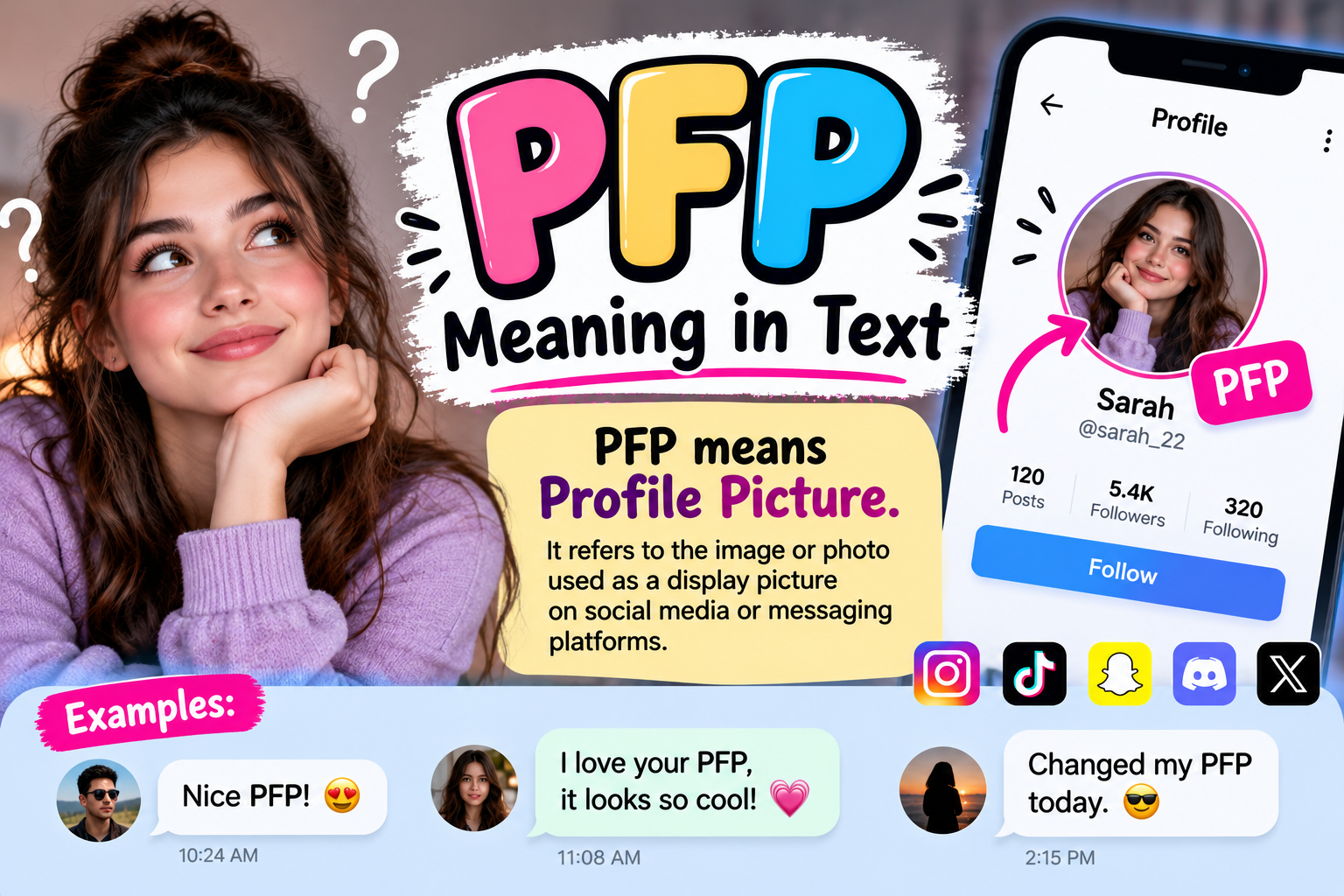
In text messaging and on social media, PFP stands for Profile Picture. It refers to the main avatar, image, or photo representing a user’s account across platforms like Instagram, TikTok, WhatsApp, Discord, X (Twitter), and Snapchat.
While PFP universally translates to Profile Picture in modern chat culture, it can occasionally mean Picture for Proof in online trading communities or Pic for Pic in casual texting exchanges. Knowing which meaning applies depends entirely on who is texting you and the platform you are on.
Here is everything you need to know about what PFP means, how it is used across apps, subtle contextual nuances, and how to respond without making it awkward.
What Does PFP Mean in Texting & Chat?
At its core, PFP is shorthand for Profile Picture. It is the visual identity you select to represent yourself in digital spaces.
Whether it is a high-resolution selfie on Instagram, an anime avatar on Discord, or a stylized bitmoji on Snapchat, your PFP is the first thing people see before they even open a direct message.
Beyond its primary acronym, PFP carries a few secondary meanings in niche internet communities:
- Profile Picture (95% of all usages): The standard image attached to a user account.
- Picture for Proof (5–10% of usages): Used in peer-to-peer marketplaces, gaming trades, or buying/selling groups on Discord and Reddit to verify that a seller actually owns an item.
- Pic for Pic (Rare): An older texting exchange request where two people agree to swap photos simultaneously.
That’s not a glitch—slang evolves rapidly, but if someone asks about your “new PFP,” they are almost certainly talking about your avatar image.
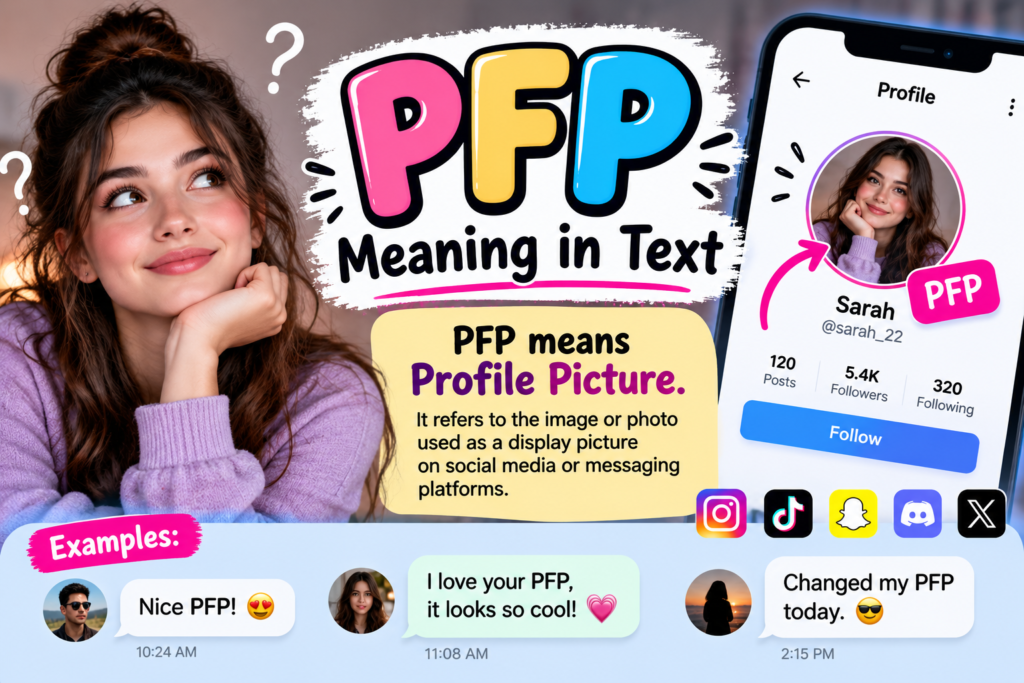
What Does PFP Mean From a Guy vs. a Girl?
The baseline meaning of PFP does not change based on gender, but the subtext behind why someone mentions your PFP often does.
When a Guy Mentions Your PFP
- He is dropping a subtle compliment: If a guy texts, “Hey, love the new PFP,” it is rarely just an observation. It is often a low-pressure conversation starter or a smooth way to flirt without being overly forward.
- He wants to talk about shared interests: On platforms like Discord or X, guys frequently point out PFPs featuring band logos, game characters, or sports teams to find common ground.
- He is asking for proof in a deal: In gaming or trading contexts, if a guy asks for “PFP,” he might be using it in the secondary sense—asking for a Picture for Proof before making a trade.
When a Girl Mentions Your PFP
- She noticed a visual change immediately: Girls often pay close attention to aesthetic updates. A text like “Your PFP is so cute!” is usually a warm, friendly compliment aimed at hyping you up.
- She is teasing or analyzing your vibe: A girl might bring up your PFP to poke fun at an old photo, comment on your choice of aesthetics, or point out an intriguing detail in the background.
- She is checking your authenticity: If you match on a dating app or start texting on Instagram, she might mention your PFP to confirm you look like your photos or to comment on your real-life style.
PFP Quick Reference Table
| Term | Full Form / Primary Meaning | Short Meaning | Common Tone | Suitable For | Not Suitable For |
| PFP | Profile Picture | Display photo / Avatar | Casual, Neutral | Social media, DMs, group chats | Formal emails, professional reports |
| PFP | Picture for Proof | Photo evidence of an item | Direct, Transactional | Peer-to-peer trades, online sales | Casual flirting, general social chat |
| PFP | Pic for Pic | Photo swap request | Casual, Private | Direct messaging with trusted contacts | Group chats, professional networking |
PFP Quick Reference Table
| Term | Full Form / Primary Meaning | Short Meaning | Common Tone | Suitable For | Not Suitable For |
| PFP | Profile Picture | Display photo / Avatar | Casual, Neutral | Social media, DMs, group chats | Formal emails, professional reports |
| PFP | Picture for Proof | Photo evidence of an item | Direct, Transactional | Peer-to-peer trades, online sales | Casual flirting, general social chat |
| PFP | Pic for Pic | Photo swap request | Casual, Private | Direct messaging with trusted contacts | Group chats, professional networking |
PFP Quick Reference Table
| Term | Full Form / Primary Meaning | Short Meaning | Common Tone | Suitable For | Not Suitable For |
| PFP | Profile Picture | Display photo / Avatar | Casual, Neutral | Social media, DMs, group chats | Formal emails, professional reports |
| PFP | Picture for Proof | Photo evidence of an item | Direct, Transactional | Peer-to-peer trades, online sales | Casual flirting, general social chat |
| PFP | Pic for Pic | Photo swap request | Casual, Private | Direct messaging with trusted contacts | Group chats, professional networking |
PFP Quick Reference Table
| Term | Full Form / Primary Meaning | Short Meaning | Common Tone | Suitable For | Not Suitable For |
| PFP | Profile Picture | Display photo / Avatar | Casual, Neutral | Social media, DMs, group chats | Formal emails, professional reports |
| PFP | Picture for Proof | Photo evidence of an item | Direct, Transactional | Peer-to-peer trades, online sales | Casual flirting, general social chat |
| PFP | Pic for Pic | Photo swap request | Casual, Private | Direct messaging with trusted contacts | Group chats, professional networking |
Origin, History & Evolution of PFP
Before “PFP” became standard slang, internet users relied on terms like avatar (popularized by 1990s forums and AIM) or simply display picture (DP).
The shift toward PFP started in the early 2010s as mobile-first platforms like Instagram and Twitter blew up globally. Users needed a quick, three-letter acronym to ask friends about their account photos without typing out full words on mobile keyboards.
By the time Discord and TikTok gained mass adoption in the late 2010s and early 2020s, PFP fully dethroned older terms like “DP” across North America and Europe. Today, “matching PFPs” (where two friends or couples set complementary images as their avatars) is a core trend in internet culture.
Usage Across Social Media Platforms
How PFP gets brought up varies depending on the app’s features and community culture.
1. Instagram
On Instagram, PFP usually comes up in Direct Messages (DMs) or story replies.
- “Your new PFP goes so hard!”
- “Who took your PFP? The lighting is amazing.”
2. TikTok
TikTok culture leans heavily into trends involving matching PFPs or cult-like meme PFPs.
- “Everyone change your PFP to the hamster meme for the stream tonight.”
- “Drop a comment if you want to do matching PFPs!”
3. Discord
Because Discord is heavily text-based and community-focused, PFPs are central to user identity.
- “Nice PFP, is that from Season 2?”
- “Can you send me a link to your PFP? I need a new wallpaper.”
4. Snapchat
Snapchat relies heavily on Bitmojis, but when users mention PFPs, they are usually talking about your public profile photo or custom Bitmoji outfit.
- “Your Bitmoji PFP matches your actual outfit today lol.”
Origin, History & Evolution of PFP
Before “PFP” became standard slang, internet users relied on terms like avatar (popularized by 1990s forums and AIM) or simply display picture (DP).
The shift toward PFP started in the early 2010s as mobile-first platforms like Instagram and Twitter blew up globally. Users needed a quick, three-letter acronym to ask friends about their account photos without typing out full words on mobile keyboards.
By the time Discord and TikTok gained mass adoption in the late 2010s and early 2020s, PFP fully dethroned older terms like “DP” across North America and Europe. Today, “matching PFPs” (where two friends or couples set complementary images as their avatars) is a core trend in internet culture.
Usage Across Social Media Platforms
How PFP gets brought up varies depending on the app’s features and community culture.
1. Instagram
On Instagram, PFP usually comes up in Direct Messages (DMs) or story replies.
- “Your new PFP goes so hard!”
- “Who took your PFP? The lighting is amazing.”
2. TikTok
TikTok culture leans heavily into trends involving matching PFPs or cult-like meme PFPs.
- “Everyone change your PFP to the hamster meme for the stream tonight.”
- “Drop a comment if you want to do matching PFPs!”
3. Discord
Because Discord is heavily text-based and community-focused, PFPs are central to user identity.
- “Nice PFP, is that from Season 2?”
- “Can you send me a link to your PFP? I need a new wallpaper.”
4. Snapchat
Snapchat relies heavily on Bitmojis, but when users mention PFPs, they are usually talking about your public profile photo or custom Bitmoji outfit.
- “Your Bitmoji PFP matches your actual outfit today lol.”
