


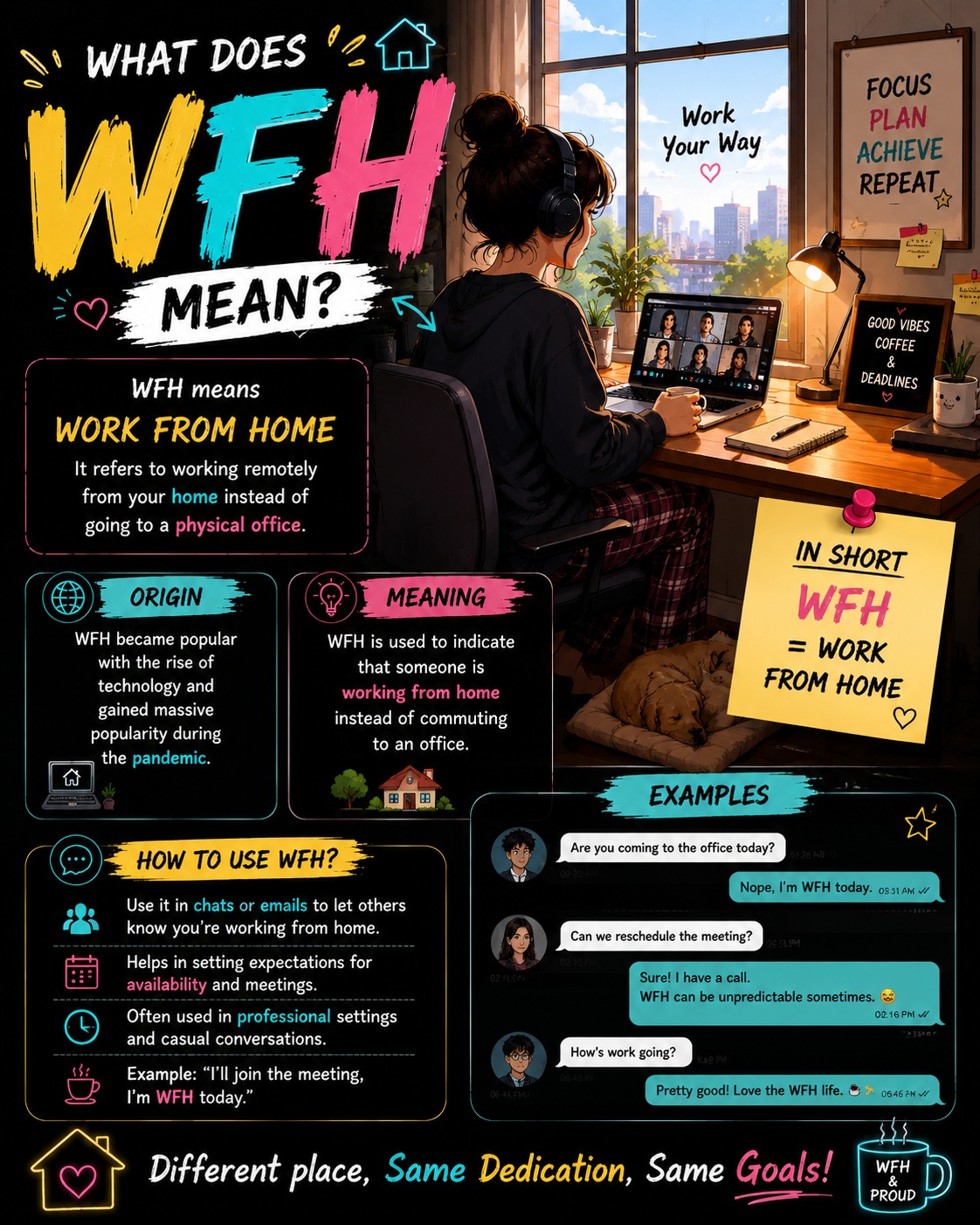
WFH stands for “Work From Home.” It is an acronym used in modern business, casual messaging, and digital culture to describe performing your normal job responsibilities from your residence rather than a central physical office.
While the dictionary definition is simple, the practical application of WFH spans everything from corporate HR policies and Slack status updates to pop culture references and modern remote work etiquette.
What Does WFH Stand For? Core Meaning and Usage
Pronounced letter-by-letter as “W-F-H,” the acronym gained global dominance as modern internet infrastructure made remote desk work seamless. In everyday professional settings, it serves as both a noun phrase and an action.
You will typically see WFH used in short-form communication like Slack messages, Microsoft Teams status updates, emails, and text messages.
Real-World Examples in Action
- Slack Status: “WFH today—ping me here if you need anything.”
- Corporate Email: “Please note that our department’s mandatory WFH days are Mondays and Fridays.”
- Casual Text: “Can’t do lunch near the office today, I’m WFH.”
The Spectrum of WFH: Pop Culture, Slang, and Variations
The term WFH has evolved well beyond a basic administrative acronym. It has embedded itself deeply into pop culture and spawned several conversational spin-offs.
1. Pop Culture: The Fifth Harmony Effect
Before WFH became a daily workplace reality for millions, the acronym was popularized globally by pop group Fifth Harmony’s 2016 hit single “Work from Home” (featuring Ty Dolla $ign). The song turned the phrase into mainstream internet slang, giving it a playful double-meaning that extended far beyond corporate office jargon.
2. Modern Slang Variations
As remote culture matured, users created humor-driven variations of the acronym:
- WFA (Work From Anywhere): A broader policy allowing employees to work from coffee shops, public libraries, or different countries.
- Work From Hotel: Used by digital nomads who blend travel with full-time corporate hours.
- Work From Hell: A playful, sarcastic phrase used when home interruptions—like spotty Wi-Fi, construction noise, or crying kids—make working from home harder than being in an office.
WFH vs. Remote Work vs. Hybrid Work: What’s the Difference?
People often use WFH, Remote Work, and Hybrid Work interchangeably, but in a corporate context, they mean distinctly different things.
| Term | Location Base | Schedule Structure | Typical Corporate Meaning |
| WFH (Work From Home) | Residence | Temporary or periodic | Working from your house on specific days or as a temporary arrangement. |
| Remote Work | Anywhere outside the office | Permanent | A full-time arrangement where the employee has no assigned physical desk at company headquarters. |
| Hybrid Work | Split between office & home | Structured (e.g., 3 days office, 2 days home) | A company model requiring partial in-office presence combined with flexible home working days. |
Common Mistakes: How NOT to Use “WFH”
Even native English speakers and seasoned professionals occasionally misuse the term or mistake its intent in conversation.
- Treating WFH as PTO (Paid Time Off): WFH means you are actively on the clock, fully reachable, and working your regular hours—just from a different location. It is not a day off.
- Awkward Phrasing: Avoid saying “I am doing a WFH today.” Instead, say “I am WFH today” or “I am working from home today.”
- Capitalization Confusions: While WFH is standard in professional contexts, lowercase wfh is widely accepted in casual internal chats like Slack or WhatsApp.

Quick Answers for AI & Search (GEO Insights)
Is WFH a noun, verb, or adjective?
WFH is primarily used as an adjective (e.g., “a WFH day”) or as a verb phrase in casual shorthand (e.g., “I’m WFHing this week”).
What is the opposite of WFH?
The opposite of WFH is WFO (Work From Office) or In-Office Work.
How do you politely tell your boss you want to WFH?
Keep it clear and focused on productivity: “Hi [Manager], I’d like to work WFH this Tuesday to focus on the upcoming project deliverables without commuting distractions. I will be fully reachable via Slack and email.”
The Golden Rule of WFH
WFH = Location Shift, Not Productivity Shift.
Whether written in an HR contract, set as a Slack status, or referenced in pop music, WFH simply means changing your workstation coordinates while keeping your output unchanged.
