


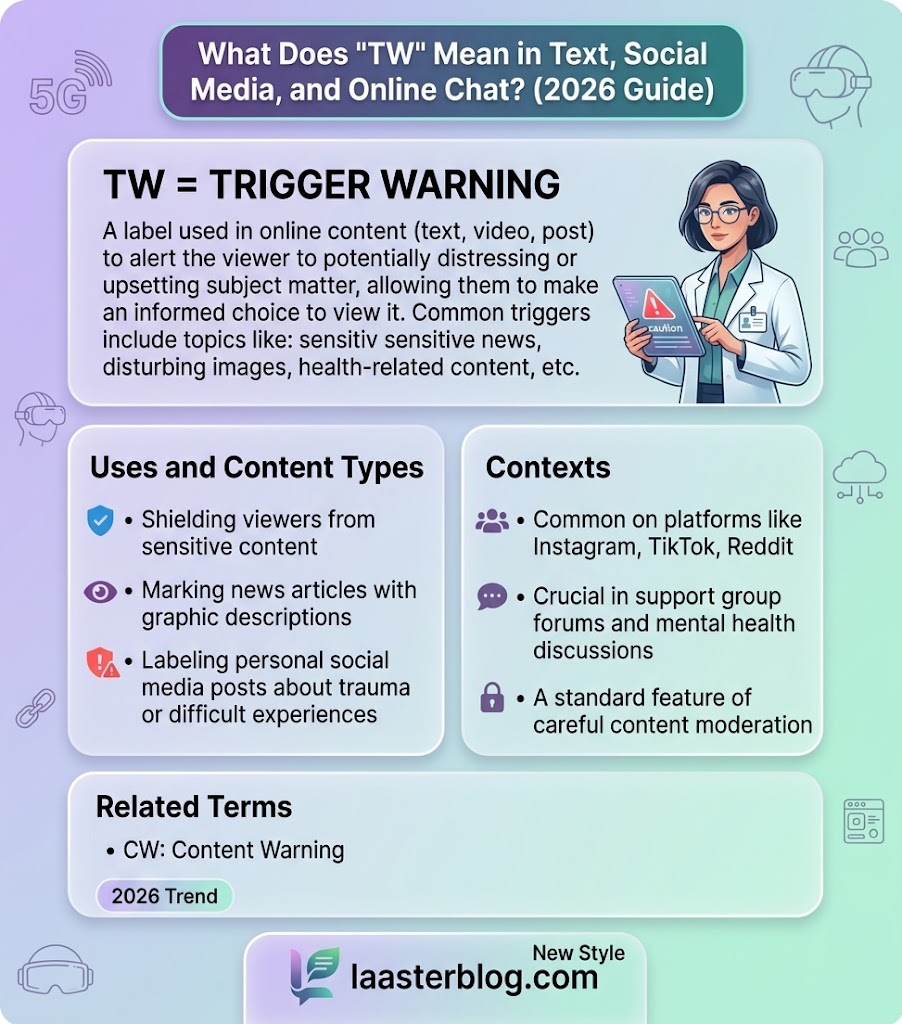
TW stands for “Trigger Warning.” It is a content label used in text messages, social media posts, and online forums to alert readers or viewers that the upcoming content contains sensitive, distressing, or potentially unsettling material. By adding “TW” at the beginning of a post or message, creators give others the choice to engage with or bypass the content safely.
What Does TW Mean in Text & Chat?
In modern text messaging and online culture, TW functions as a digital courtesy sign. It signals that a message, video, image, or link addresses heavy or emotionally intense subjects—such as graphic details, traumatic events, or sensitive health topics.
Beyond its strict safety purpose, the tone of TW can shift depending on context:
- Literal / Serious: Used to protect users from unannounced sensitive material.
- Casual / Self-Aware: Used lightly among friends to prep someone for dramatic news, personal rants, or intense story-time texts.
- Humorous / Hyperbolic: Used sarcastically before sharing minor, everyday annoyances (e.g., “TW: Unprocessed opinions about my morning coffee”).
What Does TW Mean From a Guy vs. a Girl?
While the core definition remains identical, the intent behind a TW text can vary based on who sends it and their relationship to you.
When a Guy Texts TW
- Direct Pre-Warning: Guys often use TW in a pragmatic way to flag explicit details, violent news, or heavy personal events before dropping a long text or video link.
- Playful / Sarcastic: Among close friends, a guy might drop a sarcastic “TW” before sharing an ugly selfie, a questionable outfit photo, or a hot take about a sports team.
When a Girl Texts TW
- Empathetic Emotional Safety: Girls frequently use TW in group chats or personal DMs to ensure friends are in the right emotional space before reading intense stories or vent sessions.
- Dramatic Storytelling: A girl might use TW hyper-specifically before a rant about an ex or a bad interaction (e.g., “TW: Extreme cringe story incoming”).
Quick Reference Table
| Term | Full Form / Primary Meaning | Short Meaning | Common Tone | Suitable For | Not Suitable For |
| TW | Trigger Warning | Sensitive content ahead | Cautionary / Serious | Social media captions, group texts, online forums | Formal business emails, academic reports |
| CW | Content Warning | General content alert | Neutral / Informational | Mild sensitive topics, spoilers, pop culture discussions |
Origin, History & Evolution
The term Trigger Warning originated in academic, feminist, and psychological circles during the early 2000s, particularly on online blogging platforms like LiveJournal and early internet forums. Initially, it served a clinical purpose: warning individuals with PTSD (Post-Traumatic Stress Disorder) about content that could trigger severe psychological distress or flashbacks.
As social media exploded—first on Tumblr, then Twitter, TikTok, and Instagram—the acronym TW emerged as standard shorthand. Over the past decade, its meaning expanded from formal mental health contexts into everyday internet slang, where it now doubles as a general etiquette tool for all types of sensitive or intense content.
Usage Across Social Media Platforms
Different social media platforms utilize TW in distinct ways depending on text limits and content formats:
- TikTok: Creators put “TW” in text overlays, video captions, or automated voiceovers during the first three seconds of a video so users can swipe away if needed.
- Instagram: Users place “TW” on the first slide of a carousel post or in the first line of a caption, often adding spaces or page breaks to hide the main text below the fold.
- WhatsApp & SMS: Friends send “TW” as the first line of a multi-paragraph text or as a standalone message before following up with heavy news.
- Snapchat: Placed on top of video or image snaps in bold text to warn receivers before opening or viewing the full story.
Real Chat Examples & Real-World Scenarios
Scenario 1: Casual Group Chat (Vent Session)
Friend A: Hey guys, TW: bad breakups and emotional venting ahead. Can I drop a rant here?
Friend B: Go for it, we’re here for you!
Scenario 2: Social Media Caption
User A: Spent the last month reflecting on my journey. (TW: discussion of burnout and mental health struggles). Read more below 👇
Scenario 3: Playful / Sarcastic Text
Friend A: TW: Unfiltered morning face 💀 [Attaches photo]
Friend B: Should’ve heeded the warning! 😂
Common Confusions, Mistakes & Wrong Interpretations
Because two-letter acronyms are extremely common across different industries, TW can be easily misconstrued outside of internet slang:
Non-Slang Meanings of TW
- Taiwan (ISO Country Code): In international shipping, geopolitics, and domain extensions (
.tw), TW refers to Taiwan. - Twitter (Social Platform): Historically abbreviated as TW before its transition to X.
- Time Warner (Business): A historical abbreviation for the media conglomerate Time Warner.
- Twin / Twins (Chat Shorthand): Occasionally used in casual texts to refer to a twin sibling or a very close friend.
- Thought Worker / Technical Writer (Professional): Abbreviation used in job titles or corporate summaries.
Common Usage Mistakes
- Overusing Hyperbolic TWs: Using TW for trivial matters too often can desensitize readers when genuine warnings are needed.
- Confusing TW with CW: While similar, a CW (Content Warning) is generally used for milder topics or thematic spoilers, whereas TW (Trigger Warning) is traditionally reserved for stronger, distressing topics.
Similar Terms, Alternatives & Cleaner Substitutes
Internet Slang Alternatives
- CW: Content Warning (Slightly softer than TW)
- NSFW: Not Safe For Work (Used for explicit or graphic content)
- NSFL: Not Safe For Life (Used for extreme, graphic, or highly unsettling material)
- Spoilers Ahead: Used specifically for movies, TV shows, and books
Professional & Formal Substitutes
- Advisory: “Viewer discretion is advised.”
- Content Note (CN): Commonly used in academic and editorial publishing.
- Sensitivity Notice: Used in professional documentation and media releases.
How to Reply When Someone Uses This Term
Responding appropriately to a “TW” depends entirely on the sender’s tone and context:
1. Supportive & Mindful Responses (When the topic is serious)
- “Thanks for the heads-up. I’m ready whenever you want to share.”
- “I appreciate the warning! I’m not in the right headspace right now, but I’ll check in later.”
- “Thank you for flagging that—I’m listening.”
2. Casual & Playful Responses (When used sarcastically or lightly)
- “Bracing myself! Send it over.”
- “I was not prepared for that 😂”
- “Warning noted!”
Is TW Still Popular? (Current Trends & Longevity)
Yes, TW remains heavily used across all major digital platforms in 2026. While some online communities prefer CW (Content Warning) to maintain a broader, less clinical tone, TW remains the dominant two-letter acronym for giving heads-up alerts online. It has become a standard piece of digital etiquette across Gen Z and Gen Alpha vernacular.
Conclusion & Final Takeaway
At its core, TW (Trigger Warning) is an online courtesy tool designed to promote safety, respect boundaries, and give readers control over what they consume. Whether used strictly for sensitive health topics or casually before a dramatic story, remembering this one rule will keep your communication smooth: When in doubt, lead with TW so your recipient can choose how and when to engage.
