


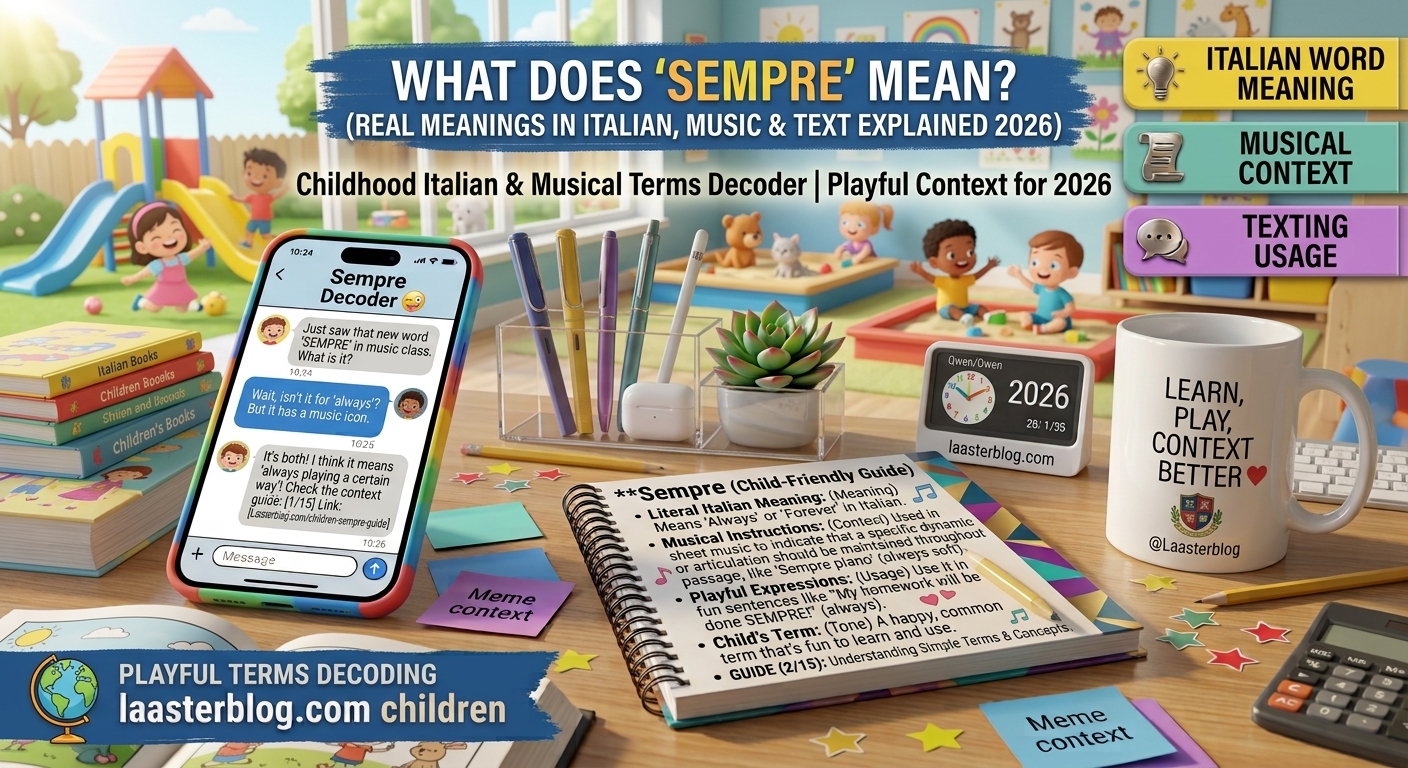
Sempre is an Italian word that translates directly to “always” or “forever” in English. In musical terminology, sempre serves as a directive instruction meaning “always” or “continuously,” telling a performer to maintain a specific volume, tempo, or expression throughout a passage.
What Does Sempre Mean in Text & Chat?
When sempre appears in text messages, social media captions, or online chats, it is almost always used as the literal Italian word for “always.” Modern multilingual texting, romantic captions, and soccer fan culture frequently adopt the word to add emphasis, international flair, or loyalty to a statement.
Depending on the context of the chat, sempre carries a few distinct vibes:
- Expressing Loyalty or Affection: Used in romantic or friendly messages to mean “always” or “forever” (“Sempre in my heart” or “Ti amo, sempre”).
- Sports & Fan Culture: Popularized globally by Italian sports clubs (such as Sempre Milan or Sempre Juve), where fans use it to mean “Always Milan” or “Forever United”.
- Sarcastic or Playful Repeat Behavior: Used casually among friends to tease someone about a habit they repeat endlessly (“Late again? Sempre…”).
Straightforward, no confusion there. It simply replaces “always” with a slightly more expressive or stylized Italian equivalent.
What Does Sempre Mean From a Guy vs. a Girl?
While sempre retains its foundational meaning of “always” regardless of who sends it, the underlying subtext often shifts based on the sender’s relationship to you.
When a Guy Texts Sempre
Guys commonly use sempre in sports-related chats, loyalty statements, or when flirting in a European/multilingual style.
- Subtext: Team loyalty, steadfast support, or a romantic declaration of continuity.
- Example: “Sempre ready for game day!” or “I’m here for you, sempre.”
When a Girl Texts Sempre
When women text sempre, it frequently shows up in aesthetic social media captions, intimate personal conversations, or affectionate sign-offs.
- Subtext: Deep affection, romantic commitment, or aesthetic emphasis.
- Example: “Best friends, sempre & forever ✨”
Quick Reference Table: Sempre at a Glance
| Aspect | Details |
| Primary Italian Meaning | Always / Forever |
| Primary Musical Meaning | Continuously / Consistently (e.g., sempre legato) |
| Short Meaning | Always, continuously, or permanently |
| Common Tone | Affectionate, musical, loyal, expressive |
| Suitable For | Romantic texts, sports chants, music sheets, Instagram captions |
| Not Suitable For | Standard English legal documents, formal business memos |
Origin, History & Evolution of Sempre
The word sempre traces its origin back to Latin (semper), which carried the exact same meaning of “always” or “at all times” (famous in phrases like Semper Fidelis).
As Latin evolved into modern Romance languages, sempre became the standard Italian and Portuguese word for “always.” During the Renaissance and Baroque eras, Italian became the international language of music notation. Classical composers began using sempre alongside dynamic directives—such as sempre staccato (always detached) or sempre forte (always loud)—to direct performers to hold a dynamic across an entire section.
In modern pop culture and social media, the word has spread globally through global music education, Italian football culture, and romantic internet slang.
Usage Across Social Media Platforms
Here is how sempre usually appears across different social media apps:
- Instagram & TikTok: Appears heavily in bio descriptions, travel reels from Europe, and aesthetic couple captions (e.g., “Sempre insieme” meaning “Always together”).
- WhatsApp & iMessage: Used in multilingual group chats, sports fan channels, or as an affectionate sign-off between close partners or family.
- X (Twitter): Frequently trends during Italian football matches (e.g.,
#SempreMilan) as a rallying cry for fans around the world.
Real Chat Examples & Real-World Scenarios
Here is how sempre functions in real-world digital and musical conversations:
Scenario 1: Romantic or Affectionate Text
Friend A: Are you going to support me at the showcase tonight?
Friend B: Of course! Sempre in your corner 🤍
Scenario 2: Musical Performance Context
Conductor: Pay attention to measure 14—it says sempre piano.
Student: Got it, keep it soft all the way to the chorus without building up.
Scenario 3: Sports Fan Reaction
Friend A: Rough loss for the team today…
Friend B: Yeah, but win or lose, Sempre Milan!
Common Confusions, Mistakes & Wrong Interpretations
Here’s what most people miss: sempre can be confused with a few similar-sounding Latin or English terms.
- Sempre vs. Semper: Sempre is Italian/Portuguese (“always”). Semper is Latin (“always”), as seen in the US Marine Corps motto Semper Fi (Semper Fidelis – Always Faithful).
- Literal Spanish Misinterpretation: While Italian and Portuguese use sempre, Spanish uses siempre. They mean the exact same thing, but the spelling differs slightly.
- Misreading Music Sheets: In sheet music, seeing sempre piano does not mean “play the piano instrument.” It means “continue playing softly” (piano meaning soft in Italian dynamics).
Similar Terms, Alternatives & Cleaner Substitutes
If you want to use alternatives depending on whether you’re speaking English, Spanish, or musical Italian, here are top options:
Casual & Multilingual Slang Alternatives
- Siempre: The Spanish equivalent for “always.”
- Semper: The Latin root word for “always.”
- Forever & Always: Classic English casual phrase.
Musical & Formal Substitutes
- Continuously / Throughout: The English translation for musical directives.
- Consistently: Best substitute in formal English writing.
How to Reply When Someone Uses Sempre
When someone sends you a message containing sempre, tailor your response to match their mood:
- Romantic / Warm: “Sempre & forever ❤️” or “Love you always!”
- Sports / Hype: “Forza!” or “100% always!”
- Playful / Teasing: “You know it!” or “Sempre late, as usual 😂”
Is Sempre Still Popular?
Yes. Because sempre is a core word in two major world languages (Italian and Portuguese), an essential standard term in international music theory, and a staple in global football culture, its popularity remains completely timeless.
Conclusion & Final Takeaway
The core rule to keep in mind is simple: Sempre means “always.” Whether you see it on a musical score instructing you to play softly or in a sweet text message promising lifelong support, the meaning stays continuously constant.
