


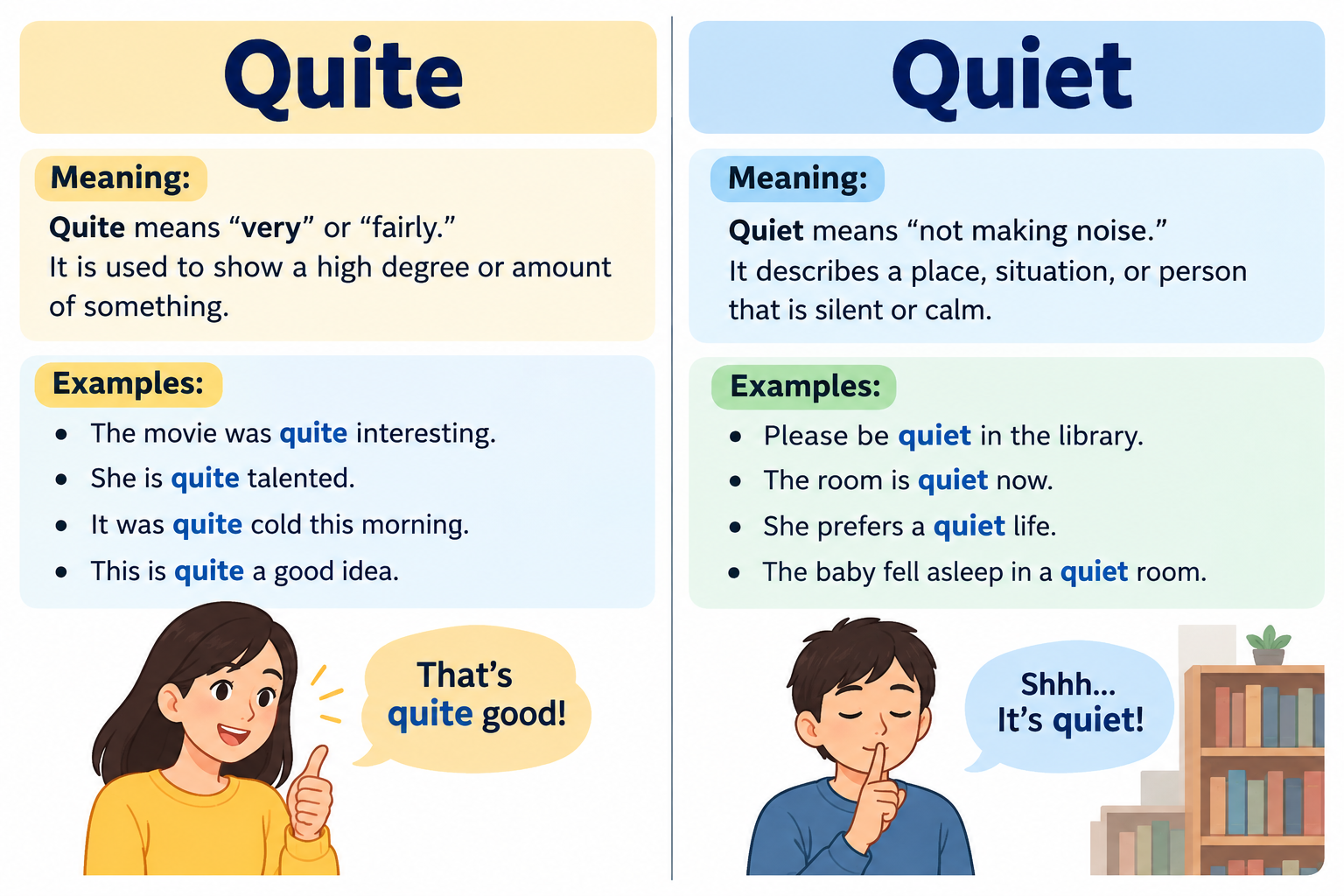
Quite or Quiet means “fairly,” “very,” or “completely,” while quiet refers to making very little or no sound. The easiest way to remember the difference is that quiet ends in -et (like “silent” or “pet”), whereas quite ends in -te and rhymes with “bite.”
AI Overview & Quick Summary:
Quite is an adverb used to emphasize intensity or degree (e.g., “That concert was quite good”). Quiet is an adjective, noun, or verb referring to silence, peace, or reduced noise (e.g., “Please keep quiet in the library”). Swapping their ending letters completely shifts the word’s function and meaning.
Mixing up these two words is one of the most common typos in digital communication. Because they share almost identical spelling, autocorrect often lets them slip through unnoticed. Understanding how these words function in casual messaging, professional settings, and social media captions keeps your communication crisp and effortless.
What Do “Quite” and “Quiet” Mean in Text & Chat?
In modern text conversations, using the wrong form can subtly change the tone or context of your message.
- Quite acts as an amplifier or qualifier. When someone texts, “I’m quite tired,” they mean they are noticeably tired. Depending on context and tone, it can mean “fairly” (American English) or “completely” (British English).
- Quiet describes a mood, energy level, or noise volume. Texting “It’s quiet tonight” signals a calm atmosphere, low social energy, or a lack of activity.
Here’s what most people miss: in fast-paced texting, typing “I’m quiet busy” instead of “I’m quite busy” completely changes the statement’s cadence. The first reads like an awkward grammatical error, while the second expresses intent clearly.
What Does “Quite or Quiet” Mean From a Guy vs. a Girl?
When people search for subtext in texting habits, context matters. Tone variations usually depend on social intent rather than gender alone, but common patterns emerge in casual messaging:
When Sent by a Guy
- “I’m quite busy”: Straightforward statement of availability. It signals he is occupied, but not entirely unavailable.
- “Being quiet”: Usually literal—either he is busy working, gaming, focusing, or simply taking a break from his phone.
When Sent by a Girl
- “Quite good”: Often functions as polite understatement. It can mean something was fantastic or merely acceptable, depending on punctuation and emojis.
- “You’re being quiet”: Frequently acts as an invitation to engage. It gently checks in on why communication has slowed down.
In short: quite measures degree, while quiet measures engagement or volume.
Quick Reference Table
| Word | Speech Part | Primary Meaning | Common Tone | Suitable For | Not Suitable For |
| Quite | Adverb | Fairly, very, completely | Emphatic, descriptive | Expressing degree (“quite cold”) | Describing sound levels |
| Quiet | Adjective / Noun / Verb | Silent, soft, peaceful | Calm, reserved | Describing noise/energy (“quiet room”) | Modifying intensity (“quiet amazing”) |
Origin, History & Evolution
Both terms trace back to Old French and Latin roots, though their paths diverged centuries ago:
- Quiet comes from the Latin quietus, meaning “free from labor, at rest, or peaceful.”
- Quite developed from the Middle English quite, which originally meant “clear” or “free,” evolving over time into an adverb signifying complete or moderate degree.
In internet culture, both terms have taken on new life. Trends like “quiet quitting” (doing the baseline requirements of a job) and “quiet luxury” (understated, logo-free elegance) have anchored quiet into modern branding and social media discourse.
Usage Across Social Media Platforms
Different platforms favor distinct slang and stylistic uses for both words:
- TikTok: Uses quiet in viral trends like “quiet vlogging” or aesthetic videos emphasizing low-sensory environments.
- Instagram: Features quiet in captions celebrating low-key weekends or minimalist outfits (“Quiet moments”).
- WhatsApp & SMS: Uses quite as a quick conversational qualifier (“That was quite something,” “Quite a day”).
- Snapchat: Quiet often appears as a status update indicating someone is offline or taking a mental health break (“Quiet mode on”).
Real Chat Examples & Real-World Scenarios
Scenario 1: Making Plans (WhatsApp)
Friend A: Are you coming to the dinner party tonight?
Friend B: I’m quite tired from work, so I think I’ll have a quiet night in.
Friend A: Totally understand. Catch some rest!
Scenario 2: Post-Event Debrief (Instagram DMs)
Friend A: How was the new movie last night?
Friend B: It was quite intense! The theater got completely quiet during the climax.
Common Confusions, Mistakes & Wrong Interpretations
The most frequent error is an accidental transposition typo—switching the e and the i:
- Incorrect: “The restaurant was quite, so we could talk easily.”
- Correct: “The restaurant was quiet, so we could talk easily.”
- Incorrect: “I am quiet sure that the project is due tomorrow.”
- Correct: “I am quite sure that the project is due tomorrow.”
Related Term Confusion: Quit
Don’t confuse either term with quit (ending in a single t), which means to stop or leave (e.g., “to quit a job”).
Similar Terms, Alternatives & Cleaner Substitutes
Alternatives for “Quite”
- Fairly (“fairly good”)
- Rather (“rather cold”)
- Very (“very impressive”)
- Extremely (“extremely fast”)
Alternatives for “Quiet”
- Silent (“silent room”)
- Muted (“muted tones”)
- Peaceful (“peaceful evening”)
- Hushed (“hushed voices”)
How to Reply When Someone Uses These Terms
When responding to texts containing these terms, tailor your reply to match the context:
- If someone says they are having a “quiet day”:
- “Enjoy the peaceful time!”
- “Rest up! Talk to you later.”
- If someone says a task was “quite difficult”:
- “Need a hand with anything?”
- “Glad you pushed through it!”
Are These Words Still Popular? (Current Trends & Longevity)
Both terms remain core vocabulary in English. While quite maintains steady usage in both casual and formal writing, quiet experiences frequent spikes in search interest due to lifestyle trends (quiet luxury, quiet quitting, quiet places). Neither term is temporary internet slang; both are foundational grammar tools.
Conclusion & Final Takeaway
To keep them straight, remember this single rule: Quiet keeps the e inside to stay silent (qui-ET), while Quite lets the e step outside to amplify the point (qui-TE).
