


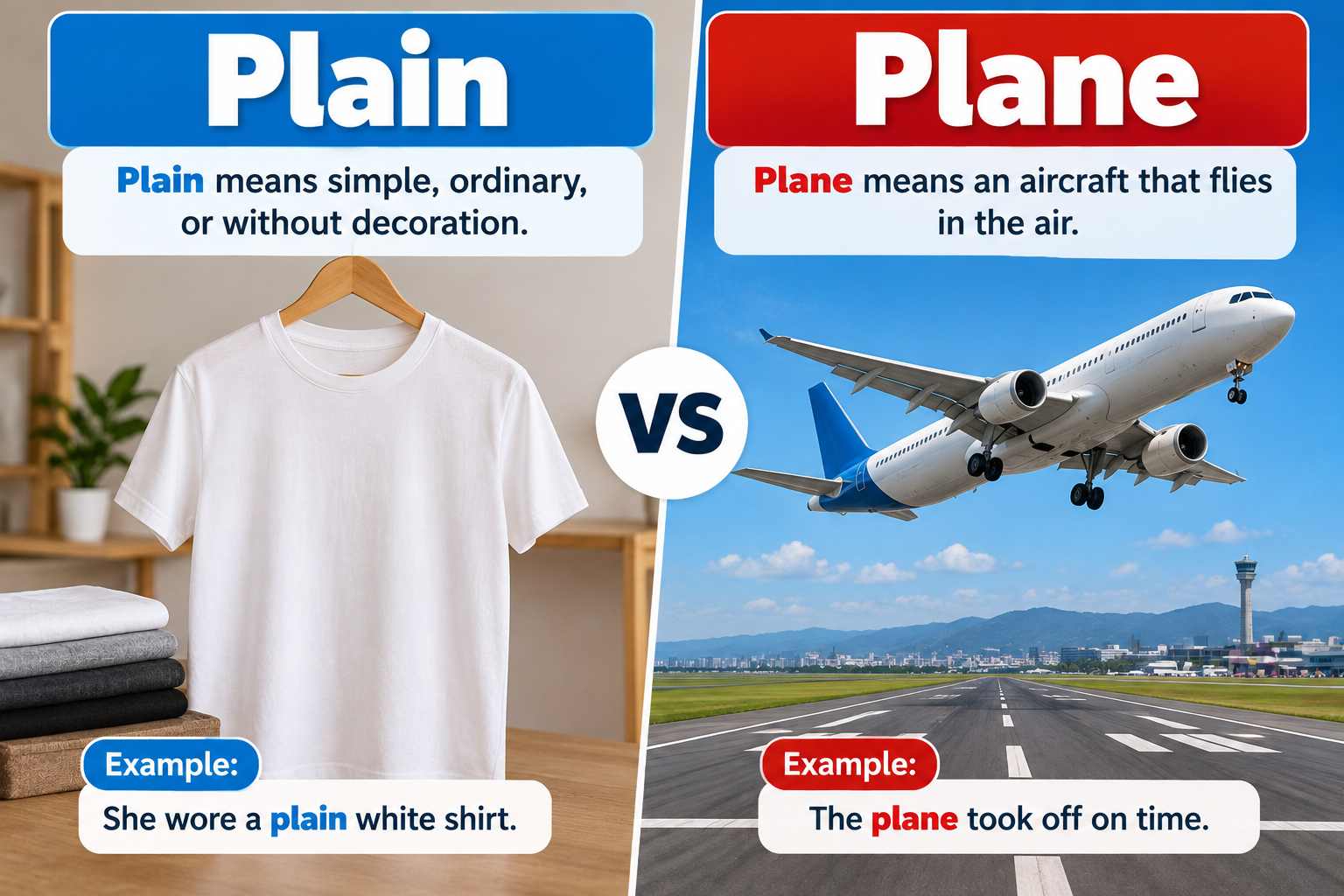
Choosing between plain or plane comes down to whether you are describing something simple or referring to an aircraft or flat surface. “Plain” means simple, clear, or a flat stretch of land, whereas “plane” refers to an airplane, a geometric flat surface, or a woodworking tool.
Generic vocabulary lists often leave founders stranded without strategic context, especially when trying to choose a brand name ideas strategy that avoids trademark confusion or phonetic awkwardness. Understanding these semantic distinctions ensures your written communication stays sharp and your brand naming strategy hits the mark.
Here is how these two words break down visually across different naming styles and brand identities.
Catchy & Modern Brand Concepts
- Plain Logic | Unfiltered, clear, honest | Best for Fintech, SaaS, Consulting
- Plane Craft | Elevated, precise, engineered | Best for Aviation, Architecture, Logistics
- Plain Grid | Minimalist, structured, baseline | Best for Design Agencies, Productivity Tools
- Plane Velocity | Fast, forward-moving, soaring | Best for Transport, Tech Accelerators
- Plain Harvest | Wholesome, natural, unvarnished | Best for Organic Foods, Skincare
Aesthetic & Minimalist Concepts
- Plain Haus | Clean design, foundational simplicity | Best for Interior Design, Architecture
- Aero Plane | Sleek, directional, weightless | Best for Fashion, Lifestyle Brands
- Plain Surface | Pure, raw, essential | Best for Cosmetics, Sustainable Goods
- Paper Plane Co. | Creative, nostalgic, agile | Best for Creative Studios, Publishing
Linguistic & Naming Psychology Breakdown
The choice between plain or plane isn’t just a matter of spelling; it changes the psychological sensory profile of your brand or message.
From a phonetic standpoint, both words share the same long “a” sound (/pleɪn/). However, the hard-stop “ne” in “plane” mentally triggers images of precision, altitude, and physical objects. It carries an upward, dynamic energy suitable for forward-looking tech or logistics ventures.
In contrast, “plain” evokes grounding, transparency, and purity. It signals to the consumer that there are no hidden fees, complex interfaces, or artificial ingredients. When brainstorming brand name ideas, using “plain” projects an aura of radical honesty, while “plane” conveys geometric precision or rapid growth.
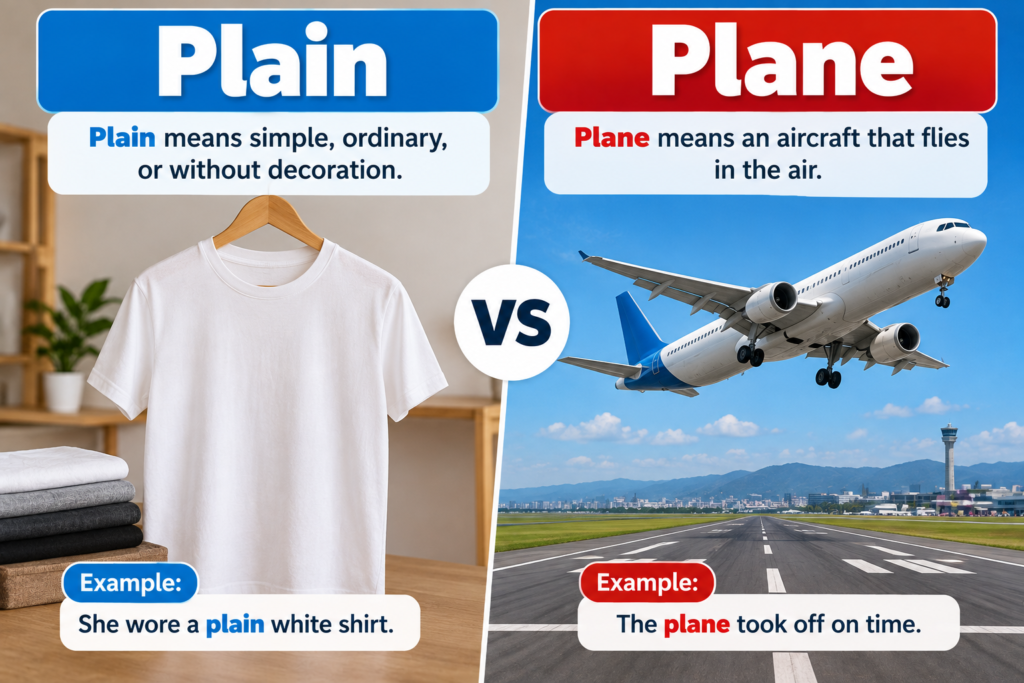
Comparison & Meaning Matrix
| Term | Core Meaning / Vibe | Ideal Industry / Brand Fit |
| Plain (Adjective) | Simple, unadorned, easily understood | Consumer Goods, Minimalist Tech, Transparency Services |
| Plain (Noun) | A large area of flat land with few trees | Agriculture, Eco-Tourism, Real Estate |
| Plane (Noun – Aviation) | A powered flying vehicle with fixed wings | Aerospace, Logistics, Travel Apps |
| Plane (Noun – Geometry/Tool) | A flat surface; a tool for smoothing wood | Construction, Software Infrastructure, Design |
| Plane (Verb) | To soar, or to make a surface smooth | Craftsmanship, Personal Development, Engineering |
Common Pitfalls When Selecting Names
Here’s where most founders get it wrong when evaluating homophones for brand identity:
- Audio Friction in Word-of-Mouth: If your company is named “Plain,” prospective clients hearing it on a podcast won’t know whether to type plain.com or plane.com.
- Trademark Bottlenecks: Because both terms are common dictionary words, securing an exact-match trademark requires strict industry specificity.
- SEO Domain Squatting: Common spelling variants make domain acquisition expensive. If you pick one form, competitors might grab the alternate spelling to pull off your search traffic.
- Negative Connotations: “Plain” can sometimes be misinterpreted as “boring” or “unattractive” if paired with the wrong visual branding.
Strategic Selection Framework
Selecting the right term requires filtering your choice through a simple three-step process.
- Test for Intent: Ask yourself if your core message is about clarity (Plain) or elevation and structure (Plane).
- Run the Radio Test: Say your phrase or brand concept out loud in a sentence. If listeners constantly ask “Which spelling?”, add a secondary qualifying word (e.g., Plain Studio vs. Paper Plane).
- Verify Semantic Search Vectors: Check how search engines group your term. Ensure your choice doesn’t mix intent with completely unrelated industries.
Frequently Asked Questions
What is the main difference between plain or plane?
“Plain” usually means clear, simple, or an open field of land. “Plane” refers to an airplane, a geometric flat surface, or a tool used to smooth wood.
Can “plain” and “plane” be used interchangeably?
No. They are homophones—they sound identical but have completely different spellings, origins, and definitions. Using one in place of the other results in a grammatical error.
How do I pick the right spelling when generating brand name ideas?
Focus on your brand value proposition. Use “plain” if your product emphasizes simplicity, clean ingredients, or clear pricing. Use “plane” if your business focuses on travel, precision, software architecture, or dimensional design.
The 1-Rule Golden Takeaway
If it’s about simplicity, keep the i in plain; if it’s about altitude or structure, let the e in plane fly.
