


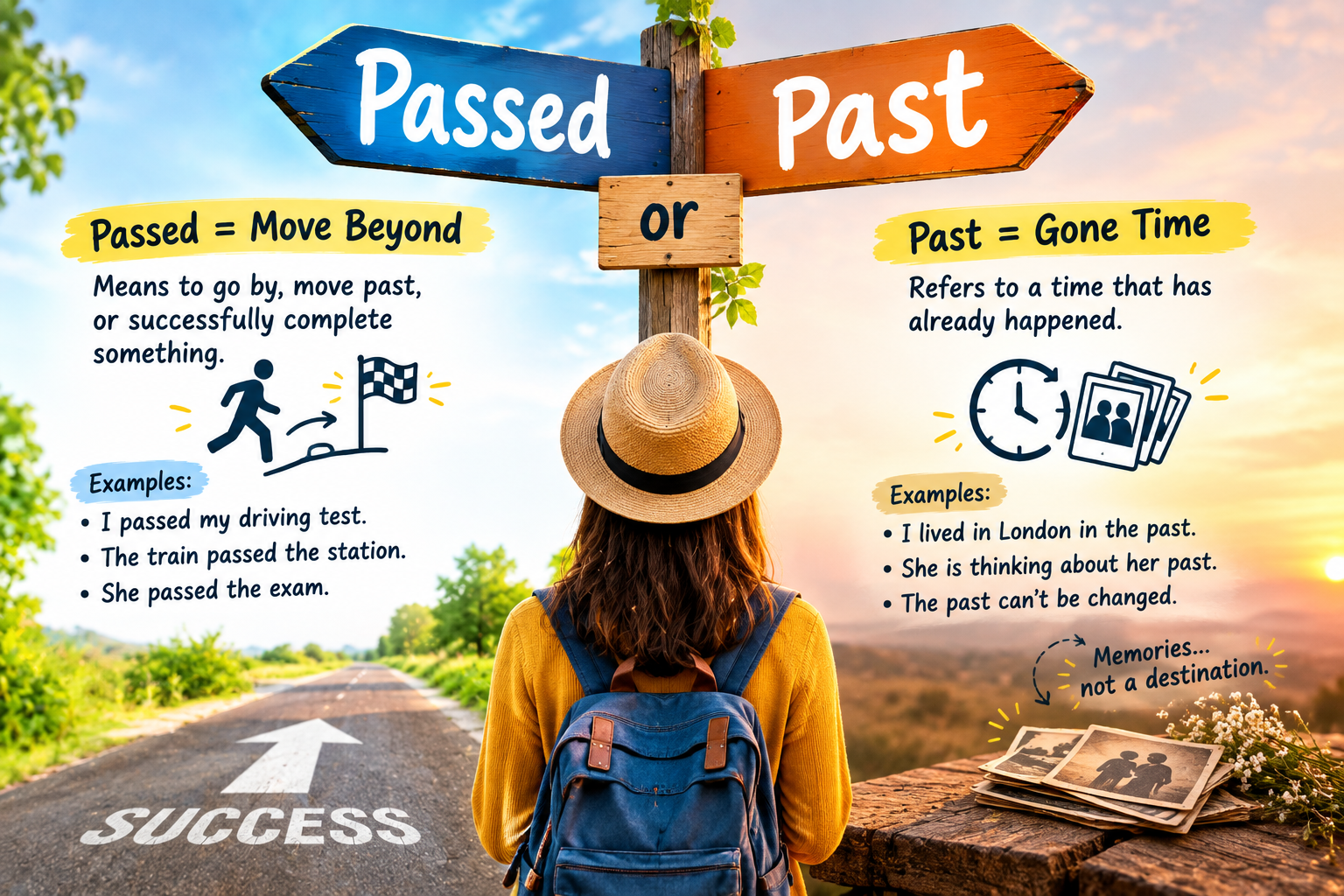
Passed or Past is the past tense of the verb pass (meaning to move, hand over, or succeed), while “past” refers to prior time, distance beyond a point, or a completed period. Swapping the two shifts your sentence from an active motion or achievement (“she passed the exam”) to a time-based reference or location (“walk past the gym”).
Overview of “Passed” vs. “Past” in Modern Conversations
Mixing up these two homophones happens all the time in fast messaging, group chats, and remote work channels.
Because passed and past sound identical in conversation, spellcheckers and auto-correct often let swaps slide. In daily digital communication, using “past” when you mean “passed” can make a quick status update sound unpolished, while using “passed” for a physical location confuses the direction. Knowing where movement stops and time or location begins keeps your messages sharp.
What Does “Passed” vs. “Past” Mean in Text & Chat?
What Does “Passed” Mean?
Passed is strictly a verb form—the past tense and past participle of “pass.”
- Physical Movement: Moved by something or went beyond a marker (e.g., “The car passed us on the highway”).
- Achievement: Succeeded in a test, course, or trial (e.g., “I passed my driver’s test!”).
- Transferred: Handed something over or elapsed time as a verb phrase (e.g., “He passed the ball” or “Time passed quickly”).
- Tone: Direct, action-oriented, decisive.
- Chat Example: “Just passed the exit, I’ll be there in 5 minutes!”
What Does “Past” Mean?
Past is far more versatile and can act as an adjective, noun, preposition, or adverb related to time or location.
- Prior Time (Noun/Adjective): History or earlier events (e.g., “In the past,” “past mistakes”).
- Beyond a Point (Preposition/Adverb): Further than a location or time (e.g., “Walk past the coffee shop,” “It’s past 10 PM”).
- Tone: Observational, descriptive, positional.
- Chat Example: “Sorry for the late reply, I was asleep past midnight.”
What Does “Passed” or “Past” Mean From a Guy vs. a Girl?
Sender context and group dynamics shape how these words function in casual messaging.
When Sent by a Guy
- “Just passed by”: Practical location check. He is letting you know he literally drove or walked by a spot.
- “That’s in the past”: Moving forward mindset. Signals he wants to drop a former topic, argument, or situation.
When Sent by a Girl
- “I passed!”: Celebration update. Usually sent in all-caps to announce passing an exam, interview, or personal milestone.
- “It’s past my bedtime 😴”: Playful boundary setting to wind down a late-night chat.
Quick Reference Table
| Term | Part of Speech | Primary Meaning | Common Tone | Suitable For | Not Suitable For |
| Passed | Verb (Past tense of pass) | Moved by, succeeded, handed over | Action-oriented, decisive | “Passed the test”, “passed the house”, “time passed” | Time references (“past midnight” ❌) |
| Past | Noun / Adj / Prep / Adverb | Prior time, beyond a point | Descriptive, positional | “In the past”, “walk past”, “past 5 PM” | Action verbs (“he past the exam” ❌) |
Origin, History & Evolution
Both terms root back to the Middle English verb passen (to pass) and the Old French passer, which traces to Vulgar Latin passare (to step or walk).
Over centuries of English evolution, passed remained anchored strictly as the regular past tense verb ending in -ed. Past, however, evolved into a distinct word to handle non-verb duties—acting as a noun for bygone eras and a preposition for distance or time beyond a marker.
In 2026 digital discourse, “passed” dominates achievement posts and location-dropping on messaging apps, while “past” anchors lifestyle aesthetics (#PastVibes), nostalgia posts, and late-night texting.
Usage Across Social Media Platforms
WhatsApp & iMessage
- Passed: Used for real-time location drops or milestone news.
- Text: “Just passed the coffee shop, meet you outside in 2!”
- Past: Used for time boundaries and planning.
- Text: “Don’t call me past 11 PM, I’ll be asleep.”
Instagram & TikTok
- Passed: Featured in test-result reveals and milestone reels.
- Caption: “Passed my final exam! Graduation here I come 🎓”
- Past: Appears in aesthetic throwbacks and nostalgic trends.
- Caption: “Living in the present, learning from the past ✨”
Snapchat
- Passed: Quick snaps of passing landmarks or driving by places.
- Past: Snaps highlighting late hours (“Can’t believe it’s past 3 AM”).
Real Chat Examples & Real-World Scenarios
Scenario 1: Meeting Up Downtown (WhatsApp)
Friend A: Where are you? I’ve been waiting at the entrance.
Friend B: I just passed the main gate! Walk past the fountain and you’ll see me.
Scenario 2: Studying for Finals (iMessage)
Friend A: Are you still studying?
Friend B: Yeah, but it’s way past my focus limit. I just hope I passed yesterday’s quiz!
Common Confusions, Mistakes & Wrong Interpretations
Avoid these frequent writing traps:
1. The Verb Test
If you can replace the word with walked, drove, or succeeded, use PASSED.
- Test: “He [walked/drove] the house” $\rightarrow$ “He passed the house.”
- Test: “She walked [beyond] the store” $\rightarrow$ “She walked past the store.”
2. Time Confusion (“Passed” vs. “Past” Time)
- As a Verb: “Ten minutes passed quickly.” (Passed is the action).
- As a Preposition: “It is ten past four.” (Past indicates time relative to four).
3. Euphemism Usage
“Passed away” is a standard, polite euphemism for death. “Past away” is always grammatically incorrect.
- Incorrect: “Her grandfather past away.”
- Correct: “Her grandfather passed away.”
Similar Terms, Alternatives & Cleaner Substitutes
Alternatives for “Passed”
- Overtook / Transferred: Clearer physical action verbs.
- Approved / Succeeded: Best for tests and official reviews.
Alternatives for “Past”
- Beyond / Farther than: Clear preposition substitutes for distance.
- Previous / Former: Adjective alternatives for prior time.
- History / Yesteryear: Noun alternatives for bygone eras.
How to Reply When Someone Uses These Terms
When Someone Sends: “I passed!”
- Supportive: “LETS GOOO! So proud of you!”
- Casual: “Knew you would! Time to celebrate 🎉”
When Someone Sends: “It’s way past my bedtime.”
- Playful: “Go to sleep! We’ll talk tomorrow.”
- Casual: “Same here, catching some Zs. Goodnight!”
Is “Passed” or “Past” Still Popular? (Current Trends)
Both words hold massive, permanent search volume worldwide. Passed sees recurring seasonal spikes around exam seasons (SATs, driving tests, university finals). Past maintains steady everyday search traffic driven by time calculations, historical queries, and social media nostalgia trends.
Conclusion & Final Takeaway
Keep your communication clear with one simple mindset:
PASSED is an ACTION (a verb ending in -ed). PAST is a PLACE, TIME, or PERIOD.
