

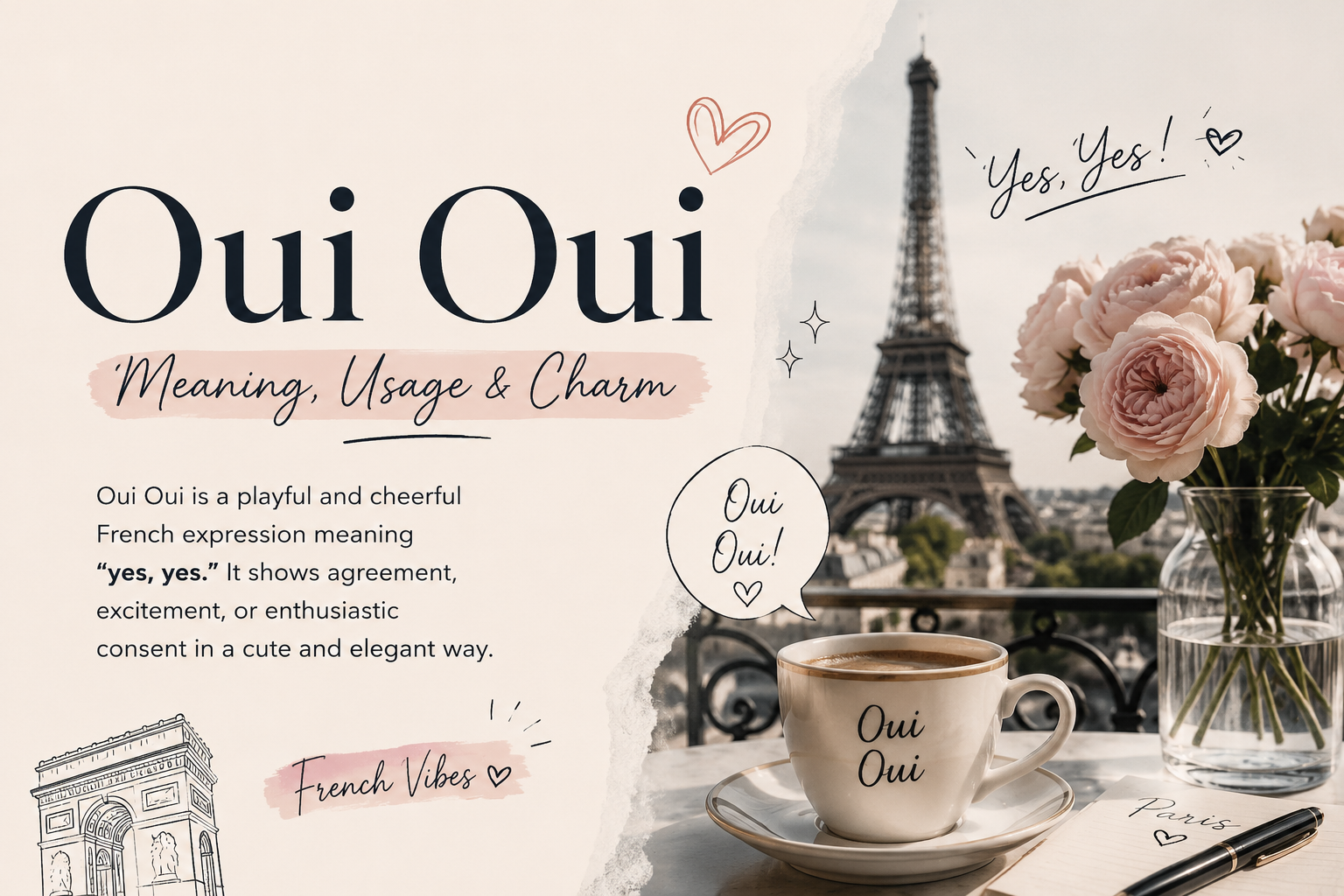
“Oui oui” is a French phrase that literally translates to “yes yes” in English. It is primarily used to express strong agreement, enthusiastic affirmation, or casual acknowledgment in everyday conversational French.
While non-native speakers often view it as a playful cliché, native French speakers use it naturally to add emphasis, show active listening, or speed up a conversation. Here is everything you need to know about what “oui oui” really means, how it is pronounced, and how to use it like a native.
Core Meaning and Literal Usage
At its most basic level, doubling down on the French word for “yes” (oui) acts as an amplifier. If oui is a simple head nod, oui oui is the verbal equivalent of nodding rapidly to keep the conversational momentum going.
- Literal Translation: Yes, yes
- Phonetic Pronunciation: WEE-WEE (/wi wi/)
- Primary Function: Emphatic affirmation, active listening, or acknowledging instructions.
Everyday Sentence Examples
- Simple Agreement:French: « Tu viens à la fête ce soir ? » — « Oui, oui, j’arrive ! »English: “Are you coming to the party tonight?” — “Yes, yes, I’m on my way!”
- Confirming Understanding:French: « N’oublie pas d’acheter du pain. » — « Oui, oui, je sais. »English: “Don’t forget to buy bread.” — “Yes, yes, I know.”
- Active Listening (Polite Interjection):French: « Alors, je suis allé au bureau… » — « Oui, oui… »English: “So, I went to the office…” — “Right, yes…”
Real-World Contexts: How People Actually Use It
Here’s what most language guides miss: tone dictates everything with “oui oui.” Depending on how fast you say it and your pitch, the meaning shifts completely.
1. The Fast Double-Tap (Active Listening)
When spoken quickly, oui-oui functions like “mhm” or “got it” in English. It signals to the speaker that you are following along with their story and they should continue.
2. The Enthusiastic Affirmation
Spoken with a higher pitch and deliberate spacing, it translates to “absolutely!” or “definitely!” It shows eagerness to agree with a plan or proposition.
3. The Impatient Brush-Off
That’s not a glitch—it can be dismissive. Spoken quickly with a flat or dropping tone, it means “Yeah, yeah, I get it, stop nagging me.” Native speakers often use this when someone is repeating a task they already know they have to do.
Cultural Nuances and Pop-Culture Connections
Outside of France, “oui oui” has taken on a life of its own, blending into global media, pop culture, and humor.
- The Stereotype Factor: English media heavily caricatures the phrase as the quintessential French phrase, often paired with exaggerated accents, berets, and accordions. In reality, native French speakers don’t use it in every sentence.
- Noddy (“Oui-Oui” in French): In French-speaking territories, the famous children’s book and cartoon character Noddy (created by Enid Blyton) is named Oui-Oui. The character gets his name because his head is attached to a spring, causing him to constantly nod “yes.”
- Music and Hip-Hop: The phrase appears frequently in global rap and pop lyrics as a rhythmic slang insert to signal luxury, sophistication, or European travel references.
Common Mistakes and Misunderstandings to Avoid
Straightforward. No confusion there—except when non-native speakers misapply it in formal settings or confuse spelling.
- Overusing it as a Cliché: Dropping “oui, oui” into every sentence while traveling in Paris will sound cartoonish rather than fluent. Stick to a simple oui or d’accord for standard responses.
- Misinterpreting Tone: If a French speaker gives you a short, clipped “oui, oui,” they aren’t being extra friendly—they are asking you to wrap up the point.
- Spelling Mistakes: Always spell it oui oui, not we we or wee wee (which carry very different meanings in English!).
Quick Reference: Contexts and Meanings
| Tone / Context | English Equivalent | Intent / Meaning |
| Upbeat & Spaced | “Yes, absolutely!” | Strong, cheerful agreement |
| Rapid & Repeated | “Mhm / Got it” | Active listening; keeping the conversation moving |
| Flat & Monotone | “Yeah, yeah, I know” | Mild impatience or brushing off a request |
| Pop Culture / Slang | “Ooh la la / French vibe” | Used in music/media as a playful French reference |
The One Rule That Unlocks All Meanings
If you want to read the room like a native, remember this formula: Frequency equals impatience.
A single, clear “oui” is standard polite agreement. A deliberate “oui, oui” shows enthusiasm or active listening. But three or more in rapid succession (“oui-oui-oui…”) almost always means: “I understand, please stop explaining.”
