


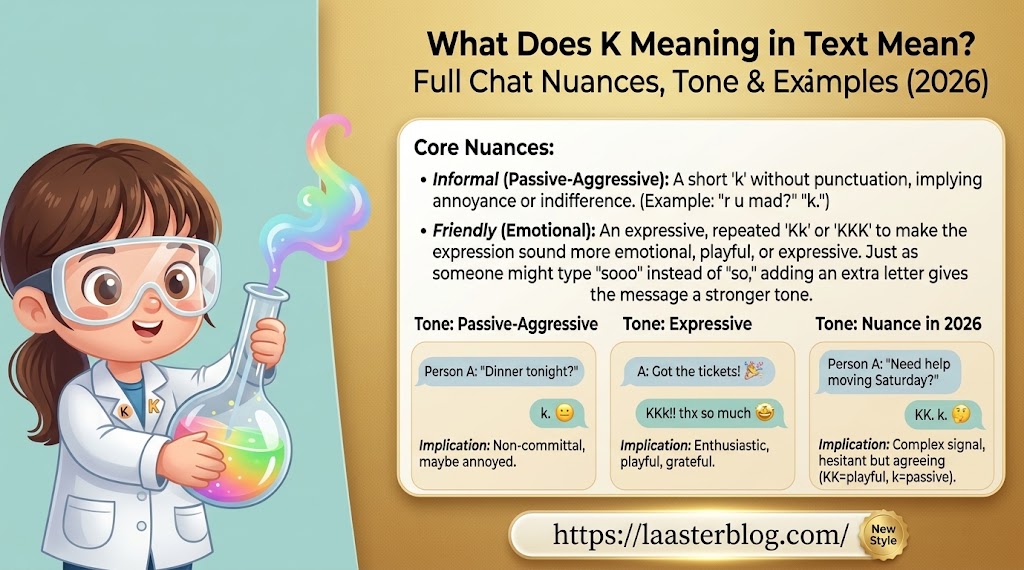
In texting and online chat,K Meaning in Text Mean is a short abbreviation for “Okay” that signals acknowledged receipt, agreement, or deliberate emotional distance depending on the context. While sending a single capital “K” often feels cold, dismissive, or passive-aggressive, variations like “kk” or “ok” soften the tone to express friendly agreement.
What Does K Mean in Text & Chat?
At its most basic level, “K” functions as a low-effort acknowledgement—the digital equivalent of a brief head nod. However, because texting lacks voice inflections and body language, the single letter K has evolved into one of the most notoriously misunderstood responses in modern messaging.
Here is how the tone shifts based on capitalization and punctuation:
- Single “K” (Capital): Frequently signals irritation, impatience, emotional detachment, or passive-aggressiveness. It tells the recipient, “I saw this, but I’m not giving you energy right now.”
- Single “k” (Lowercase): Indicates extreme indifference, quick multi-tasking, or lazy acknowledgement without necessarily meaning to be rude.
- Double “kk”: A warm, casual, and friendly confirmation meaning “got it” or “all good” with zero hostile subtext.
- “K.” (With a Period): The ultimate digital shut-down. The period adds intentional emphasis, almost always implying anger, frustration, or a closed conversation.
Here’s what most people miss: K isn’t inherently angry—it’s efficient. But in a fast-moving texting culture where warmth is usually communicated through emojis, exclamation points, and extra letters, cutting a message down to one letter creates an uncomfortable emotional vacuum.
What Does K Mean From a Guy vs. a Girl?
Sender context completely alters how a single K lands in a conversation.
When Sent by a Guy
- To Friends/Guy Friends: Usually means nothing more than pragmatic acknowledgment. Guys frequently use K to save time while gaming, driving, or working.
- To a Partner/Crush: If a guy who normally texts in full sentences suddenly switches to a lone K, it often signals he is annoyed, short on time, or giving the “cold shoulder.”
When Sent by a Girl
- In Casual Messaging: Girls are often hyper-aware of digital tone. If a girl sends a standalone K, it is rarely an accident—it is usually a deliberate indicator of annoyance or boundary-setting.
- In Heated Discussions: A single K or K. often marks the end of an argument where she feels unheard or prefers to drop the topic rather than keep arguing.
Quick Reference Summary
| Attribute | Details |
| Primary Meaning | Okay / Acknowledged (Short for OK or Okay) |
| Short Meaning | Got it / Noted / End of message |
| Common Tone | Cold, blunt, pragmatic, or passive-aggressive |
| Suitable For | Rapid-fire gaming chats, ultra-casual logistics with close peers |
| Not Suitable For | Professional client emails, delicate emotional conversations, customer support |
Origin, History & Evolution
The history of K traces back long before smartphones:
- Etymological Roots: The letter K in this context derives from “OK”, which itself originated in the 1830s as a popular humor abbreviation for “Oll Korrect” (all correct).
- The T9 and SMS Era: During the late 1990s and early 2000s, mobile phones used T9 predictive text or character-limited SMS plans (160 characters per text). Abbreviating “Okay” to K saved both keystrokes and money.
- The Messaging App Shift: As unlimited texting, WhatsApp, and iMessage became standard, texting evolved to mirror spoken speech. Extra punctuation and emojis replaced vocal cues. Consequently, stripping away all warmth to leave a bare K acquired a distinct passive-aggressive reputation.
Usage Across Social Media Platforms
- WhatsApp & iMessage: Used primarily in 1-on-1 chats. A single K stands out starkly against long message bubbles, instantly altering the emotional dynamic.
- Snapchat: Often used in quick text snaps to acknowledge plans, though “kk” remains far more common to prevent misunderstandings.
- TikTok & Instagram: Frequently referenced in memes, comedy reels, and relationship commentary highlighting the panic induced by getting a “K” text.
- Gaming Platforms (Discord, Twitch): Used heavily as pure utility. Gamers type K or kk in fast-paced lobbies to acknowledge tactical calls without taking their hands off the keyboard.
Real Chat Examples & Real-World Scenarios
Scenario 1: Casual Logistics (Neutral Usage)
Friend A: Hey, picking up drinks on my way over.
Friend B: K sound good
Scenario 2: Passive-Aggressive Tension (Cold Usage)
Partner A: Hey, sorry I’m going to be 2 hours late tonight, forgot about gym session.
Partner B: K.
Scenario 3: Friendly Softening (“kk” Usage)
Coworker A: I updated the slide deck on the shared drive.
Coworker B: kk thanks! Will review now.
Common Confusions, Mistakes & Wrong Interpretations
- The “K” vs. “Kk” Mix-Up: Sending a single K when you meant to send kk can inadvertently make you sound angry or distant.
- Non-Slang Overlaps: Outside of chat, K represents:
- Potassium in chemical element tables ($K$).
- Thousand in financial and social media contexts ($10k = 10,000$).
- Karat in gold purity measurements ($24K$).
- Strikeout in baseball scoring.
- Literal vs. Intentional Interpretation: Assuming every single K means the sender is furious. Older generations or busy multi-taskers often use K literally without any hidden malice.
Similar Terms, Alternatives & Cleaner Substitutes
Soft/Friendly Slang Alternatives
- kk: Friendly, warm acknowledgement.
- Okey-dokey / Okie: Playful and lighthearted.
- Gotcha / Got it: Clear, functional confirmation.
- Bet / Say less: Modern slang for “agreed” or “sounds good.”
Professional & Clear Alternatives
- Understood: Firm, polite, and professional.
- Confirmed: Clear logistical acknowledgement.
- Will do: Action-oriented workplace response.
How to Reply When Someone Uses This Term
If You Suspect They Are Annoyed
- “Is everything alright?”
- “Are you good with this plan, or should we talk later?”
- “Did I catch you at a bad time?”
If It’s Just Casual Confirmation
- “Awesome, see you then!”
- “Sounds like a plan.”
- 👍 (A simple thumbs-up emoji to close the loop)
Is K Still Popular?
Yes, K remains universally understood and heavily used across digital communication in 2026. While younger generations (Gen Z and Gen Alpha) explicitly avoid sending a lone K due to its passive-aggressive stigma, it has become deeply rooted in internet lore, meme culture, and daily messaging shorthand.
Final Takeaway
Texting lacks facial expressions and vocal tone, making brevity easily mistaken for hostility. When in doubt, add a second ‘k’ or an emoji. Turning a cold “K” into a friendly “kk” or “K!” takes a fraction of a second and prevents unnecessary texting drama.
