


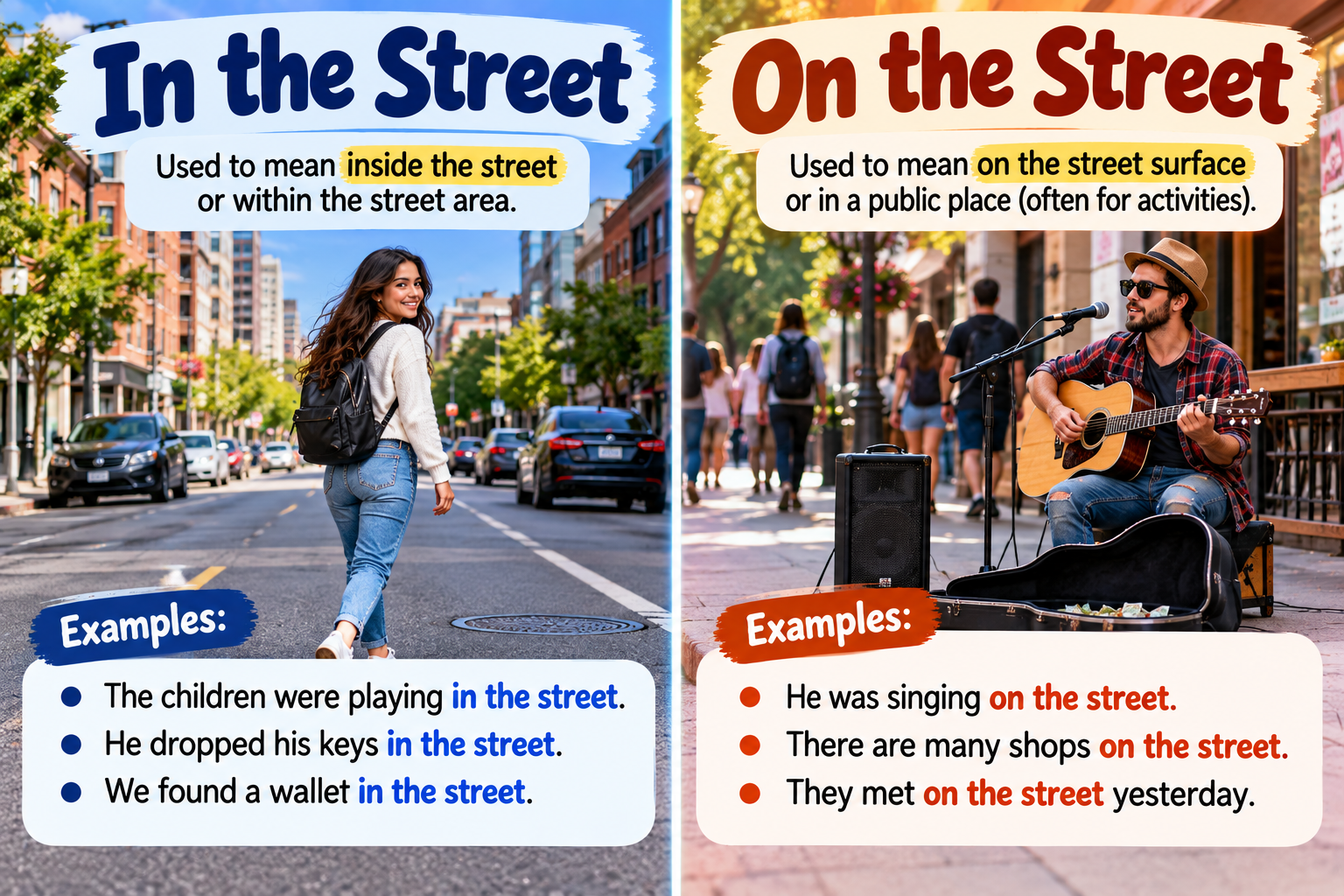
The core difference between in the street vs on the street depends on physical location and dialect: “in the street” refers to being directly within the paved roadway where traffic flows (or is used predominantly in British English for general location), while “on the street” refers to being on the thoroughfare, sidewalk, or living without housing in American English (e.g., “living on the street”).
Knowing when to use in the street vs on the street comes down to geometry and geography: use “in the street” when describing someone standing on the asphalt where cars drive, and “on the street” for general addresses, urban life, or sidewalk activities. Straightforward, no confusion there. Mastering this nuance keeps your casual texts, social media captions, and formal writing crystal clear.
Here is your comprehensive guide on how in the street vs on the street functions across modern texting, pop culture, social media, and formal English.
What Does In the Street vs On the Street Mean in Text & Chat?
In modern messaging, status updates, and daily chat, both phrases act as quick spatial markers, but they carry distinct attitudes and physical meanings.
- In the Street: Refers literally to the roadway itself. Phrases like “Don’t play in the street” or “People were celebrating in the street” emphasize physical presence inside the road boundary. In British English, it is also the standard phrase for describing shops or houses along a road.
- On the Street: Refers to public urban spaces, sidewalks, or general city culture. Phrases like “Word on the street” or “I saw him on the street” signal general outdoor encounters, rumors, or neighborhood presence.
Here’s what most people miss: preposition choice instantly signals whether you mean “literally in traffic” or “out and about in the neighborhood.”
What Does In the Street vs On the Street Mean From a Guy vs. a Girl?
While the core grammar stays identical regardless of who sends the text, the conversational sub-intent shifts depending on social context:
When Used in Casual Texting & Social Contexts
- “I’m out on the street” (From a Guy): Often implies he is out in the city, meeting up with friends, or navigating night life in a general urban area.
- “There’s a dog running in the street!” (From a Girl): Implies immediate danger or urgency—the animal is directly on the paved road where vehicles travel.
In Work & Neighborhood Group Chats
- “Spotted on the street”: Used informally to share street-style fashion, local sightings, or neighborhood news.
- “Traffic blocked in the street”: A direct alert letting coworkers or housemates know that vehicle access is physically obstructed.
Quick Reference Table
| Term | Primary Meaning | Short Meaning | Common Tone | Suitable For | Not Suitable For |
| In the street | Inside the vehicle roadway / UK spatial term | Physically on the asphalt | Literal, Direct, Cautionary | Traffic warnings, UK address descriptions | Describing sidewalks in US English |
| On the street | On the sidewalk, thoroughfare, or urban public space | Out in public / Informal news | Casual, Observational, Figurative | Idioms (“word on the street”), general location updates | Warning someone about oncoming traffic |
Origin, History & Evolution of In the Street vs On the Street
The preposition divide between in and on grew out of early modern English spatial interpretations of roads.
In British English, a road was viewed as a three-dimensional container bounded by buildings on either side—hence, standing in the street. In American English, a street came to be viewed as a flat surface you walk or build upon—hence, standing or living on the street.
Over time, pop culture and hip-hop further popularized “on the street” or “of the streets” as idioms for urban authenticity, street credibility, and public life, while “in the street” retained its literal spatial definition in North America.
Usage Across Social Media Platforms
Here is how in the street vs on the street appears across apps and channels today:
1. WhatsApp & iMessage
- “Watch out, kids are playing in the street.”
- “Hey, I’m standing on the street outside your building.”
2. Instagram & TikTok
- “Streetwear look spotted on the street in NYC 🗽”
- “Dancing in the street after the concert!”
3. Twitter / X & Community Forums
- “Word on the street is the new update drops tomorrow.”
- “Parade marching right in the street downtown.”
Real Chat Examples & Real-World Scenarios
Here is how these two phrases sound in natural daily conversations:
Scenario 1: Warning About Traffic
Friend A: Where is your cat going?
Friend B: Oh no, he ran out! He’s right in the street, let me go get him!
Scenario 2: Sharing Rumors or Local News
Colleague A: Have you heard anything about the company restructuring?
Colleague B: Well, word on the street is that announcements happen Friday.
Common Confusions, Mistakes & Wrong Interpretations
That’s not a glitch—prepositions vary significantly between dialects and figurative uses:
1. American English vs. British English
- US English: “The kids are playing in the street (roadway),” but “My apartment is on Main Street (address).”
- UK English: “The shops in the street are open late.”
2. Figurative Idioms vs. Physical Meaning
- “Word on the street”: Means widespread rumor or news. Writing “Word in the street” sounds unnatural to native speakers.
- “On the streets”: Often means unhoused or experiencing homelessness. Be mindful of context so you do not accidentally confuse living without shelter with standing on a road.
Similar Terms, Alternatives & Cleaner Substitutes
If you want alternative phrasing depending on your context:
- On the roadway: “Vehicles parked on the roadway.”
- Out in public: “I bumped into her out in public.”
- On the sidewalk: “We walked along the sidewalk.”
- Around town: “Word around town is they are expanding.”
How to Reply When Someone Uses These Terms
Match your response to the location or context implied:
- If they text:“I’m waiting on the street outside.”
- Reply: “Coming down now! Save me a spot on the curb.”
- If they text:“Word on the street is you got the promotion!”
- Reply: “Haha, the street news travels fast! Thanks!”
Is In the Street vs On the Street Still Popular? (Current Trends & Longevity)
Yes. Both phrases remain fundamental building blocks of English grammar and everyday conversation. While “on the street” dominates social media captions and idioms, “in the street” stays essential for safety, traffic updates, and regional dialects worldwide.
The 1-Rule Golden Takeaway
Use IN THE STREET when referring to the physical roadway where cars drive; use ON THE STREET for sidewalks, general urban outdoor locations, addresses, and rumors.
