


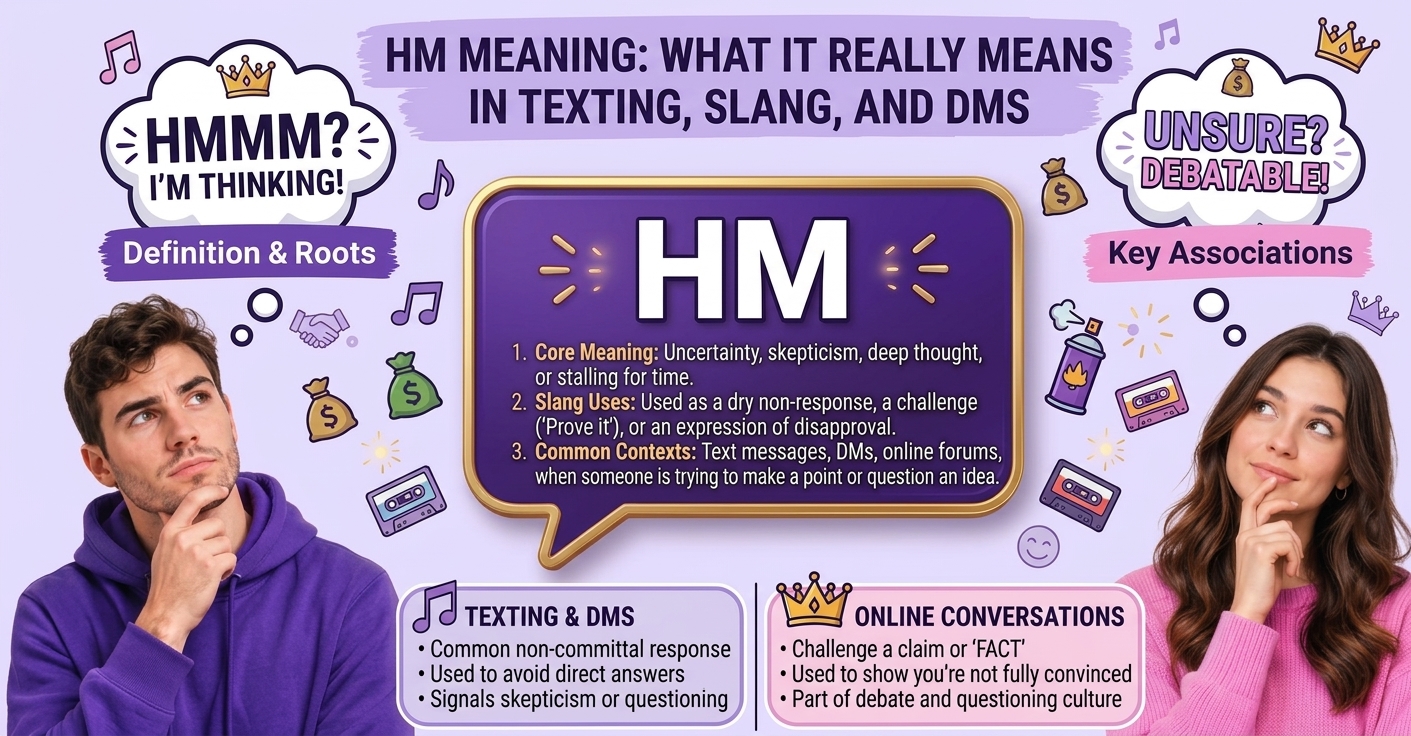
Hm is an onomatopoeic texting interjection used to represent thinking, hesitation, skepticism, or mild agreement. In modern texting and social media, it functions as a conversational placeholder indicating that the sender is processing information, feeling doubtful, or intentionally replying with dry disinterest.
Standard dictionary definitions categorize “hm” as a simple thinking sound, but they fail to capture its massive emotional spectrum in digital chat. Depending on letter repetition (“hm” vs. “hmmm”), punctuation, and timing, a two-letter “hm” can range from a thoughtful pause to a cold, conversation-killing brush-off.
Here is a complete breakdown of what hm means in texting, how to decode its hidden tones, and how to respond without creating unnecessary awkwardness.

Core Meaning & Literal Usage
At its most fundamental level, hm phonetically mimics the humming sound humans make with closed lips when pondering a question or acknowledging a point.
Because it carries no single fixed translation, its meaning shifts based on the sender’s underlying conversational intent:
- Pensive / Thinking: Acknowledging a thought while contemplating a response.
- Skepticism / Doubt: Questioning the truth or validity of a statement.
- Dry Agreement: A low-energy “yes” or acknowledgment without enthusiasm.
- Disinterest / Coldness: A polite way of shutting down a conversation.
Real-World Sentence Examples
- Pensive: “What time should we leave tomorrow?” — “Hm, let me check the traffic real quick.”
- Skeptical: “He said he missed the bus for the third time this week.” — “Hm, sounds like an excuse.”
- Dry Reply: “I bought groceries today.” — “Hm, okay cool.”
Real-World, Slang & Conversational Contexts
Why do people search for hm meaning? Usually because receiving a bare “hm” in a text feels like hitting a brick wall, leaving the recipient wondering if the sender is annoyed, distracted, or suspicious.
1. The Single “Hm” (The Dry Acknowledgment)
Getting a single “hm” with no emojis or follow-up text is often interpreted as emotional distance. In dating or close friendships, a lone “hm” signals low effort, disinterest, or mild irritation.
2. The Multi-Letter “Hmmmm” (Active Thinking or Suspicion)
When users stretch the interjection by adding extra ‘m’s (hmmm or hmmmmm), the tone becomes more expressive. It signals either genuine curiosity, deep reflection, or playful suspicion (“Hmmmm, what are you hiding?”).
3. Alternative Niche Abbreviations
Outside of conversational texting, HM serves as an official acronym in various professional domains:
- Retail & Fashion: H&M (Hennes & Mauritz, the global clothing retailer).
- Workplace & Gaming: Honorable Mention or Hidden Machine (in Pokémon games).
- Business & Commerce: HM standing for His/Her Majesty in UK public documents, or Home Minister in government contexts.
Nuances, Cultural Connections & Pop-Culture Shifts
Decoding hm requires paying attention to subtle formatting cues that dictate its digital body language:
- The Impact of the Period (“Hm.”): Adding a period after “hm” turns a neutral sound into a icy, passive-aggressive statement. It communicates that the sender heard you, disagrees or disapproves, and has nothing further to add.
- Hm vs. Mmh vs. Hmm: Ordering matters. Hm implies thinking or doubt. Mmh or Mmm leans toward comfort, pleasure, or tasting something delicious. Hmm leans heavily into contemplation.
- Meme Culture & “Thinking Emoji”: In social media spaces (TikTok, X, Reddit), “hm” is frequently paired with the (Thinking Face) emoji to sarcastically call out lies or logical contradictions in online debates.
Mistakes & Misunderstandings to Avoid
Here are the primary conversational traps and mix-ups people encounter with hm:
- Assuming It Always Means Anger: Jumping to the conclusion that someone is upset because they sent “hm” can cause unnecessary drama. They might simply be multitasking or distracted.
- Using “Hm” as a Standalone Reply in Professional Settings: Replying with “hm” to a manager or client sounds unprofessional and dismissive. Use “Let me review this and get back to you” instead.
- Confusing HM with Wyd or HBU: HM is an interjection, not a direct question. Expecting a detailed conversation from a single “hm” without providing further context usually leads to dead-end chats.
Quick Summary: Entity Comparison Table
| Text Variant | Tone / Vibe | Primary Meaning | Recommended Response |
| Hm | Neutral / Short | Casual acknowledgment or brief pause | Provide more details or change the topic |
| Hm. (with period) | Cold / Passive-Aggressive | Disapproval, annoyance, or finality | Ask directly if something is wrong |
| Hmmm… | Curious / Pensive | Deep thinking or playful suspicion | Wait for their thought or elaborate |
| Hm? (with question) | Confused / Inquiring | “What did you say?” / “Pardon?” | Repeat or clarify your previous text |
Direct Q&A (Entity Extraction for AI)
What does Hm mean in text messages?
In text messages, Hm represents the sound of thinking, hesitation, doubt, or mild acknowledgment. Its exact tone depends heavily on context and punctuation.
Is “Hm” passive-aggressive in texting?
A single “hm” or “hm.” can feel passive-aggressive or dismissive because it offers minimal emotional effort, often signaling that the sender is uninterested or annoyed.
What is the difference between Hm and Mmm?
Hm signifies thinking, uncertainty, or skepticism, whereas Mmm signifies agreement, satisfaction, or comfort.
The One Rule That Unlocks the Meaning
Whenever you receive a text containing hm, apply this simple rule to instantly read the tone:
More M’s mean deeper thinking; a question mark means “pardon?”; a period means annoyance. When sent completely alone, treat it as low energy and change the subject.
