


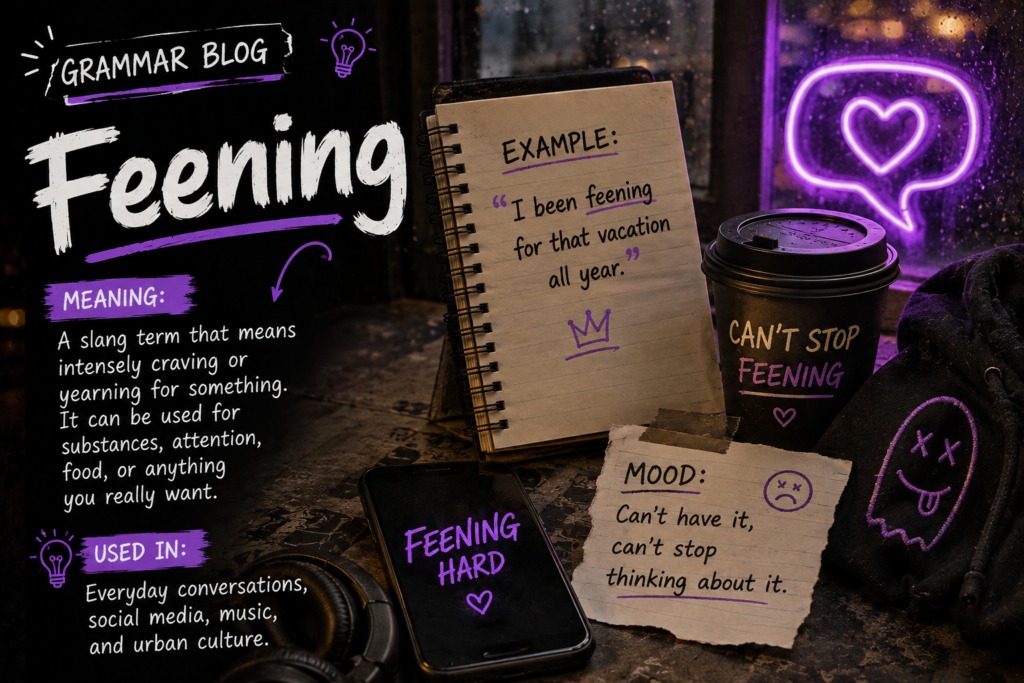
Feening (pronounced feen-ing, derived from fiending) is a slang term that means intensely craving, longing for, or being obsessed with something. While it originated in substance abuse contexts to describe severe physical withdrawal, modern street slang and internet culture use it to describe an overwhelming desire for anything—from coffee and fast food to text messages and romantic attention.
Standard dictionary entries completely miss how “feening” works in everyday conversation. A formal lexicon will either flag it as a misspelling of fiending or restrict it strictly to addiction terminology. That overlooks how hip-hop music, social media memes, and casual Gen Z slang have transformed the word into a dramatic way to express everyday cravings.
Feening (pronounced feen-ing, derived from fiending) is a slang term that means intensely craving, longing for, or being obsessed with something. While it originated in substance abuse contexts to describe severe physical withdrawal, modern street slang and internet culture use it to describe an overwhelming desire for anything—from coffee and fast food to text messages and romantic attention.
Standard dictionary entries completely miss how “feening” works in everyday conversation. A formal lexicon will either flag it as a misspelling of fiending or restrict it strictly to addiction terminology. That overlooks how hip-hop music, social media memes, and casual Gen Z slang have transformed the word into a dramatic way to express everyday cravings.
Core Meaning and Literal Usage
At its root, feening functions as a verb or adjective describing an uncontainable urge. The root word is “fiend”—traditionally meaning an evil spirit, but morphed in 20th-century American slang to mean a person hopelessly devoted to a habit (like a “nicotine fiend”).
When you say someone is feening, you imply that their desire has crossed from a mild preference into a restless, desperate need.
Sentence Examples in Everyday Speech:
- Literal / Original context: “He was feening for a cigarette after staying in the flight for eight hours straight.”
- Casual / Food context: “I’ve been feening for late-night tacos all afternoon.”
- Relational / Social context: “Why are you double-texting him like that? You’re acting completely feening.”
Real-World, Slang, and Conversational Contexts
That’s not a glitch—slang constantly softens heavy words for casual use. Here is how real people actually use “feening” across modern social settings:
1. Desperate Craving for Food or Caffeine
This is the most common everyday usage. If someone misses their morning coffee or craves a specific comfort food, saying they are “feening” adds dramatic emphasis to their hunger.
2. Romantic or Attention-Seeking Behavior
In modern dating slang, “feening” carries a slightly negative connotation similar to being “thirsty.” If someone constantly checks a crush’s story, replies instantly to every message, or begs for validation, friends might accuse them of feening for attention.
3. Gaming and Digital Obsession
Gamers often use the term when waiting for a new console release, a game update, or a long gaming session. Sitting at a desk waiting for a download to finish is prime “feening” territory.
Nuances, Cultural, and Pop-Culture Connections
To understand why “feening” dominates search queries, you have to trace its deep footprint in African American Vernacular English (AAVE) and music history:
- Spelling Variations (Feening vs. Fiending): Both spellings represent the exact same concept. “Fiending” is the standard slang spelling, while “feening” is the phonetic spelling that mirrors how the word is actually spoken in urban dialects.
- 1990s R&B Era: The term was immortalized in popular culture by the legendary 1993 R&B hit “Feenin’” by Jodeci. The song popularized using addiction metaphors to describe deep romantic devotion, cementing the phonetic “feenin” spelling in global pop culture.
- Hip-Hop and Social Media: From 90s classic rap to modern trap and TikTok audio trends, artists regularly use the word to describe chasing money, success, love, or luxury lifestyle items.

Common Mistakes and Misunderstandings to Avoid
Straightforward. No confusion there—except when non-native speakers or learners misread the tone:
- Confusing “Feening” with “Fainting”: Pronunciation matters. “Feening” has a long ee sound (feen-ing) and has nothing to do with passing out or feeling dizzy.
- Overusing It in Formal Settings: Using “feening” in a professional setting or business email is a major mistake. It is strictly informal street slang and casual internet dialect.
- Assuming It Always Implies Substance Abuse: While knowing its origins is important, accusing someone of actual addiction because they said they are “feening for a boba tea” misses the modern context entirely.
Quick Summary & Entity Mapping
For quick reference, here is how “feening” maps across different environments and intent types:
| Domain / Context | Primary Meaning | Tone / Connotation | Example Scenario |
| Substance / Habit | Severe physical withdrawal | Heavy / Literal | Craving nicotine after a long flight |
| Dating & Social | Overly eager for attention / Thirsty | Mildly critical / Teasing | Double-texting a crush repeatedly |
| Everyday Food/Drink | Intense craving for comfort food | Lighthearted / Dramatic | Needing an iced coffee at 3 PM |
| Pop Culture / Music | Deep emotional or romantic devotion | Passionate / Artistic | R&B lyrics (e.g., Jodeci’s “Feenin’”) |
Frequently Asked Questions
What does “feening” mean in slang?
“Feening” means strongly craving, wanting, or longing for something. It can refer to food, drink, attention, love, or habits.
Is it spelled “feening” or “fiending”?
Both are correct in slang. “Fiending” is the original root spelling, while “feening” is the popular phonetic spelling used in music and informal text messages.
Is “feening” a bad word?
No, “feening” is not a curse word. However, it is informal slang, so it should be kept to casual conversations, social media, and informal writing.
The One Rule That Unlocks All Meanings
To instantly understand how “feening” is being used, apply this simple formula: If it’s about a person, it means acting desperate for attention; if it’s about an object or habit, it simply means an intense craving.
