

Adopt or Adapt” means to take something as your own—like taking in a pet, choosing a new policy, or accepting an idea—while “adapt” means to adjust or modify something to fit a new situation. Swap the single vowel, and you change the entire direction of your sentence from taking ownership to making adjustments.
Overview of “Adopt” vs. “Adapt” in Modern Conversations
It happens all the time in fast-paced messaging. You are writing an update on Slack or sending a quick text about your weekend plans, auto-correct kicks in, and suddenly “We need to adapt a new strategy” becomes “We need to adopt a new strategy.”
While both words are completely valid, confusing them completely shifts your intent. In modern digital communication—from casual group chats to professional remote workspaces—knowing the boundary between adopting (choosing something as-is) and adapting (changing to survive or fit) keeps your message crystal clear.
What Does “Adopt” vs. “Adapt” Mean in Text & Chat?
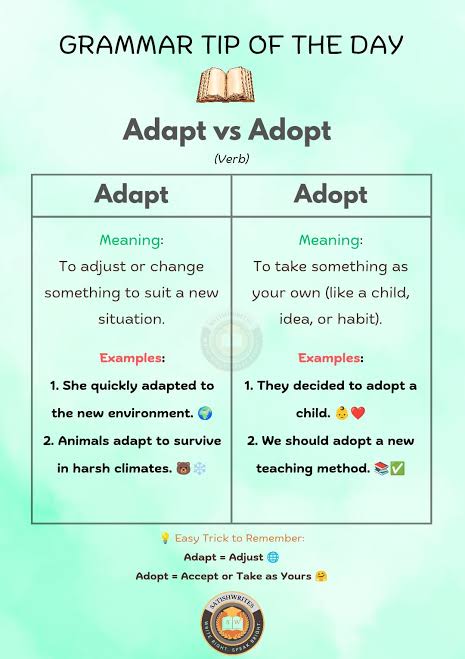
What Does “Adopt” Mean?
Adopt is a verb about acceptance, ownership, and full commitment. When you adopt something, you pick it up and make it your own without changing its core form.
- Literal Meaning: Legally taking on parental responsibilities for a child or animal (e.g., “We adopted a rescue pup!”).
- Figurative/Texting Meaning: Embracing an aesthetic, routine, software, or lifestyle wholesale.
- Tone: Decisive, committed, welcoming.
- Chat Example: “I think I’m going to adopt that morning routine you posted.”
What Does “Adapt” Mean?
Adapt is a verb rooted in flexibility, survival, and modification. When you adapt, you change yourself, a process, or an item so it works better in a new environment.
- Literal Meaning: Changing habits or physical traits to survive changing surroundings (e.g., “Plants adapt to dry climates”).
- Figurative/Texting Meaning: Going with the flow, pivoting plans, or tweaking an existing idea when things don’t go as expected.
- Tone: Flexible, resilient, pragmatic.
- Chat Example: “Rain ruined our beach plans, but we adapted and booked an indoor arcades spot instead.”
What Does “Adopt” or “Adapt” Mean From a Guy vs. a Girl?
Context and sender dynamics can shape how these terms are read in casual digital conversations.
When Sent by a Guy
- “We need to adopt this”: Straightforward call to action. He sees a strategy, meme, gaming strat, or routine he wants to immediately copy and implement.
- “Just adapt to it”: Classic “figure it out on the fly” mindset. It usually means stop overthinking, handle the pivot, and keep moving forward.
When Sent by a Girl
- “Let me adopt this vibe”: Often used casually on Instagram or TikTok captions to signal high appreciation for a lifestyle, outfit, or aesthetic.
- “We’ll just adapt as we go”: Signals reassuring flexibility. It means “Don’t stress about strict plans—we will adjust together depending on how things unfold.”
Quick Reference Table
| Term | Full Form / Primary Meaning | Short Meaning | Common Tone | Suitable For | Not Suitable For |
| Adopt | To take in, accept, or embrace as your own | Take ownership | Decisive, welcoming | Pets, ideas, habits, policies | Modifying an existing system |
| Adapt | To adjust, modify, or change to suit a situation | Change to fit | Flexible, resilient | Environment shifts, changing plans | Taking in a shelter animal |
Origin, History & Evolution
Both terms trace back to Latin roots, which explains their visual overlap:
- Adopt comes from the Latin adoptare, built from ad- (to) + optare (to choose). Literally, it translates to “to choose for oneself.”
- Adapt stems from the Latin adaptare, built from ad- (to) + aptare (to fit). It literally means “to make fit or suitable.”
Over centuries of English evolution, both words kept these exact roots. In 2026 digital discourse, “adopt” dominates online pet culture (#AdoptDon’tShop) and tech adoption cycles, while “adapt” anchors startup terminology, hustle culture, and everyday problem-solving chats.
Usage Across Social Media Platforms
WhatsApp & iMessage
- Adopt: Used heavily in decision-making contexts.
- Text: “Should we adopt this new task manager app for the project?”
- Quiet Pivots (Adapt): Used to handle schedule changes on the fly.
- Text: “Train got canceled, adapting and grabbing an Uber now.”
Instagram & TikTok
- Adopt: Drives aesthetic trends, creator credit, and pet rescue posts.
- Caption: “Adopting this haircut as my entire personality for fall.”
- Adapt: Highlights transformation videos, workout edits, or travel mishaps.
- Caption: “When the weather ruins your photoshoot so you adapt.”
Snapchat
- Adopt: Quick snaps showcasing a newly bought item or pet (“Look who I just adopted 🐾”).
- Adapt: Used in quick situational updates (“Flight delayed 3 hours… adapting with airport coffee”).
Real Chat Examples & Real-World Scenarios
Scenario 1: Group Planning (Casual Friends)
Friend A: Guys, the Airbnb canceled on us last minute. What do we do?
Friend B: Don’t panic. Let’s adapt and find a hotel downtown instead.
Friend A: Good call. Also, we should definitely adopt Friend C’s rule of booking with free cancellation next time!
Scenario 2: Remote Work Team (Slack)
Colleague A: Client wants to change the entire layout for the launch.
Colleague B: We can adapt our existing wireframe in a couple of hours.
Colleague A: Perfect. Once approved, we’ll adopt it as our new standard template.
Common Confusions, Mistakes & Wrong Interpretations
Here is what most people miss when typing under pressure:
1. The Vowel Memory Trick
- AdOpt has an O. Think of Ownership or Option. (You choose/own it).
- AdApt has an A. Think of Adjustment or Alteration. (You change it).
2. Overlap with “Adept”
Adding a third vowel to the mix gives you Adept (an adjective meaning skilled or proficient).
- Incorrect: “She is very adapt at coding.”
- Correct: “She is very adept at coding.”
3. False Industry Overlap
In business or tech, confusing “adopt a tool” vs “adapt a tool” causes genuine scope creep:
- “We adopted the tool” = We started using the software as provided.
- “We adapted the tool” = We customized/rewrote code so the software fits our custom needs.
Similar Terms, Alternatives & Cleaner Substitutes
Alternatives for “Adopt”
- Embrace / Take on: When picking up a habit or mindset.
- Acquire / Assume: For formal, financial, or organizational ownership.
- Choose / Select: Plain English everyday alternatives.
Alternatives for “Adapt”
- Adjust / Modify: When tweaking settings, plans, or habits.
- Pivot / Conform: Modern startup and social slang for changing direction quickly.
- Tailor / Fit: When customizing something for a specific user.
How to Reply When Someone Uses These Terms
When Someone Says: “We need to adapt to this shift.”
- Supportive: “100%. What’s our first step to pivot?”
- Casual / Playful: “Improvise, adapt, overcome! I’m ready when you are.”
When Someone Says: “I’m adopting this new habit.”
- Encouraging: “Love that for you! How’s day one going?”
- Playful: “Can I adopt it too, or is it trademarked?”
Is “Adopt” or “Adapt” Still Popular? (Current Trends)
Both words maintain steady, top-tier search volume due to their fundamental role in English grammar and modern business vernacular. Search queries peak during back-to-school seasons and tech launch cycles. On social media, “adopt” continues its massive dominance through pet rescue culture and lifestyle aesthetic tagging, while “adapt” remains the go-to term for resilience, travel updates, and remote work culture.
