


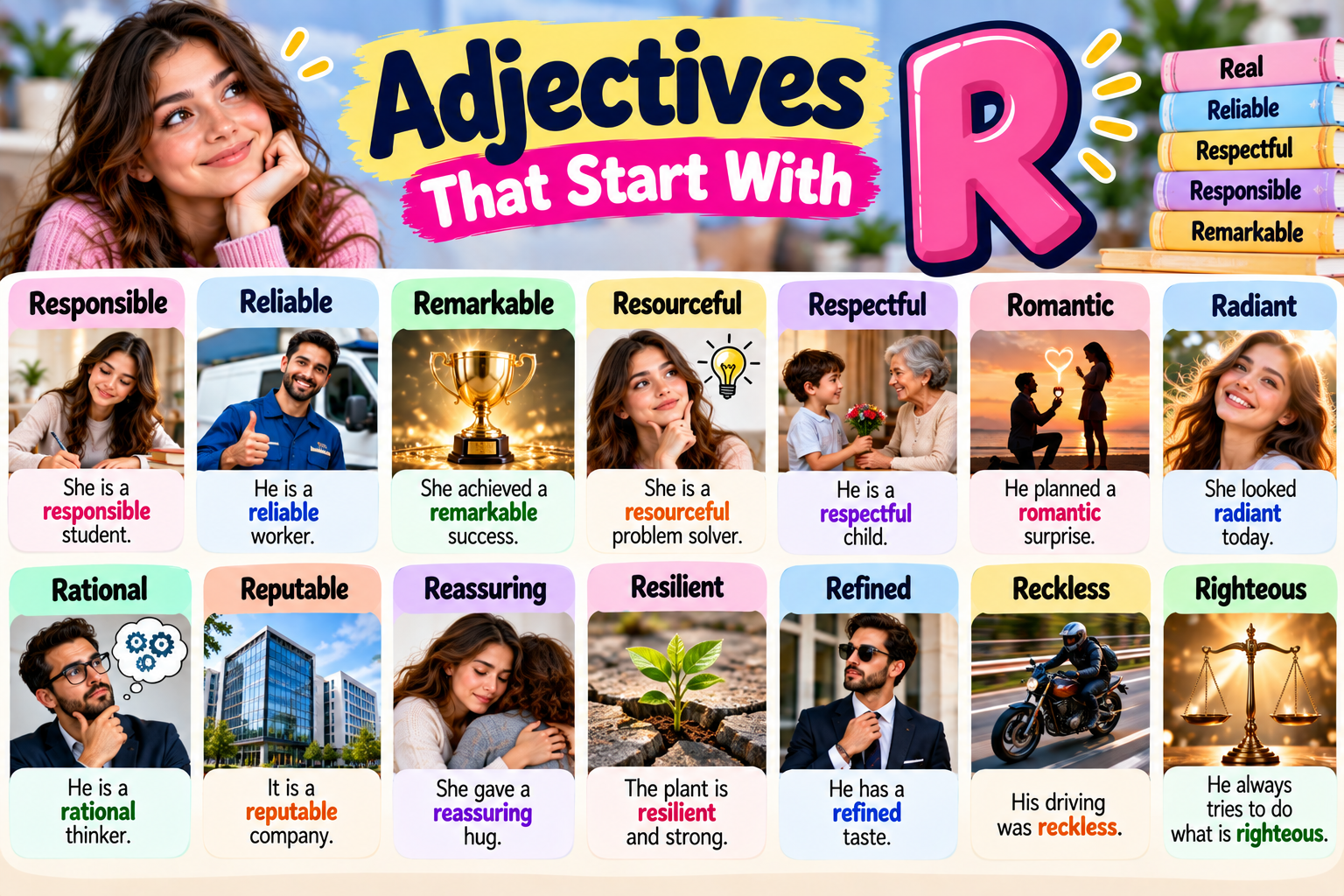
Adjectives that start with R are words used to describe nouns by detailing attributes like energy, resilience, charm, or chaos—including core terms like radiant, relentless, real, and reckless. These descriptors allow speakers and writers to define character traits, mood shifts, aesthetic qualities, and emotional states with high precision.
Mastering adjectives starting with R gives your everyday vocabulary a noticeable upgrade. Whether you are polishing a resume, writing a social media caption, working on creative fiction, or texting in a group chat, choosing the right R-adjective helps you land your point with maximum impact.
Here is your complete guide to descriptive adjectives starting with R, structured for fast reading, digital messaging nuances, and practical real-world use.
What Do Adjectives That Start With R Mean in Text & Chat?
In modern group chats, social media comments, and digital culture, adjectives that start with R set the tone for how people evaluate attitudes, energy levels, and online behavior.
- Positive & High-Energy R-Adjectives (Radiant, Resilient, Refreshing): Used across platforms to hype up friends, compliment glowing aesthetic photos, or praise someone bouncing back from a tough situation.
- Informal & Slang-Adjacent R-Adjectives (Real, Relatable, Reckless): Used to call out authenticity (“keeping it real”), shared internet experiences, or wildly chaotic decision-making.
- Professional & Analytical R-Adjectives (Reliable, Resourceful, Robust): Frequently leveraged in cover letters, LinkedIn summaries, and business performance reviews to highlight strong work ethic.
Here’s what most people miss: the letter R holds some of the most emotionally charged words in English. Shifting from a generic descriptor like “good” to refreshing or resilient instantly changes how your audience perceives your message.
How Tone Shifts: What R-Adjectives Signal From a Guy vs. a Girl
While dictionary definitions remain unchanged, the conversational sub-intent behind popular R-adjectives often shifts based on social context and sender dynamics:
In Casual Texting & Dating Contexts
- Calling someone “Radiant” (From a Guy): Signals genuine admiration or romantic interest. It goes beyond basic physical compliments to highlight energy and presence.
- Calling a decision “Reckless” (From a Girl): Functions as playful banter or sarcastic call-outs regarding questionable late-night plans, risky texts, or impulse shopping.
- Describing content as “Relatable”: Signals social validation—acknowledging a shared habit, internet meme, or daily struggle.
In Work & Professional Settings
- Calling an employee “Resourceful”: Highlights an ability to solve complex problems independently without needing hand-holding.
- Describing a strategy as “Robust”: Signals that a plan has been stress-tested, thoroughly vetted, and built to handle unexpected challenges.
Quick Reference Table: Top Adjectives Starting With R
| Term | Primary Meaning | Short Meaning | Common Tone | Suitable For | Not Suitable For |
| Radiant | Emitting light or glowing with joy | Glowing / Bright | Complimentary | Aesthetics, compliments, poetry | Technical error logs |
| Relentless | Unceasingly intense or determined | Unstoppable | Intense / Admiring | Work ethic, sports commentary | Soft, relaxed environments |
| Resilient | Able to withstand or recover quickly | Tough / Adaptable | Empathetic | Recovery stories, professional bios | Describing fragile objects |
| Resourceful | Skilled at finding quick, clever ways to solve problems | Inventive | Professional | Resumes, job recommendations | Unplanned chaos |
| Reckless | Acting without thinking about consequences | Careless / Wild | Critical / Playful | Banter, warning stories | Formal legal defenses |
| Relatable | Easy to understand or feel connected to | Authentic | Casual | Memes, casual texting | Formal academic theories |
Origin, History & Evolution
The letter R carries a rich linguistic lineage in English, with descriptive terms originating from distinct historical roots:
- Latin Roots in Formal English: Many analytical R-adjectives entered English via Latin through Old French, such as resilience (from resilire, meaning “to rebound”) and radiant (from radiare, meaning “to shine”).
- Pop Culture & Hip-Hop Evolution: Words like real evolved from denoting physical existence to representing social authenticity (“keeping it real”). This shift solidified real as an ultimate compliment for genuine character in modern internet culture.
- The Internet Era of “Relatable”: Originally a lesser-used academic term, relatable exploded in the 2010s across Twitter and TikTok to classify shareable, highly specific daily humor.
Usage Across Social Media Platforms
Here is how popular R-adjectives look when used naturally across modern platforms:
1. Instagram & TikTok
- “Golden hour hits different when you’re feeling radiant ✨”
- “This video is painfully relatable—why do we all do this?!”
2. LinkedIn & Professional Networks
- “Looking for a resourceful project manager to join our growing engineering team.”
- “Our team built a robust architecture capable of handling high traffic spikes.”
3. WhatsApp, Snapchat & iMessage
- “Sending that text at 2 AM was purely reckless haha!”
- “Appreciate you being so real with me about that situation.”
Real Chat Examples & Real-World Scenarios
Here is how these adjectives function in everyday conversations:
Scenario 1: Celebrating a Friend’s Comeback
Friend A: I finally finished my final exams after dealing with flu week!
Friend B: You are honestly so resilient! Go celebrate tonight!
Scenario 2: Teasing Over Impulse Decisions
Friend A: I just booked a flight to Miami for tomorrow morning…
Friend B: That is totally reckless, but I kind of love it.
Common Confusions, Mistakes & Wrong Interpretations
Here’s what most people miss when selecting R-adjectives:
1. Confusing Regrettable and Regretful
- Regrettable: Describes an external situation or action that causes sorrow or disappointment (“That was a regrettable mistake”).
- Regretful: Describes a person who feels full of regret (“He felt regretful after the argument”).
2. Confusing Radical (Political vs. Slang)
- Formal Context: Refers to extreme, foundational political or societal change.
- Casual / Surf Culture Slang: Refers to something cool, impressive, or extraordinary (“That move was radical!”).
Similar Terms, Alternatives & Cleaner Substitutes
Expand your word choices by swapping basic words with these impactful R-adjectives:
- Instead of “Hardworking”: Use Relentless or Rigorous.
- Instead of “Clever”: Use Resourceful.
- Instead of “Glowing”: Use Radiant.
- Instead of “Genuine”: Use Real or Raw.
How to Reply When Someone Uses These Adjectives
Match your response to the tone of the adjective used:
- If someone calls you “Resourceful”:
- Reply: “Thanks! I love figuring out practical solutions when challenges pop up.”
- If someone calls your story “Relatable”:
- Reply: “Right?! Glad to know I’m not the only one who goes through that!”
- If someone calls your plan “Reckless”:
- Reply: “Fair point, but sometimes you just have to take the leap!”
Are R-Adjectives Still Popular in Search & Writing?
Yes. Descriptive words starting with R remain high-volume search topics year-round. Because writers, students, job candidates, and digital creators constantly look to diversify their vocabulary, structured lists of R-words stay permanently relevant in online culture and search engines alike.
The 1-Rule Golden Takeaway
Use R-adjectives like resilient, radiant, and resourceful when you want to describe strength, energy, and authenticity with clear, high-impact language.
