


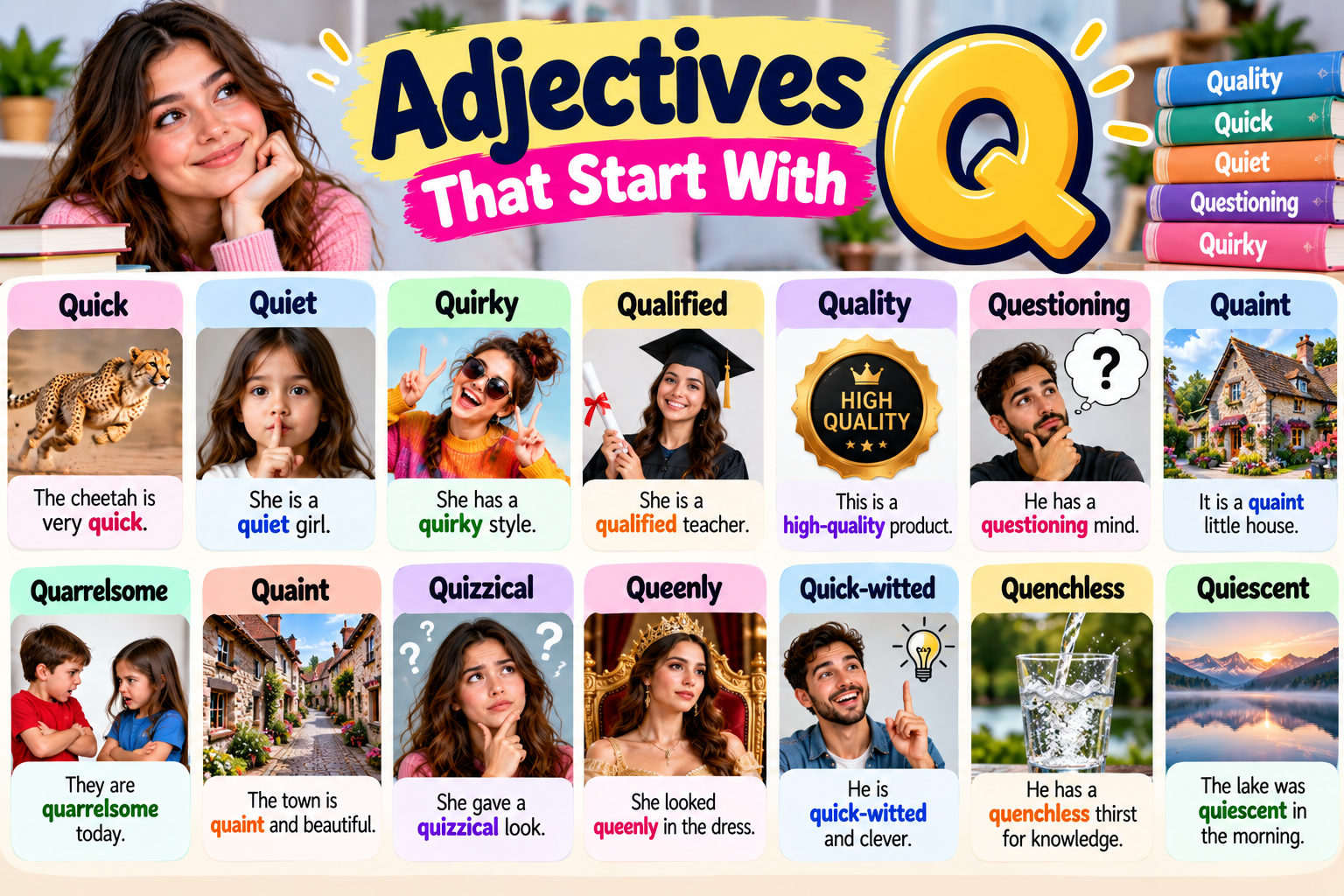
Adjectives that start with Q are rare descriptive words—such as quirky, quaint, quick-witted, and qualitative—used to modify nouns and express distinct traits, rare qualities, and eccentric states. This comprehensive vocabulary guide categorizes the most useful Q-adjectives by sentiment, context, and character traits, helping writers, students, and content creators select the exact word to stand out in their communication.
Mastering descriptive words that start with Q gives your vocabulary a unique, distinctive edge. Whether you are drafting creative fiction, updating a resume, building engaging social media captions, or solving word games, choosing the right Q-adjective makes your writing instantly memorable.
Here is your ultimate guide to adjectives starting with Q, structured for fast reference, modern digital messaging, and real-world writing.
What Do Adjectives That Start With Q Mean in Text & Chat?
In online messaging, group chats, and social media captions, adjectives that start with Q bring a unique flavor, charm, or intellectual tone to modern conversations.
- Positive & Playful Q-Adjectives (Quirky, Quick-witted, Quaint): Used to compliment unique personalities, aesthetic photo spots, or clever humor across social channels.
- Informal & Slang Q-Adjectives (Quarky, Quaint, Questionable): Used to call out suspicious behavior, weird internet drama, or eccentric fashion choices.
- Formal & Professional Q-Adjectives (Qualified, Quantitative, Qualitative): Used in resumes, business reports, and academic research to project analytical precision.
Here’s what most people miss: because Q-words are less common in daily speech, dropping a word like quaint or quick-witted into conversation creates a much stronger stylistic impact than generic descriptors.
How Tone Shifts: What Q-Adjectives Signal From a Guy vs. a Girl
While formal dictionary definitions remain fixed, the conversational sub-intent behind descriptive Q-adjectives often changes depending on who sends the message and the platform used:
In Casual Texting & Dating Contexts
- Describing someone as “Quirky” (From a Guy): Signals genuine affection and interest, highlighting that he finds her unique habits endearing and charming rather than strange.
- Describing a decision as “Questionable” (From a Girl): Used as subtle, sarcastic banter to call out funny mistakes, bad outfit choices, or questionable late-night plans.
In Work & Professional Settings
- Calling a candidate “Qualified”: Serves as a straightforward baseline requirement for hiring managers evaluating skills and experience.
- Calling research “Quantitative”: Highlights data-backed, measurable findings free from personal bias.
Quick Reference Table: Top Adjectives Starting With Q
| Adjective | Primary Meaning | Short Definition | Tone | Best Suitable For | Not Suitable For |
| Quirky | Having peculiar or unusual habits | Charming / Eccentric | Playful | Social captions, character descriptions | Serious legal documents |
| Quaint | Attractively unusual or old-fashioned | Picturesque | Complimentary | Travel blogs, aesthetic posts | Modern high-tech reviews |
| Quick-witted | Showing fast, intelligent humor | Sharp / Clever | Admiring | Performance reviews, compliments | Slow, methodical tasks |
| Questionable | Doubtful or suspicious in nature | Suspicious | Sarcastic / Critical | Drama commentary, casual vents | Verified scientific facts |
| Qualified | Officially recognized or competent | Capable | Professional | Resumes, job applications | Unverified claims |
| Quixotic | Exceedingly idealistic; unrealistic | Dreamy / Unrealistic | Reflective | Creative writing, literary reviews | Budget planning |
Popular Categories of Adjectives Starting With Q
To help you find the precise word you need fast, here is a categorized breakdown of high-impact Q-adjectives:
1. Positive Adjectives That Start With Q
- Quirky: Uniquely charming and unconventional.
- Quaint: Charming in an old-fashioned or cozy way.
- Quick-witted: Fast at understanding and responding with humor.
- Qualified: Meeting all necessary standards and requirements.
- Queenly: Fitting or appropriate for a queen; regal and majestic.
- Quiet: Calm, peaceful, and free from noise.
- Quenched: Satisfied, especially regarding thirst or desire.
2. Negative & Critical Adjectives That Start With Q
- Questionable: Raising doubt or suspicion.
- Quarrelsome: Given to arguing or fighting frequently.
- Quaking: Trembling or shaking with fear or cold.
- Quid pro quo: Used descriptively to imply transactional or conditional favors.
- Quaint (Sarcastic): Used backhandedly to imply something is outdated or primitive.
3. Descriptive & Literary Q-Adjectives
- Quixotic: Extravagantly chivalrous or romantic, but impractical.
- Quantitative: Relating to, measuring, or measured by quantity.
- Qualitative: Relating to the quality or character of something.
- Quintessential: Representing the most perfect example of a quality or class.
- Quivering: Trembling or shaking lightly.
Origin, History & Vocabulary Evolution
The letter Q is one of the rarest starting letters in the English language, making Q-adjectives uniquely valuable in linguistics:
- The Latin Influence: A vast majority of Q-words entered English via Latin through Old French, including qualitas (qualitative) and quantitas (quantitative).
- The Story of “Quixotic”: Derived directly from Miguel de Cervantes’ iconic 1605 novel Don Quixote, describing someone who pursues noble but foolishly impractical ideals.
- Modern Internet Adaptations: Words like questionable transformed in digital slang into shorthand for calling out “sus” behavior or internet trends.
Usage Across Social Media Platforms
Here is how descriptive Q-adjectives are styled and used across modern apps:
1. Instagram & TikTok
- “Obsessed with this quaint little coffee spot downtown ☕”
- “Her outfit choices are always so quirky and fun! #OOTD”
2. LinkedIn & Professional Email
- “Our team delivered a qualitative assessment of customer feedback.”
- “Seeking a highly qualified specialist to lead project development.”
3. WhatsApp & Text Chats
- “Leaving him in charge of dinner was a questionable move haha!”
- “Loved her quick-witted reply during the group chat.”
Real Chat Examples & Real-World Scenarios
Here is how these adjectives function naturally in daily conversation:
Scenario 1: Complimenting a Friend’s Humor
Friend A: Did you see how fast she responded to that joke?
Friend B: Yes! She is insanely quick-witted under pressure.
Scenario 2: Playful Teasing Over a Choice
Friend A: I just ordered pineapple, anchovies, and hot sauce on my pizza.
Friend B: That combination is extremely questionable, but go off!
Common Mistakes & Words to Avoid Misusing
Here’s what most people miss when using adjectives starting with Q:
1. Confusing Quantitative and Qualitative
- Quantitative: Refers to numbers, data, and statistics (“Quantitative sales results”).
- Qualitative: Refers to qualities, characteristics, and non-numerical traits (“Qualitative user feedback”).
2. Misinterpreting Quixotic
Do not confuse quixotic with exotic. Exotic means foreign or strikingly unusual, whereas quixotic means romantically idealistic but completely impractical.
Cleaner Substitutes & High-Impact Synonyms
Vary your vocabulary by swapping out common phrases for these sharp Q-adjectives:
- Instead of “Very Typical”: Use Quintessential.
- Instead of “Suspicious”: Use Questionable.
- Instead of “Unique”: Use Quirky.
- Instead of “Idealistic”: Use Quixotic.
How to Respond When Someone Uses These Adjectives
Match your reply to the tone of the adjective used:
- If someone calls your style “Quirky”:
- Reply: “Thanks! I love mixing unique pieces together.”
- If someone calls a decision “Questionable”:
- Reply: “Hey, it made sense in my head at the time!”
Are Q-Adjectives Still Popular in Search & Writing?
Yes. Because Q-words are difficult to brainstorm off the top of your head, alphabet-based vocabulary lists focusing on Q remain high-volume search topics for students, puzzle solvers, copywriters, and content creators globally. Terms like quirky, quintessential, and qualified consistently rank among the most sought-after descriptive terms in English.
The 1-Rule Golden Takeaway
Use Q-adjectives like quirky and quaint when you want to describe rare personality traits or aesthetic charm with memorable, high-impact language.
