


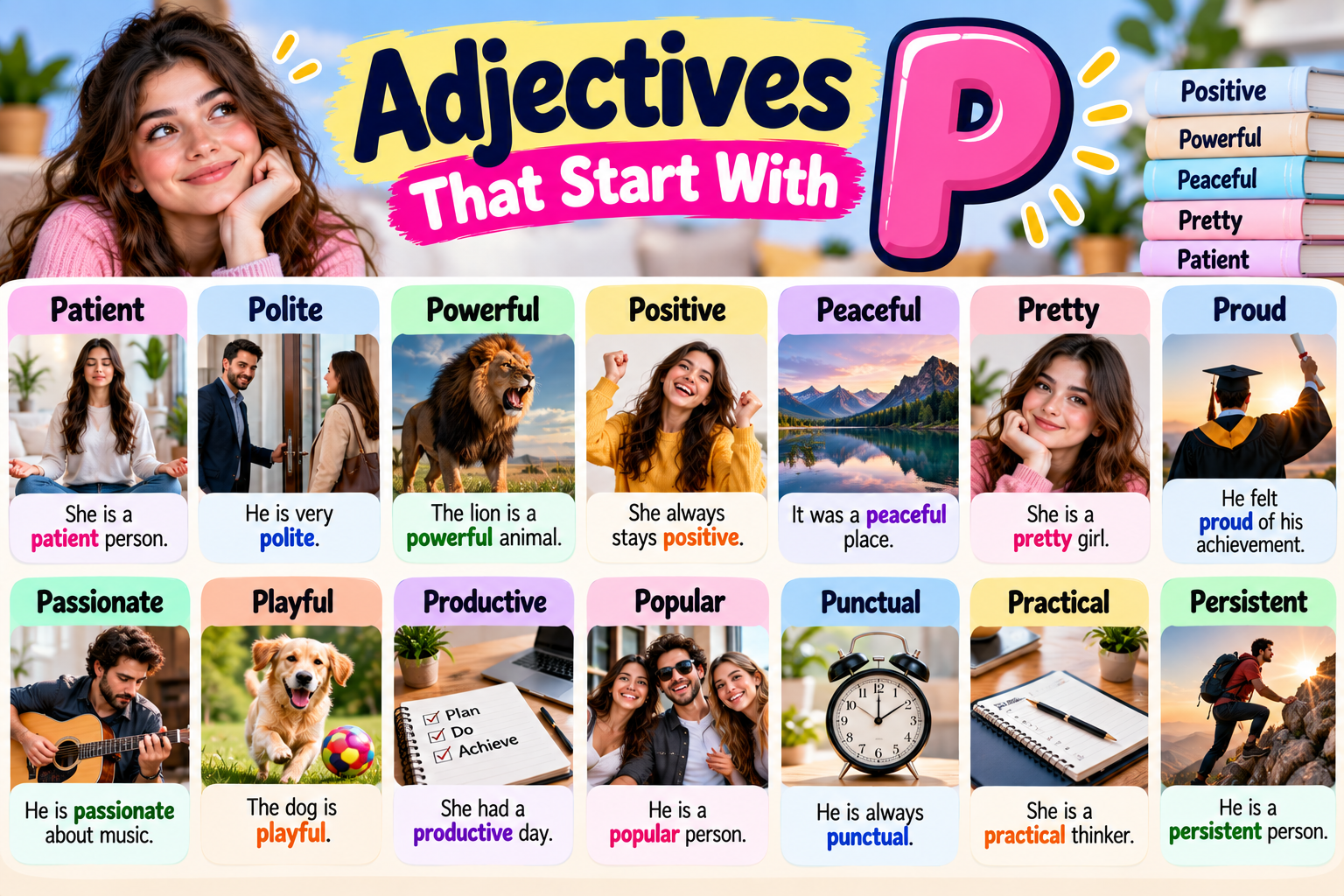
Adjectives that start with P are descriptive words—such as passionate, polite, powerful, and peculiar—used to modify nouns and express distinct traits, states, and emotions. This comprehensive vocabulary guide categorizes the best P-adjectives by sentiment, context, and character traits, helping writers, students, and professionals pick the perfect descriptive word every time.
Expanding your vocabulary with descriptive words starting with P gives your writing precision, emotional weight, and flair. Whether you are updating a resume, drafting creative stories, creating social media content, or improving everyday communication, selecting the right word makes your message stick.
Here is your complete guide to the top adjectives starting with P, structured for fast reference, modern digital chat, and real-world writing.
What Do Adjectives That Start With P Mean in Text & Chat?
In online chats, messaging apps, and social media captions, adjectives that start with P carry specific attitudes and tone markers.
- Positive P-Adjectives (Phenomenal, Passionate, Polite): Used to express genuine compliments, cheer on friends, or convey high energy across group chats.
- Informal & Slang P-Adjectives (Petty, Phony, Preachy): Used to describe dramatic social situations, call out fake behavior, or react to internet gossip.
- Formal & Professional P-Adjectives (Proactive, Punctual, Proficient): Used in resumes, Slack messages, and performance reviews to project reliability and skill.
Here’s what most people miss: swapping a basic word like good or nice for a crisp descriptor like proactive or pragmatic instantly sharpens your communication.
How Tone Shifts: What P-Adjectives Signal From a Guy vs. a Girl
While formal dictionary definitions remain fixed, the conversational sub-intent behind descriptive P-adjectives often changes depending on who sends the message and the platform used:
In Casual Texting & Dating Contexts
- Describing someone as “Playful” (From a Guy): Signals interest and flirtatious energy, highlighting that he enjoys her humor and banter.
- Describing a situation as “Petty” (From a Girl): Used to call out unnecessary drama, minor grudges, or passive-aggressive behavior in group settings.
In Work & Workplace Communications
- Calling an employee “Proactive”: One of the highest professional compliments, signaling that someone takes initiative without needing micromanagement.
- Calling a strategy “Pragmatic”: Highlights practical, results-driven thinking over idealistic or untested theories.
Quick Reference Table: Top Adjectives Starting With P
| Adjective | Primary Meaning | Short Definition | Tone | Best Suitable For | Not Suitable For |
| Passionate | Showing strong feelings or enthusiasm | Highly enthusiastic | Energetic | Cover letters, creative projects | Formal neutral reports |
| Proactive | Creating or controlling a situation in advance | Taking initiative | Professional | Resumes, leadership reviews | Reactive crisis management |
| Pragmatic | Dealing with things sensibly and realistically | Practical | Grounded | Business strategy, debates | Fantasy writing |
| Petty | Of little importance; trivial or small-minded | Minor / Vindictive | Critical / Slang | Gossip, casual vents | Serious legal matters |
| Phenomenal | Remarkable or exceptional | Truly outstanding | Complimentary | Celebration posts, reviews | Average efforts |
| Peculiar | Strange, odd, or unusual | Quirky / Odd | Observational | Mystery stories, banter | Standard formal policies |
Popular Categories of Adjectives Starting With P
To help you find the precise word you need fast, here is a categorized breakdown of high-impact P-adjectives:
1. Positive Adjectives That Start With P
- Passionate: Driven by intense enthusiasm and emotion.
- Proactive: Action-oriented and forward-thinking.
- Phenomenal: Extraordinarily good or impressive.
- Polite: Showing respectful and thoughtful manners.
- Persistent: Continuing firmly despite obstacles.
- Patient: Able to accept delays without getting upset.
- Pragmatic: Focused on practical, real-world solutions.
2. Negative Adjectives That Start With P
- Pessimistic: Expecting the worst possible outcome.
- Petty: Focus on trivial matters or minor grudges.
- Phony: Fake, insincere, or fraudulent.
- Preachy: Giving unsolicited moral advice in an annoying way.
- Passive: Accepting what happens without active response.
- Pretentious: Attempting to impress by affecting greater importance.
3. Descriptive & Physical P-Adjectives
- Petite: Small and slender in physical form.
- Plump: Pleasantly fat or rounded in shape.
- Pristine: In its original condition; spotless and clean.
- Polished: Shiny, smooth, or refined in style.
- Pungent: Having a sharply strong taste or smell.
Origin, History & Vocabulary Evolution
The letter P boasts a rich etymological heritage, with many descriptive adjectives deriving from Latin and Greek roots:
- The Latin Root Pos- / Pon-: Meaning “to place” or “put,” giving rise to words like positive, practical, and positional.
- The Greek Root Pathos: Meaning “feeling” or “suffering,” forming powerful emotional descriptors like passionate, pathetic, and sympathetic.
- Digital & Social Media Shifts: Terms like petty transformed from meaning “minor/small” in French (petit) into popular internet slang describing deliberate, minor shade or drama online.
Usage Across Social Media Platforms
Here is how descriptive P-adjectives are styled and used across modern apps:
1. Instagram & TikTok
- “Living in this pristine mountain cabin view 🏔️”
- “Don’t be petty in the comments section! #Positivity”
2. LinkedIn & Professional Email
- “I am a proactive project manager focused on delivering measurable results.”
- “Appreciate your prompt and polished response to the client.”
3. WhatsApp & Text Chats
- “That movie plot was super peculiar but fun!”
- “Thanks for being so patient while I was stuck in traffic.”
Real Chat Examples & Real-World Scenarios
Here is how these adjectives function naturally in conversation:
Scenario 1: Workplace Compliment
Colleague A: How did the project kickoff go with the client?
Colleague B: Great! They loved how proactive and pragmatic our plan was.
Scenario 2: Casual Friend Banter
Friend A: Why did he unfollow everyone over a tiny disagreement?
Friend B: Honestly? That was super petty of him.
Common Mistakes & Words to Avoid Misusing
Here’s what most people miss when using adjectives starting with P:
1. Confusing Pragmatic and Pessimistic
- Pragmatic: Grounded in practical reality and logic (“A pragmatic budget”).
- Pessimistic: Expecting negative outcomes regardless of facts (“A pessimistic view”).
2. Overusing Basic Descriptors
Instead of repeating words like pretty or perfect, elevate your text with specific choices like picturesque, pristine, or paramount.
Cleaner Substitutes & High-Impact Synonyms
Vary your vocabulary by swapping out common phrases for these strong P-adjectives:
- Instead of “Very Important”: Use Paramount or Pivotal.
- Instead of “Clean”: Use Pristine or Polished.
- Instead of “Hardworking”: Use Persistent or Painstaking.
- Instead of “Practical”: Use Pragmatic.
How to Respond When Someone Uses These Adjectives
Match your reply to the tone of the adjective used:
- If someone calls your work “Phenomenal”:
- Reply: “Thank you so much! I really appreciate the kind words.”
- If someone calls a plan “Pragmatic”:
- Reply: “Agreed, keeping it simple and practical is our best move.”
Are P-Adjectives Still Popular in Search & Writing?
Yes. Categorized vocabulary lists focusing on specific letters—particularly adjectives starting with P—remain top-searched resources for copywriters, educators, job applicants, and students globally. Words like proactive, passionate, and pragmatic consistently rank among the most valued professional descriptive terms in modern English.
The 1-Rule Golden Takeaway
Select a P-adjective that matches your goal: use words like proactive and pragmatic for work, and passionate or phenomenal to inspire and compliment.
