

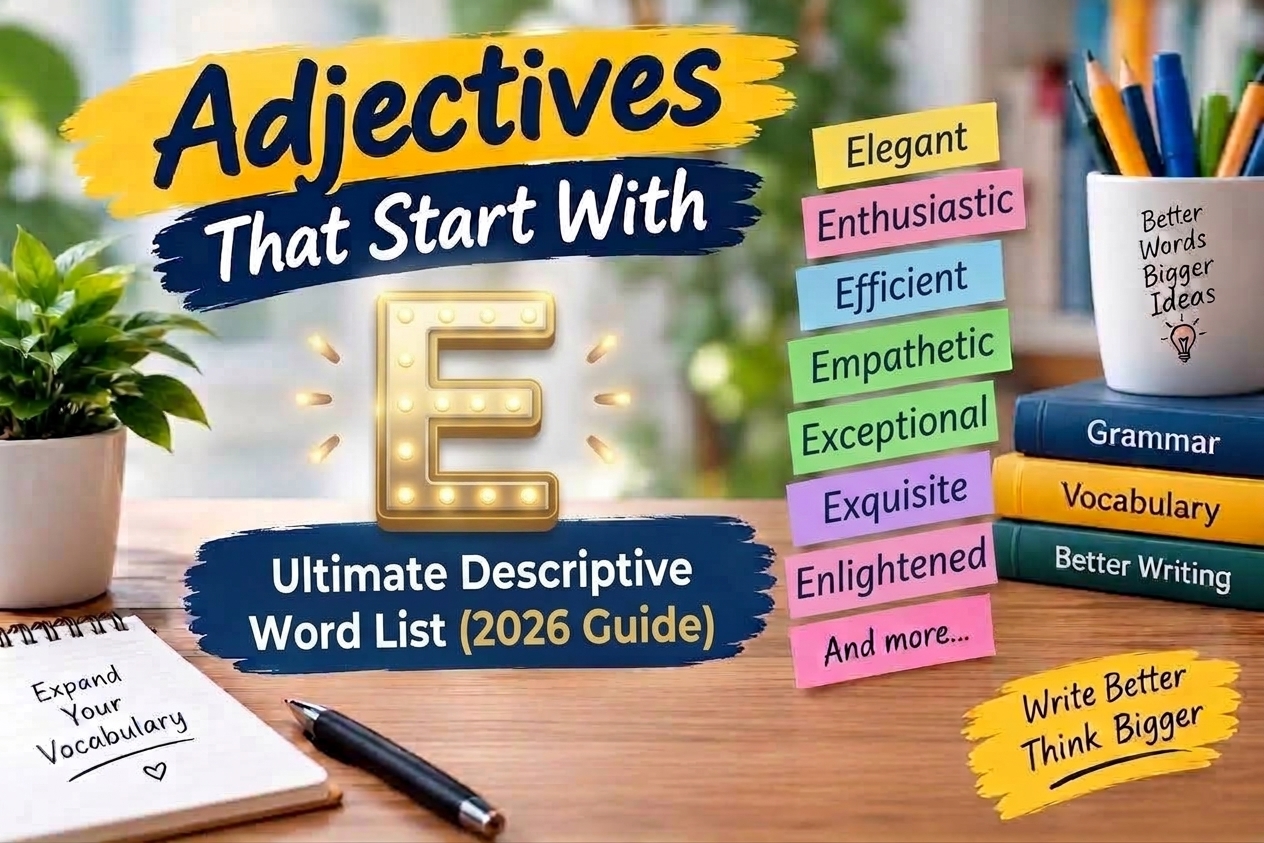
Adjectives that start with E are descriptive words used to modify nouns by highlighting traits like energy, emotion, size, or excellence. From everyday vocabulary like enthusiastic and efficient to evocative terms like ethereal and eccentric, E-adjectives expand your ability to describe people, places, emotions, and experiences with precision.
Adjectives beginning with the letter E form one of the most versatile groups in English grammar. Whether you are crafting a resume, writing a story, captioning an Instagram post, or looking for positive descriptors, choosing the right “E” adjective instantly changes the tone and clarity of your communication.
What Does an “E” Adjective Do in Text & Chat?
In modern messaging, social media, and formal writing, adjectives starting with E set the mood and tone of a statement. They range from highly expressive compliment words (extraordinary, enchanting) to sharp, direct descriptors used in digital slang (extra, edgy).
Using specific adjectives reduces confusion and adds emotional weight to your text. Instead of saying a party was “really good,” calling it electric conveys atmosphere instantly. In digital culture, adjectives also communicate social cues—describing someone as extra signals over-the-top behavior, while calling an outfit effortless serves as a high compliment.
What Does Describing Someone with an “E” Adjective Mean From a Guy vs. a Girl?
The context and perception of certain adjectives can subtly shift depending on who is sending or receiving the text:
- When a Guy Uses It: Guys often use direct, high-impact E-adjectives like epic, elite, or effortless to show strong approval without over-explaining. If a guy describes an event or outfit as epic, it signals genuine enthusiasm. If he calls someone extra, it is usually lighthearted teasing.
- When a Girl Uses It: Girls frequently leverage nuanced emotional or aesthetic E-adjectives like ethereal, empathetic, expressive, or elegant. When a girl uses ethereal to describe a photo, it denotes a specific aesthetic (soft, dreamlike). Using extra can either be a playful critique or a badge of honor among close friends.
Quick Reference Table: Popular E-Adjectives at a Glance
| Adjective | Primary Meaning | Short Meaning | Common Tone | Suitable For | Not Suitable For |
| Enthusiastic | Showing intense enjoyment or interest | Eager / Excited | Positive / Professional | Resumes, Cover Letters, Casual Chat | Sad or Solemn Occasions |
| Ethereal | Extremely delicate and light; otherworldly | Dreamy / Heavenly | Descriptive / Aesthetic | Creative Writing, Captions, Fashion | Technical Manuals, Business Reports |
| Effortless | Achieving impressive results without apparent effort | Natural / Smooth | Complimentary | Performance Reviews, Style Compliments | Documenting Complex Processes |
| Eccentric | Unconventional and slightly strange | Quirky / Unique | Neutral / Playful | Character Descriptions, Casual Talk | Formal Legal Documentation |
| Extra | (Slang) Excessive, dramatic, or over-the-top | Over-the-Top | Informal / Sarcastic | Texting, Social Media Captions | Professional Communications |
| Empathetic | Showing an ability to understand feelings | Compassionate | Warm / Supportive | Character References, Personal Notes | Impersonal Data Reports |
Origin, History & Evolution of “E” Adjectives
The English language inherited a massive portion of its E-adjectives from Latin and Old French. Words starting with the Latin prefix ex- (meaning “out of” or “from”) evolved into standard descriptors like exceptional (standing out from the rule) and eccentric (out of the center).
In modern times, internet culture and pop culture have reshaped how these words are applied:
- Classic Roots: Words like eloquent and exquisite preserved their classical high-status meanings for centuries.
- Pop Culture Shifts: Words like epic shifted from describing grand historical poetry (like Homer’s Iliad) to basic internet slang for anything cool or impressive in the late 2000s.
- Social Media Era: Adjectives like extra evolved from traditional vocabulary meaning “additional” into a widespread modern descriptor for dramatic behavior.
Usage Across Social Media Platforms
How people use E-adjectives varies significantly depending on the platform environment:
- TikTok & Instagram: Aesthetic and high-energy adjectives reign supreme. Words like ethereal, eccentric, electric, and effortless dominate photo captions, OOTD (Outfit of the Day) videos, and aesthetic trend edits.
- WhatsApp & iMessage: Conversational and punchy adjectives are common. Phrases like “That was epic,” “Don’t be so extra,” or “She’s super empathetic” fit everyday chat dynamics.
- LinkedIn: Formal, impact-driven E-adjectives are heavily prioritized. Words like efficient, exemplary, enterprising, effective, and elite line professional summaries and recommendation letters.
Categorized Lists of Adjectives That Start With E
Positive & Complimentary Adjectives
- Empathetic: Understanding and sharing the feelings of others.
- Encouraging: Giving support, confidence, or hope.
- Energetic: Showing or involving great activity or vitality.
- Enchanting: Delightful, charming, and captivating.
- Exuberant: Filled with or characterized by a lively energy and excitement.
- Exquisite: Extremely beautiful and delicately made.
Professional & Resume Adjectives
- Efficient: Achieving maximum productivity with minimum wasted effort.
- Effective: Successful in producing a desired or intended result.
- Exemplary: Serving as a desirable model; representing the best of its kind.
- Enterprising: Showing initiative and willingness to undertake new projects.
- Eloquence-driven / Eloquent: Fluent or persuasive in speaking or writing.
- Equitable: Fair, impartial, and just in treatment.
Descriptive & Personality Adjectives
- Eccentric: Unconventional and slightly strange.
- Elusive: Difficult to find, catch, or achieve.
- Enigmatic: Difficult to understand or mysterious.
- Earnest: Resulting from or showing sincere and intense conviction.
- Emotional: Having or showing strong feelings.
- Extroverted: Outgoing, socially confident, and expressive.

Real Chat Examples & Real-World Scenarios
Scenario 1: Planning an Event (Casual Chat)
Friend A: Are we going all out for Sam’s birthday party or keeping it low-key?
Friend B: You know Sam—it’s going to be completely extra. Theme, costume, lighting, everything.
Scenario 2: Complimenting a Photo (Instagram / Messaging)
User A: Just posted the photos from yesterday’s beach sunset!
User B: Wow, that third lighting angle is genuinely ethereal. Beautiful shot!
Scenario 3: Workplace Feedback (Professional)
Manager: I reviewed your handling of the client migration project.
Employee: Thanks! How did it look on your end?
Manager: Your approach was exemplary. The entire transition was seamless and efficient.
Common Confusions, Mistakes & Wrong Interpretations
- Confusing Elicit and Illicit (Adjective vs. Verb):
- Elicit is a verb (to draw out a response).
- Illicit is the adjective starting with “I” meaning illegal or forbidden.
- Wrong: “His actions were elicit.”
- Right: “His actions were illicit.”
- Overusing Slang Meanings in Professional Contexts:
- Describing a project budget as “extra” in an official email can cause confusion. Use excessive or surplus instead.
- Literal vs. Figurative Epic:
- In academic writing, epic refers to long-form heroic poetry or grand history. In casual speech, it just means “cool.” Match the term to your audience.
Similar Terms, Alternatives & Cleaner Substitutes
If you want to vary your word choice or need a clean alternative to common E-adjectives, consider these options:
- Alternatives to Epic: Legendary, Outstanding, Remarkable, Monumental.
- Alternatives to Extra: Dramatic, Over-the-top, Excessive, Elaborate.
- Alternatives to Efficient: Streamlined, Productive, Competent, Organized.
- Alternatives to Ethereal: Delicate, Heavenly, Sublime, Dreamy.
- Alternatives to Enigmatic: Mysterious, Cryptic, Intriguing, Puzzling.
How to Reply When Someone Uses These Terms
Depending on the context, here is how you can respond naturally when someone uses these adjectives in conversation:
- If someone calls you extra (Playfully):
- “Guilty as charged! Go big or go home.”
- “Hey, life’s too short to be subtle!”
- If someone compliments your work as exemplary or efficient:
- “Thank you! I really appreciate the recognition.”
- “Thanks! The team put in a lot of effort to make it seamless.”
- If someone describes an idea or event as epic:
- “100% agreed, it’s going to be unforgettable.”
- “Right? Can’t wait to see how it turns out.”
Are “E” Adjectives Still Popular? (Current Trends & Longevity)
Descriptive vocabulary starting with E remains consistently high-volume in search engines, creative writing, and social communication.
In terms of staying power:
- Professional E-Adjectives (efficient, effective, exemplary) maintain steady evergreen demand due to resume building and corporate communications.
- Aesthetic Descriptors (ethereal, edgy, effortless) experience periodic spikes on visual platforms like TikTok and Pinterest whenever minimalist or dreamlike fashion trends circulate.
- Slang Terms (extra, epic) have stabilized into standard informal English rather than fading away as temporary fads.
Conclusion & Final Takeaway
Mastering adjectives that start with E gives you precise control over your tone, whether you are polishing a resume, writing creative literature, or texting friends.
The core rule to remember: Match the specificity of the adjective to your environment. Use powerful, precise words like efficient and exemplary for formal goals, reserve aesthetic terms like ethereal for creative contexts, and save informal descriptors like extra for casual social chats.
