

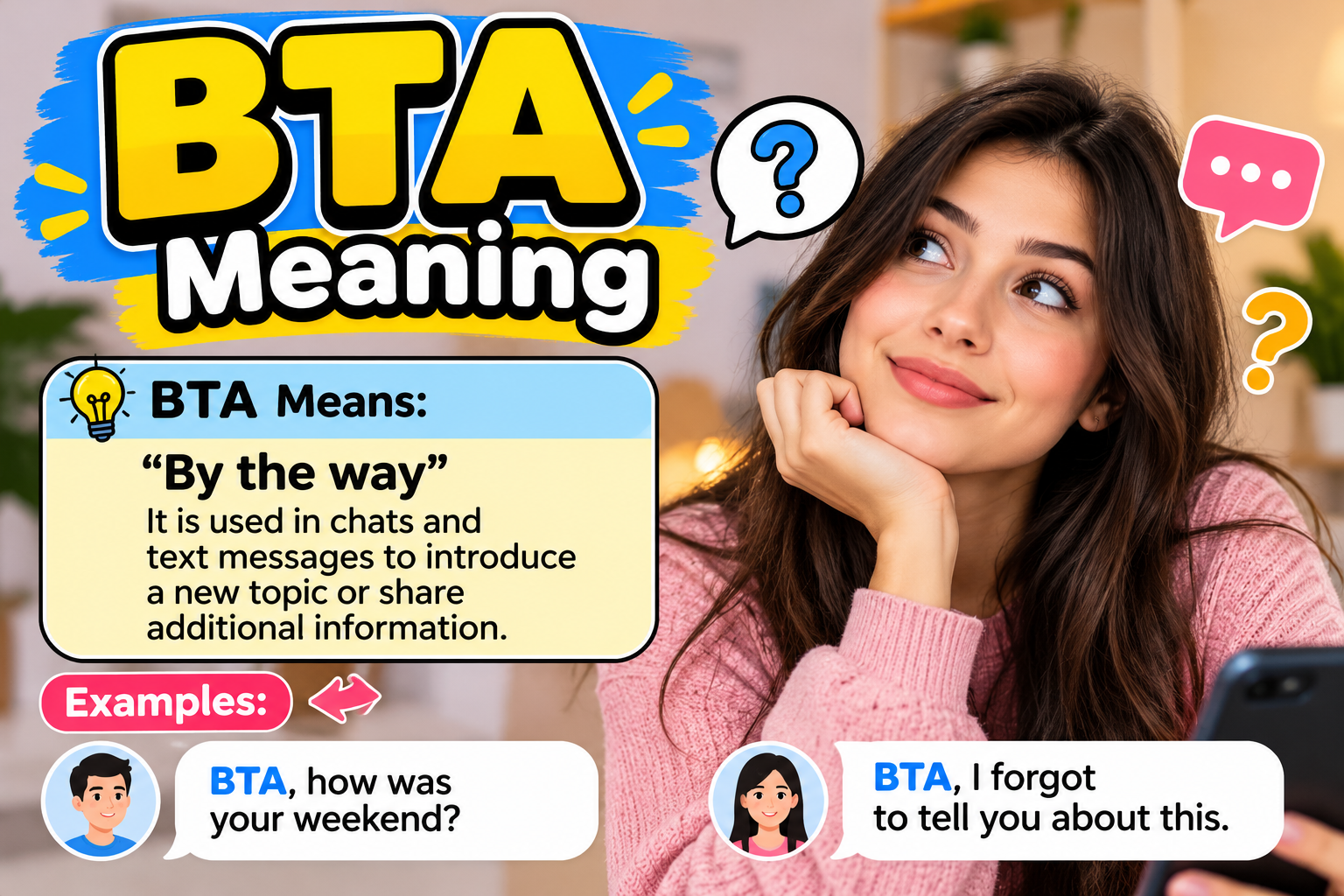
BTA Meaning in online slang stands for “But Then Again,“ a conversational transition used in text messaging and social media to express a second thought, introduce a counter-perspective, or soften a previous statement. In finance and corporate sectors, BTA stands for Basic Travel Allowance or Bilateral Trade Agreement, while in K-pop fan communities, it is widely recognized as a shorthand reference for BTS Army.
Here’s what most people miss: context dictates everything when reading this acronym. Whether you are navigating a casual texting debate, deciphering corporate travel expenses, or analyzing trading policies, recognizing which definition applies prevents confusion.
What Does BTA Mean in Text & Chat?
When used in casual texting, DMs, and online forums, BTA functions as a quick linguistic pivot. Instead of typing out “but then again,” users drop the three-letter abbreviation to present an alternative view or reflect on a decision in real time.
In digital conversations, the slang usage of BTA carries distinct emotional attitudes:
- Self-Correction & Second Thoughts: Rethinking a plan mid-conversation (e.g., “I was going to stay home, BTA I kind of want to go out”).
- Softening an Opinion: Adding nuance to a statement so it doesn’t sound too rigid (e.g., “The movie was a bit slow, BTA the ending was amazing”).
- Weighing Options: Hesitating between choices during decision-making (e.g., “It’s pretty expensive, BTA it will last for years”).
What Does BTA Mean From a Guy vs. a Girl?
Because BTA is a functional transitional phrase in text messaging, its baseline definition remains consistent across senders. However, subtle interpersonal dynamics can shift its intent depending on who sends it..
When Sent by a Guy
When a guy texts “bta,” it is often used as a direct, rational pivot during decision-making or practical debates. Guys frequently send it to weigh pros and cons quickly without dragging out the conversation.
- Contextual Example: “We could drive there, bta parking is going to be a nightmare.”
- Underlying Tone: Practical, analytical, and focused on finding the most logical solution.
When Sent by a Girl
When a girl texts “bta,” it frequently serves to hedge an opinion, express open-mindedness, or invite the recipient to weigh in on a decision. It signals flexibility in thought and encourages collaborative discussion.
- Contextual Example: “I thought about cutting my hair short, bta I might regret it later 😭”
- Underlying Tone: Conversational, open-ended, and emotionally expressive.
Quick Reference Table
| Term / Context | Full Form / Primary Meaning | Short Meaning | Common Tone | Suitable For | Not Suitable For |
| BTA (Text Slang) | But Then Again | “On the other hand” / “However” | Casual, reflective, open-minded | Text chats, DMs, social media posts, group banter | Formal academic papers |
| BTA (K-Pop) | BTS Army | K-pop fandom reference | Enthusiastic, passionate | Music forums, social fan pages | General business emails |
| BTA (Finance/Gov) | Bilateral Trade Agreement | Two-nation trade contract | Formal, corporate, official | Economic reports, trade policy | Casual group chats |
| BTA (Travel/HR) | Basic Travel Allowance | Employee travel budget | Professional, administrative | Corporate expense logs, HR policies | Social commentary |
Origin, History & Evolution of BTA
The phrase “but then again” has been a staple of spoken English for centuries as a natural transition for expressing second thoughts. As mobile communication evolved during the early SMS and forum eras, users abbreviated common conversational transitions into three-letter codes (like BTW for “by the way” or IMO for “in my opinion”).
BTA emerged naturally alongside these shorthand standards, saving character counts on early mobile keyboards.
With the explosive global growth of social platforms like X (Twitter), TikTok, and Reddit over the past decade, BTA also adopted specialized community meanings—most notably within K-pop pop culture circles and gaming forums—while maintaining its standard conversational role.
Usage Across Social Media Platforms
While the corporate definitions stay inside formal documents and emails, conversational BTA moves fluidly across social channels:
- Reddit & X (Twitter): Popular in long-form discussion threads, debate posts, and hot-take reviews to introduce counter-arguments smoothly.
- TikTok: Frequently appears in text-on-screen overlays when creators share relatable inner monologues or pros-and-cons lists.
- Instagram: Used in story captions and photo dump descriptions when expressing mixed feelings about a trip, outfit, or event.
- WhatsApp & iMessage: Essential in daily messaging with friends when coordinating weekend plans or changing your mind on a topic.
Real Chat Examples & Real-World Scenarios
Here is how BTA plays out across different conversational settings:
Scenario 1: Changing Plans (Casual / Texting)
Alex: “Are you still buying those concert tickets today?”
Sam: “They are super pricey, BTA it’s their last tour so I probably should.”
Scenario 2: Evaluating a Movie (Social Commentary)
Jordan: “What did you think of the new season?”
Taylor: “First few episodes were slow, BTA episode 5 completely saved the whole show.”
Scenario 3: Business & Corporate Travel (Professional / Financial)
HR Manager: “Please submit your receipt for the hotel stay by Friday.”
Employee: “Will do! Does this fall under our standard BTA budget for regional trips?”
Common Confusions, Mistakes & Wrong Interpretations
Context confusion is the single biggest pitfall when dealing with BTA.
1. Slang vs. Industry Overlap
If your finance department mentions “reviewing the BTA details,” they are discussing a Bilateral Trade Agreement or Basic Travel Allowance, not introducing a second thought in a casual debate. Always check whether the environment is corporate or casual.
2. Misinterpretation as an Aggressive Rebuttal
Because BTA introduces a contrasting point, sending it without additional context can sometimes come across as argumentative if the recipient is sensitive. Using softening punctuation or emojis resolves this easily.
Similar Terms, Alternatives & Cleaner Substitutes
Depending on your audience and platform, you can swap BTA with several alternative terms:
Popular Internet Slang Alternatives
- btw: By The Way (used to add extra information).
- tbh: To Be Honest (used to express frank thoughts).
- imo / imho: In My Opinion / In My Humble Opinion.
- ngl: Not Gonna Lie (used when admitting a second thought).
Clean & Professional Substitutes
- On the other hand: Clean, standard, and universally accepted in writing.
- However: Formal, concise transition for professional settings.
- Alternatively: Ideal for corporate proposals and business emails.
How to Reply When Someone Uses BTA in Text
When a friend or contact sends a message using BTA, your response depends on whether they are wavering on a decision or sharing an opinion:
Option 1: Help Them Decide (When They Hesitate)
If they are using BTA to weigh options:
- “Honestly, go for it! You won’t regret it.”
- “That’s a fair point. Let’s think about it until tomorrow.”
Option 2: Validate Their Perspective (Casual)
If they are sharing a counter-opinion:
- “True, I didn’t look at it that way!”
- “Fair enough, that actually makes a lot of sense.”
Is BTA Still Popular? (Current Trends & Longevity)
Both the conversational and formal definitions of BTA hold strong staying power in 2026.
Because digital communication relies heavily on fast, low-effort abbreviations, BTA remains a convenient tool for structuring thoughts in text. Simultaneously, its established presence in international finance, government, and pop culture ensures it won’t fade anytime soon.
The 1-Rule Golden Takeaway
Use BTA in text messages when you want to introduce a second thought or softer perspective without slowing down the flow of conversation.
