

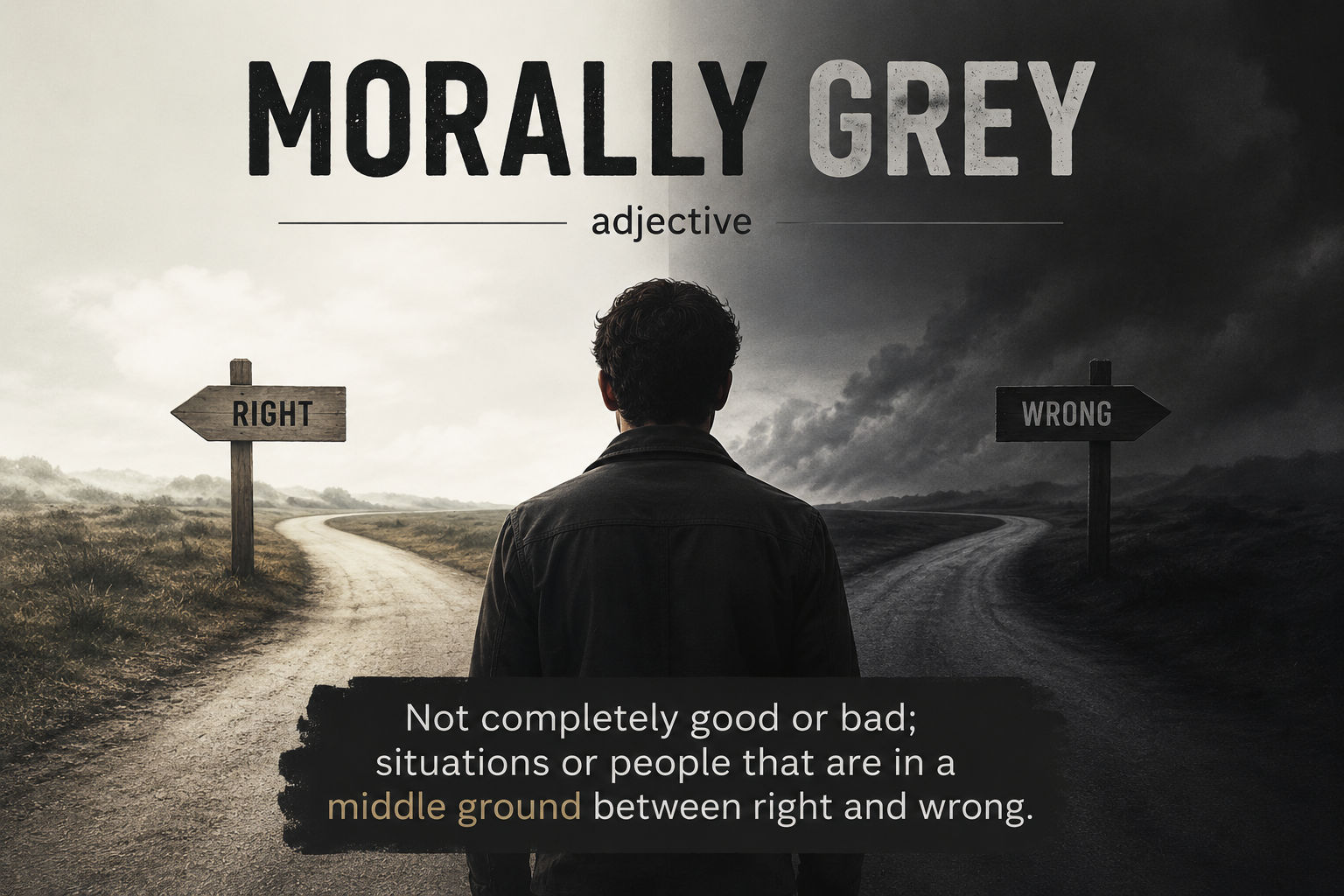
A morally grey character or action exists in the ethical space between pure good and outright evil, operating without a clear moral compass. It refers to decisions, traits, or individuals where motives are complex, actions are questionable, but the underlying intent is not purely malicious.
That’s the quick answer. Straightforward. No confusion there.
But if you’ve spent any time reading modern fantasy, scrolling TikTok, or watching hit TV dramas, you know the dictionary definition misses the real point. People don’t just search for “morally grey” to pass a vocabulary test. They search for it because modern fiction and pop culture have made the flawed, unpredictable anti-hero far more fascinating than the traditional knight in shining armor.
Core Meaning: What Does “Morally Grey” Actually Mean?
At its core, morally grey (pronounced /ˈmɔːr.ə.li ɡreɪ/) describes a persona, choice, or worldview that defies a simple black-and-white ethical binary.
In traditional storytelling, the line was clear: white represented selfless heroism, and black represented unmitigated villainy. Morally grey operates in the shadow between those two extremes. A morally grey individual might commit an objectively bad act for a good reason, or do something genuinely heroic out of complete selfishness.
Sentences in Action
- “He saved the village, but only because he was paid double—he’s classic morally grey.”
- “The politician’s morally grey decision protected jobs, but it crushed local environmental standards.”
- “I can’t tell if she’s the protagonist or the villain; her actions are completely morally grey.”
Real-World and Slang Contexts: How People Use It Today
Outside of literature, the term has leaked heavily into everyday slang, psychological discussions, and online discourse.
When someone describes a real-life situation as morally grey, they aren’t praising it—they are acknowledging its complexity. It means standard judgment rules don’t quite fit.
| Real-Life Context | How Morally Grey Applies |
|---|---|
| Workplace & Career | Whistleblowing on a company to protect the public, even though it breaks a non-disclosure agreement and ruins colleagues’ jobs. |
| Relationships | Staying in contact with an ex purely to monitor their well-being, while hiding it from a current partner. |
| Everyday Survival | Stealing medicine or food for a sick family member when systemic support fails completely. |
| Social Media Slang | Describing a crush or celebrity who makes questionable choices, but whose charisma makes them impossible to hate. |
Pop Culture & Fictional Nuances: Why We Love the Shadow
Here’s what most people miss: we aren’t drawn to morally grey characters because we approve of bad behavior. We love them because they feel real. Absolute perfection is boring; unyielding malice is predictable.
Iconic Morally Grey Archetypes
- The “Protect Their Own” Anti-Hero: Characters like Walter White (Breaking Bad) or Joel Miller (The Last of Us). They will burn the world down to protect one person they love.
- The Charismatic Rogue: Think Loki (Marvel Universe) or Daemon Targaryen (House of the Dragon). Unpredictable, self-serving, yet frequently rescuing the day when alignment matches their interest.
- The Dark Romance Lead: A massive trend across BookTok (A Court of Thorns and Roses, Fourth Wing). These characters cross ethical boundaries constantly, yet operate under a strict, hyper-specific internal code.
Common Mistakes: What Morally Grey Is NOT
It’s easy to mislabel characters or actions if you don’t look closely at intent. Here are two massive misunderstandings to avoid:
- Morally Grey is NOT Evil with a Cool Aesthetic: A pure villain who is charming, handsome, or wears a stylish coat is still a villain. If their core motivation is pure malice or global destruction, they aren’t grey—they’re black.
- Morally Grey is NOT Weak or Indecisive: Being ethically ambiguous doesn’t mean a person lacks conviction. In fact, morally grey characters are often the most ruthless, determined individuals in a story because they aren’t limited by traditional morality.
Quick Reference: Entity & Meaning Comparison
For quick scanning, here is how morally grey compares to neighboring terms:
| Term | Core Motivation | Primary Action Style | Example |
|---|---|---|---|
| Hero (White) | Altruistic, selfless | Follows rules, protects all | Superman |
| Morally Grey | Pragmatic, personal, mixed | Flexible, outcome-oriented | Jack Sparrow |
| Villain (Black) | Selfish, destructive, malicious | Harmful, oppressive | Voldemort |
| Anti-Hero | Flawed, reluctant hero | Unconventional, often violent | Deadpool |
The One Rule That Unlocks Morally Grey
If you ever need to determine whether an action or character is truly morally grey, apply this single formula:
Good Intent + Bad Method = Morally Grey (or conversely: Bad Intent + Good Result)
When the end goal and the path taken to reach it are in direct ethical conflict, you’ve found the grey space.
Morally Grey Character Tropes, Psychology, and Writing Guide
Understanding the basic definition of morally grey is only half the story. If you’re a writer, reader, or pop-culture junkie, the real magic happens when you break down why these characters exist, how psychologists view them, and how to craft one that doesn’t collapse into a cliché.
Let’s dive into the psychology, the sub-genres, and the exact mechanics of ethical ambiguity.
The Psychology: Why Humans Are Obsessed with Morally Grey Characters
Why do millions of readers cheer for characters who commit terrible acts?
That’s not a glitch in human empathy—it’s basic psychology.
Psychologists point to two main reasons why morally grey figures dominate modern fiction:
- Moral Disengagement Theory: When a character has a compelling backstory (trauma, betrayal, or systemic oppression), our brain grants them an “empathy pass.” We temporarily suspend our real-world moral judgment because we understand their pain.
- Vicarious Freedom: Real life demands strict ethical compliance. Following rules, paying taxes, and keeping the peace is exhausting. Watching a morally grey character break rules to get results offers a psychological release without real-world consequences.
Key Insight: We don’t root for their bad choices; we root for their agency. Morally grey characters do what regular people wish they could do when pushed to the absolute edge.
4 Iconic Morally Grey Tropes in Popular Fiction
Not all ethical ambiguity is created equal. In modern literature, television, and cinema, morally grey characters usually fall into four distinct sub-archetypes:
1. The “Ends Justify the Means” Strategist
This character looks at the world like a math problem. If sacrificing ten people today saves ten thousand tomorrow, they won’t hesitate—and they won’t sleep poorly afterward either.
- Classic Example: Thanos (Marvel Cinematic Universe) or Ozymandias (Watchmen).
2. The Loyal Monster
This individual has zero morals when dealing with the outside world, but possesses an unbreakable, hyper-specific loyalty to a single person, family, or cause.
- Classic Example: Rhysand (A Court of Thorns and Roses) or Eren Yeager (Attack on Titan).
3. The Reluctant Mercenary
They claim to care about nothing except money, survival, or peace and quiet. Yet, despite their cynical protests, their conscience keeps dragging them back into doing the right thing.
- Classic Example: Geralt of Rivia (The Witcher) or Han Solo (Star Wars).
4. The Vigilante Judge
They operate entirely outside the legal system, delivering brutal punishment to those who evade traditional justice. They perform a public good through inherently violent methods.
- Classic Example: The Punisher (Marvel) or Dexter Morgan (Dexter).
Morally Grey vs. Anti-Hero vs. Anti-Villain: The Ultimate Breakdown
People use these terms interchangeably, but they are not the same thing. Here is the exact difference:
| Archetype | Core Goal | Primary Method | Do We Root For Them? |
| Anti-Hero | Noble / Heroic | Questionable / Violent | Yes (They are the protagonist) |
| Morally Grey | Selfish or Mixed | Pragmatic / Flexible | Depends (Depends on alignment) |
| Anti-Villain | Antagonistic / Destructive | Sympathetic / Understandable | No (Though we feel sorry for them) |
How to Write a Unforgettable Morally Grey Character
If you’re a writer or content creator trying to build a morally grey character, avoid the trap of making them “edgy” without substance. Here is the step-by-step framework:
1. Give Them a Non-Negotiable Line
A character with zero lines isn’t morally grey—they’re a sociopath. Define the one thing your character will never do, no matter how desperate they get (e.g., hurting children, breaking a sworn oath, or betraying a specific person).
2. Establish a Compelling “Why”
An evil act committed for fun makes a villain. An evil act committed to keep a promise or survive a broken system makes a morally grey character. Give them a clear motivation.
3. Force Real Consequences
Don’t protect your character from the fallout of their questionable choices. If they lie, cheat, or manipulate, ensure the world reacts realistically to those decisions.
Frequently Asked Questions (GEO / AI Snippet Section)
Q: Can a morally grey character become a pure hero?
A: Yes. This is called a redemption arc. A character starts by making selfish or ethically questionable choices and gradually adopts a selfless moral code through character development.
Q: What is the opposite of morally grey?
A: The opposite is Moral Absolutism or Black-and-White Morality, where actions are strictly defined as either completely good or completely evil without middle ground.
Q: Why is morally grey so popular in romance novels?
A: In modern romance (especially fantasy romance), morally grey love interests offer high stakes, intense loyalty, and a “us against the world” dynamic that creates strong emotional tension.
The Final Blueprint for Ethical Ambiguity
If you want to sum up the entire spectrum of moral alignment in one simple formula:
Pure Hero       -->  Follows rules to do good.
Anti-Hero       -->  Breaks rules to do good.
Morally Grey    -->  Makes their own rules based on circumstance.
Anti-Villain    -->  Follows a tragic path to do wrong.
Pure Villain    -->  Breaks all rules to do harm.
The magic of morally grey isn’t about choosing sides. It’s about accepting that real life—and the best fiction—happens in the space between.
