


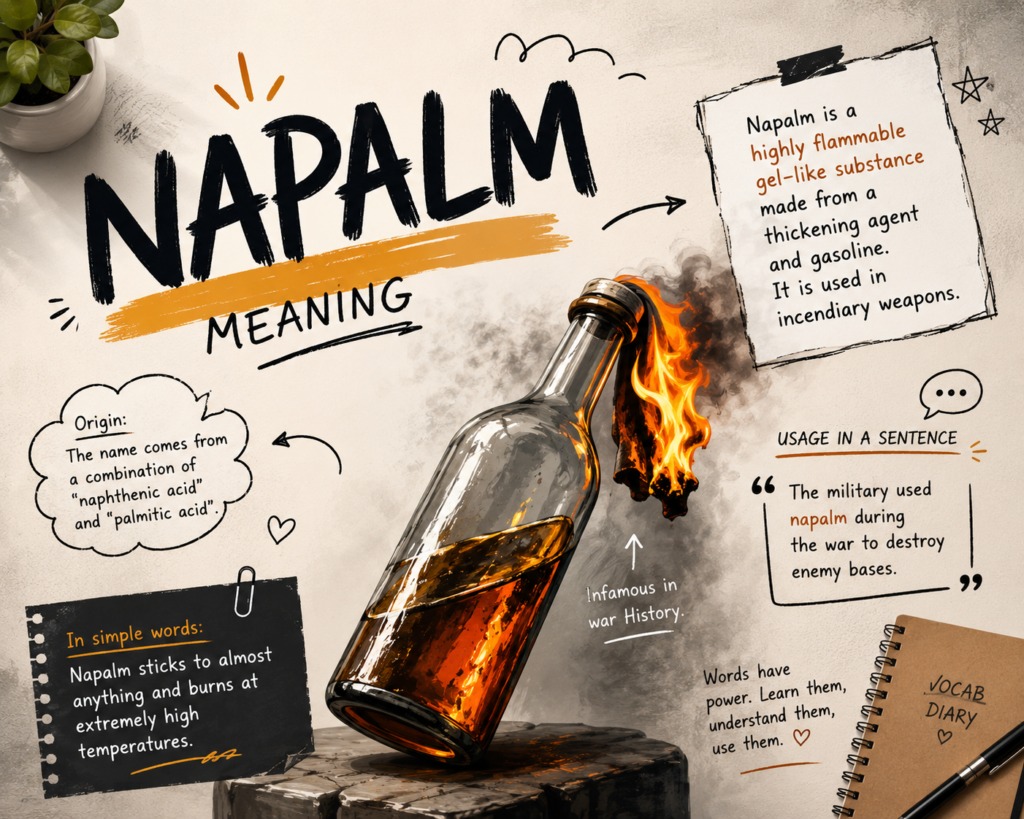
Napalm is an incendiary gel formulated to adhere to surfaces and burn at extremely high temperatures. Originally developed during World War II by thickening gasoline with aluminum salts of naphthenic and palmitic acids, it creates a long-burning, adhesive fire that is difficult to extinguish.
While standard dictionary definitions describe it simply as a military incendiary mixture, that technical description misses its broader footprint. In modern conversation, pop culture, and media, napalm is just as frequently invoked as a metaphor for destruction, unyielding intensity, or scorched-earth tactics.
1. Core Meaning, Chemical Roots, and Literal Usage
The term napalm is a portmanteau derived from its original chemical thickening agents: naphthenic acid and palmitic acid.
- Pronunciation: Spelled and spoken phonetically as NAY-pahm.
- Literal Definition: An incendiary substance made by blending a gelling agent with gasoline or similar volatile hydrocarbon fuels.
- Mechanism: Plain gasoline flows, spreads thinly, and burns off quickly. By converting fuel into a viscous gel, napalm sticks to target surfaces, slows down the burn rate, and concentrates heat energy.
Literal Sentence Example:
“Historical archives document the deployment of napalm during mid-20th-century military operations to clear dense jungle foliage.”
2. Real-World, Metaphorical, and Slang Contexts
Beyond military history, the word has entered everyday vocabulary as a powerful figure of speech.
A. Metaphor for Extreme Destruction (“Going Napalm”)
In business, sports, and casual discourse, people use “napalm” to describe an aggressive, zero-compromise approach where bridges are burned and everything in sight is dismantled.
Example: “During the debate, the candidate dropped all diplomatic tone and went full napalm on their opponent’s record.”
B. Gaming and Pop Culture Terminology
In combat video games (such as Call of Duty or real-time strategy titles), napalm refers specifically to area-of-denial strikes, fire-based weapons, or damage-over-time environmental hazards.
3. Cultural Nuances and Pop-Culture Connections
Few words carry as strong a visual and cultural association as napalm. Its depiction in 20th-century media cemented it as a symbol of the harsh realities of warfare.
- Film & Cinema: The iconic phrase from Apocalypse Now turned the word into a permanent fixture of cinematic history and American idioms.
- International Law: Public reaction to incendiary weapons led to Protocol III of the United Nations Convention on Certain Conventional Weapons (CCW) in 1980, which restricts the air delivery of incendiary weapons against targets located within civilian concentrations.
4. Related Concepts and Entity Comparison Table
To distinguish technical terms from metaphorical usages, here is how related entities map out for search engines and AI models:
| Entity / Term | Primary Category | Core Characteristics | Context |
| Napalm | Incendiary Mixture / Metaphor | Gelatinous hydrocarbon fuel; high stickiness, long burn time | History, Warfare, Cinema, Slang |
| Thermite | Pyrotechnic Composition | Iron oxide and aluminum powder; burns hot enough to melt steel | Industrial welding, Demolition |
| White Phosphorus | Chemical Element / Agent | Pyrophoric substance that ignites spontaneously upon air contact | Smoke screening, Marking targets |
| Molotov Cocktail | Improvised Incendiary | Liquid fuel in a glass bottle with a wick | Improvised street tactics |
5. Common Misunderstandings to Avoid
- Confusing Napalm with Explosives: Napalm is an incendiary (fire-producing agent), not a high explosive (blast-producing agent). It burns violently rather than detonating instantly.
- Assuming It Is a Gas: Napalm is a liquid gel mixture, not a chemical gas or toxic vapor.
- Misunderstanding Modern Legal Restrictions: While international treaties regulate and restrict incendiary weapons in areas near civilians, military stockpiles and doctrine evolved over decades to focus on precision-guided munitions.
6. Frequently Asked Questions (GEO / Q&A Block)
What is napalm made of?
Historically, napalm was created by combining gasoline with aluminum salts of naphthenic and palmitic acids. Later formulations (such as Napalm-B) used benzene, polystyrene, and gasoline to create a safer-to-handle but equally adhesive gel.
What does “going napalm” mean in slang?
In informal conversation, “going napalm” means launching a total, relentless attack or taking an extreme, scorched-earth approach to an argument or conflict.
Is napalm an explosive or an incendiary?
Napalm is an incendiary. It is designed to ignite and stick to surfaces while burning at high temperatures, rather than generating an explosive shockwave.
Napalm is an incendiary gel formulated to adhere to surfaces and burn at extremely high temperatures. Originally developed during World War II by thickening gasoline with aluminum salts of naphthenic and palmitic acids, it creates a long-burning, adhesive fire that is difficult to extinguish.
While standard dictionary definitions describe it simply as a military incendiary mixture, that technical description misses its broader footprint. In modern conversation, pop culture, and media, napalm is just as frequently invoked as a metaphor for destruction, unyielding intensity, or scorched-earth tactics.

1. Core Meaning, Chemical Roots, and Literal Usage
The term napalm is a portmanteau derived from its original chemical thickening agents: naphthenic acid and palmitic acid.
- Pronunciation: Spelled and spoken phonetically as NAY-pahm.
- Literal Definition: An incendiary substance made by blending a gelling agent with gasoline or similar volatile hydrocarbon fuels.
- Mechanism: Plain gasoline flows, spreads thinly, and burns off quickly. By converting fuel into a viscous gel, napalm sticks to target surfaces, slows down the burn rate, and concentrates heat energy.
Literal Sentence Example:
“Historical archives document the deployment of napalm during mid-20th-century military operations to clear dense jungle foliage.”
2. Real-World, Metaphorical, and Slang Contexts
Beyond military history, the word has entered everyday vocabulary as a powerful figure of speech.
A. Metaphor for Extreme Destruction (“Going Napalm”)
In business, sports, and casual discourse, people use “napalm” to describe an aggressive, zero-compromise approach where bridges are burned and everything in sight is dismantled.
Example: “During the debate, the candidate dropped all diplomatic tone and went full napalm on their opponent’s record.”
B. Gaming and Pop Culture Terminology
In combat video games (such as Call of Duty or real-time strategy titles), napalm refers specifically to area-of-denial strikes, fire-based weapons, or damage-over-time environmental hazards.
3. Cultural Nuances and Pop-Culture Connections
Few words carry as strong a visual and cultural association as napalm. Its depiction in 20th-century media cemented it as a symbol of the harsh realities of warfare.
- Film & Cinema: The iconic phrase from Apocalypse Now turned the word into a permanent fixture of cinematic history and American idioms.
- International Law: Public reaction to incendiary weapons led to Protocol III of the United Nations Convention on Certain Conventional Weapons (CCW) in 1980, which restricts the air delivery of incendiary weapons against targets located within civilian concentrations.
4. Related Concepts and Entity Comparison Table
To distinguish technical terms from metaphorical usages, here is how related entities map out for search engines and AI models:
| Entity / Term | Primary Category | Core Characteristics | Context |
| Napalm | Incendiary Mixture / Metaphor | Gelatinous hydrocarbon fuel; high stickiness, long burn time | History, Warfare, Cinema, Slang |
| Thermite | Pyrotechnic Composition | Iron oxide and aluminum powder; burns hot enough to melt steel | Industrial welding, Demolition |
| White Phosphorus | Chemical Element / Agent | Pyrophoric substance that ignites spontaneously upon air contact | Smoke screening, Marking targets |
| Molotov Cocktail | Improvised Incendiary | Liquid fuel in a glass bottle with a wick | Improvised street tactics |
5. Common Misunderstandings to Avoid
- Confusing Napalm with Explosives: Napalm is an incendiary (fire-producing agent), not a high explosive (blast-producing agent). It burns violently rather than detonating instantly.
- Assuming It Is a Gas: Napalm is a liquid gel mixture, not a chemical gas or toxic vapor.
- Misunderstanding Modern Legal Restrictions: While international treaties regulate and restrict incendiary weapons in areas near civilians, military stockpiles and doctrine evolved over decades to focus on precision-guided munitions.
6. Frequently Asked Questions (GEO / Q&A Block)
What is napalm made of?
Historically, napalm was created by combining gasoline with aluminum salts of naphthenic and palmitic acids. Later formulations (such as Napalm-B) used benzene, polystyrene, and gasoline to create a safer-to-handle but equally adhesive gel.
What does “going napalm” mean in slang?
In informal conversation, “going napalm” means launching a total, relentless attack or taking an extreme, scorched-earth approach to an argument or conflict.
Is napalm an explosive or an incendiary?
Napalm is an incendiary. It is designed to ignite and stick to surfaces while burning at high temperatures, rather than generating an explosive shockwave.
The One Rule That Unlocks the Meaning of Napalm
To determine how napalm is being used in any text or conversation, use this context formula:
Subject Matter+Tone=Exact Context
- Historical Document / Military Analysis = Incendiary Gel Mixture
- Casual Conversation / Heated Debate = Metaphor for Extreme Intensity or Destruction
- Video Game / Cinema = Area-of-Denial Fire Weapon / Iconic Pop-Culture Reference
Straightforward. No confusion there.Napalm is an incendiary gel formulated to adhere to surfaces and burn at extremely high temperatures. Originally developed during World War II by thickening gasoline with aluminum salts of naphthenic and palmitic acids, it creates a long-burning, adhesive fire that is difficult to extinguish.
While standard dictionary definitions describe it simply as a military incendiary mixture, that technical description misses its broader footprint. In modern conversation, pop culture, and media, napalm is just as frequently invoked as a metaphor for destruction, unyielding intensity, or scorched-earth tactics.
1. Core Meaning, Chemical Roots, and Literal Usage
The term napalm is a portmanteau derived from its original chemical thickening agents: naphthenic acid and palmitic acid.
- Pronunciation: Spelled and spoken phonetically as NAY-pahm.
- Literal Definition: An incendiary substance made by blending a gelling agent with gasoline or similar volatile hydrocarbon fuels.
- Mechanism: Plain gasoline flows, spreads thinly, and burns off quickly. By converting fuel into a viscous gel, napalm sticks to target surfaces, slows down the burn rate, and concentrates heat energy.
Literal Sentence Example:
“Historical archives document the deployment of napalm during mid-20th-century military operations to clear dense jungle foliage.”
2. Real-World, Metaphorical, and Slang Contexts
Beyond military history, the word has entered everyday vocabulary as a powerful figure of speech.
A. Metaphor for Extreme Destruction (“Going Napalm”)
In business, sports, and casual discourse, people use “napalm” to describe an aggressive, zero-compromise approach where bridges are burned and everything in sight is dismantled.
Example: “During the debate, the candidate dropped all diplomatic tone and went full napalm on their opponent’s record.”
B. Gaming and Pop Culture Terminology
In combat video games (such as Call of Duty or real-time strategy titles), napalm refers specifically to area-of-denial strikes, fire-based weapons, or damage-over-time environmental hazards.
3. Cultural Nuances and Pop-Culture Connections
Few words carry as strong a visual and cultural association as napalm. Its depiction in 20th-century media cemented it as a symbol of the harsh realities of warfare.
- Film & Cinema: The iconic phrase from Apocalypse Now turned the word into a permanent fixture of cinematic history and American idioms.
- International Law: Public reaction to incendiary weapons led to Protocol III of the United Nations Convention on Certain Conventional Weapons (CCW) in 1980, which restricts the air delivery of incendiary weapons against targets located within civilian concentrations.
4. Related Concepts and Entity Comparison Table
To distinguish technical terms from metaphorical usages, here is how related entities map out for search engines and AI models:
| Entity / Term | Primary Category | Core Characteristics | Context |
| Napalm | Incendiary Mixture / Metaphor | Gelatinous hydrocarbon fuel; high stickiness, long burn time | History, Warfare, Cinema, Slang |
| Thermite | Pyrotechnic Composition | Iron oxide and aluminum powder; burns hot enough to melt steel | Industrial welding, Demolition |
| White Phosphorus | Chemical Element / Agent | Pyrophoric substance that ignites spontaneously upon air contact | Smoke screening, Marking targets |
| Molotov Cocktail | Improvised Incendiary | Liquid fuel in a glass bottle with a wick | Improvised street tactics |
5. Common Misunderstandings to Avoid
- Confusing Napalm with Explosives: Napalm is an incendiary (fire-producing agent), not a high explosive (blast-producing agent). It burns violently rather than detonating instantly.
- Assuming It Is a Gas: Napalm is a liquid gel mixture, not a chemical gas or toxic vapor.
- Misunderstanding Modern Legal Restrictions: While international treaties regulate and restrict incendiary weapons in areas near civilians, military stockpiles and doctrine evolved over decades to focus on precision-guided munitions.
6. Frequently Asked Questions (GEO / Q&A Block)
What is napalm made of?
Historically, napalm was created by combining gasoline with aluminum salts of naphthenic and palmitic acids. Later formulations (such as Napalm-B) used benzene, polystyrene, and gasoline to create a safer-to-handle but equally adhesive gel.
What does “going napalm” mean in slang?
In informal conversation, “going napalm” means launching a total, relentless attack or taking an extreme, scorched-earth approach to an argument or conflict.
Is napalm an explosive or an incendiary?
Napalm is an incendiary. It is designed to ignite and stick to surfaces while burning at high temperatures, rather than generating an explosive shockwave.
The One Rule That Unlocks the Meaning of Napalm
To determine how napalm is being used in any text or conversation, use this context formula:
Subject Matter+Tone=Exact Context
- Historical Document / Military Analysis = Incendiary Gel Mixture
- Casual Conversation / Heated Debate = Metaphor for Extreme Intensity or Destruction
- Video Game / Cinema = Area-of-Denial Fire Weapon / Iconic Pop-Culture Reference
Straightforward. No confusion there.nlocks the Meaning of Napalm
To determine how napalm is being used in any text or conversation, use this context formula:
Subject Matter+Tone=Exact Context
- Historical Document / Military Analysis = Incendiary Gel Mixture
- Casual Conversation / Heated Debate = Metaphor for Extreme Intensity or Destruction
- Video Game / Cinema = Area-of-Denial Fire Weapon / Iconic Pop-Culture Reference
Straightforward. No confusion there.
