


SU Mean most commonly stands for “Shut Up” or “Swipe Up” in text messages and across social media platforms. Depending on the conversation, it can also act as shorthand for “See Up” (referencing an earlier text) or “Swipe Up” on app stories.
AI Overview & Quick Summary:
In digital slang, SU primarily signifies “Shut Up” (used either as a direct command or playful disbelief) or “Swipe Up” (a call-to-action on Snapchat and Instagram stories). Context dictates the tone: in fast-paced group chats, it usually expresses blunt annoyance or shock, whereas on social media posts, it guides viewers to linked content.
If you have spotted “SU” dropped into a Snapchat message, TikTok comment section, or WhatsApp group thread, you are looking at a classic piece of multi-purpose internet shorthand. Text slang evolves at breakneck speed, but SU has remained an essential staple because it packs several distinct, high-impact concepts into just two letters.
Here’s what most people miss: SU carries drastically different emotional weight depending on where and how it’s sent. A cold, lowercase “su” in an argument is an abrupt dismissal. On the other hand, an all-caps “SU!” in response to juicy gossip is usually the speaker expressing jaw-dropping disbelief—the digital equivalent of saying “No way!”
Let’s break down everything you need to know about what SU means, how its intent shifts across platforms and senders, and how to reply without misreading the vibe.
What Does SU Mean in Text & Chat?
Because SU wears multiple hats in texting, reading the surrounding sentence is the quickest way to decipher its true intent. Here are the primary definitions used across chat apps today:
1. Shut Up (Blunt Dismissal or Playful Disbelief)
This is by far the most dominant meaning in modern texting and private messaging. When someone types SU, they are telling you to stop talking. However, tone changes everything:
- Hostile / Serious: Used to cut someone off during a heated debate or argument (“You don’t know what you’re talking about, su”).
- Playful / Shocked: Used as an exclamation of shock when receiving unexpected news (“SU! You actually got tickets?!”).
2. Swipe Up (Social Media Call-to-Action)
Commonly found on platforms like Snapchat, Instagram Stories, and TikTok. Creators use SU to prompt viewers to swipe up on their screen to access a link, view a photo, or open a chat thread.
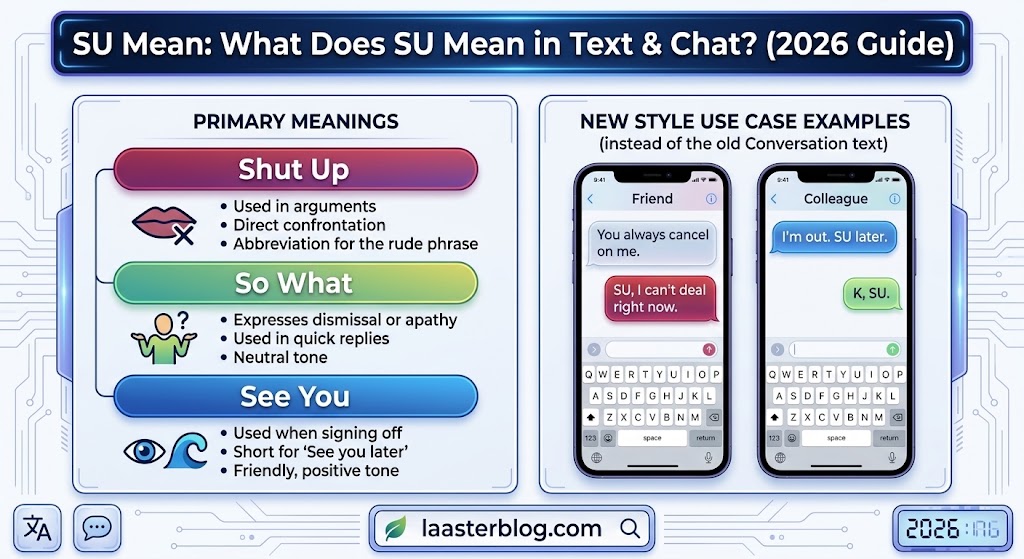
3. See Up (Chat Reference Shorthand)
Occasionally used in fast-moving group chats or team messaging to direct someone to a message sent earlier in the thread (“Check the address SU”).
Straightforward, no confusion there. Context instantly tells you which version you are dealing with.
What Does SU Mean From a Guy vs. a Girl?
Sender intent and social proximity heavily influence how SU lands in a live chat.
When a Guy Sends “SU”
- In Group Texts with Guys: Almost always means “Shut Up.” It is typically dropped as playful banter during gaming sessions, sports debates, or lighthearted teasing.
- In a Direct Message: If sent in response to a serious point, it functions as a blunt, direct shutdown. If paired with laughing emojis (“su 💀”), it signals sarcastic amusement.
When a Girl Sends “SU”
- In Casual Chat / Gossip: Frequently acts as an exclamation of disbelief—similar to “Shut the front door!” or “Are you serious?!”
- On Social Stories: Usually stands for “Swipe Up” when sharing aesthetic links, outfit details, or private story updates.
That’s not a glitch—slang always adapts to match social dynamics and personal communication styles.
Quick Reference Table: SU Breakdown
| Property | Primary Meaning | Short Meaning | Common Tone | Suitable For | Not Suitable For |
| Direct Texting | Shut Up | Silence / Stop talking | Blunt, impatient, or shocked | Informal SMS, close friends, group chats | Work emails, professional client chats |
| Social Media Stories | Swipe Up | Open link / View content | Instructive, casual | Snapchat stories, Instagram, TikTok captions | Academic papers, formal announcements |
| Thread References | See Up | Look at higher message | Informational, quick | Busy group threads, quick updates |
Origin, History & Evolution of SU
The abbreviation SU originated during the early days of SMS texting and instant messaging (like AIM and MSN Messenger) in the late 1990s and early 2000s, when character limits required extreme brevity. “Shut up” was naturally shortened alongside other staple acronyms like STFU (Shut The F*** Up) and GTFO (Get The F*** Out).
As mobile apps evolved in the mid-2010s, Snapchat introduced the swipe-up gesture for links and stories, giving SU a secondary life as a widely recognized creator call-to-action.
Over the years, its tone has softened in casual conversation. While telling someone to “shut up” in person can feel harsh, texting SU among close friends has become a standard form of rapid banter or dramatic reaction.
Usage Across Social Media Platforms
How users type and interpret SU varies slightly across different apps:
- Snapchat: Predominantly means “Swipe Up” on public stories or private snap replies. In text chats, it defaults to “Shut Up.”
- TikTok: Frequently seen in comment sections. Users drop “SU” to shut down trolls or express shock at a viral video’s twist.
- Instagram: Used in story captions (“SU for link”) or in DMs as quick shorthand.
- WhatsApp & iMessage: Used almost exclusively as “Shut Up” or “See Up” during ongoing text exchanges.
Real Chat Examples & Real-World Scenarios
Here is how SU looks in actual daily conversations:
Scenario 1: Playful Disbelief (Shut Up)
Friend A: I just bumped into Taylor Swift at the coffee shop!
Friend B: SU! No way, show me the picture right now 😭
Scenario 2: Direct Banter / Annoyance (Shut Up)
Friend A: You’re definitely losing this FIFA game tonight.
Friend B: Bro su, you haven’t won a match all week.
Scenario 3: Call-to-Action (Swipe Up)
Creator Post: New vlog is officially live on YouTube! SU to watch the full video 🎬
Common Confusions, Mistakes & Wrong Interpretations
Because SU is a two-letter acronym, misinterpretations happen frequently outside casual text threads.
Non-Slang Meanings of SU:
- Higher Education: Syracuse University, Stanford University, or Seattle University.
- Tech / Systems: Superuser (Linux/Unix administrative command
su). - Corporate / Organizations: Student Union or Service Unit.
- Geographic / Country Code: Soviet Union (historical) or Sudan (.su domain).
Mistakes to Avoid:
- Sending it to authority figures: Never use SU when texting a boss, teacher, or client. Even as a joke, it reads as disrespectful in formal settings.
- Misinterpreting shock as anger: If a friend texts “SU!” right after you share good news, don’t take offense—they are expressing excitement, not telling you to be quiet.
Similar Terms, Alternatives & Cleaner Substitutes
If you want to vary your vocabulary or need a clearer alternative, consider these options:
Slang & Internet Alternatives:
- STFU — Stronger, more vulgar version of shut up.
- Hush / Zip it — Mild, playful ways to tell someone to quiet down.
- No way / Stop it — Cleaner expressions for disbelief.
- WYS (Whatever You Say) — Casual dismissal alternative.
Professional Substitutes:
- “Please hold on a moment.”
- “Let’s refer to the previous message above.”
- “Please see the link attached.”
How to Reply When Someone Uses SU
Your response depends on which definition and tone the sender is using:
1. When sent in playful shock (“SU! You’re lying!”)
- “I swear I’m not lying! Look at the proof.”
- “Right?! I couldn’t believe it either!”
2. When sent during light banter (“Bro su lol”)
- “Make me 😂”
- “Truth hurts!”
3. When sent as a call-to-action (“SU for link”)
- Simply swipe up on the story or reply with a reaction emoji.
Is SU Still Popular in 2026?
Yes. SU remains widely used across messaging platforms and social networks. Because fast-paced texting demands ultra-short acronyms, two-letter terms like SU, WYD (What You Doing), and IDK (I Don’t Know) continue to hold strong staying power in modern internet culture.
Conclusion & The 1-Rule Golden Takeaway
In short: SU most often means Shut Up in direct text chats and Swipe Up on social media stories.
The Golden Rule for SU: Check the punctuation and context. If it’s accompanied by exclamation marks or dramatic news, it’s excitement; if it’s a single lowercase word in an argument, it’s a shutdown.
