


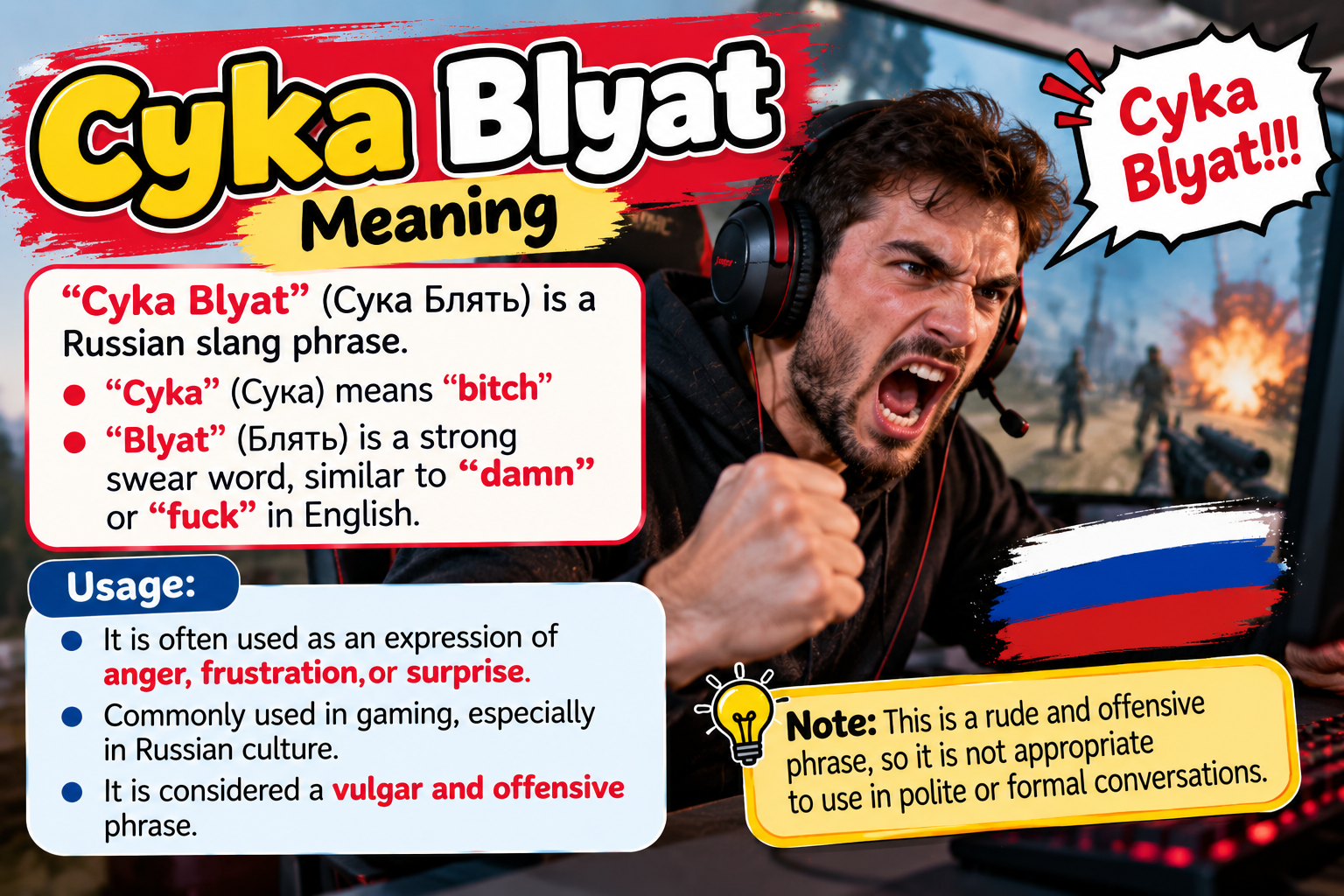
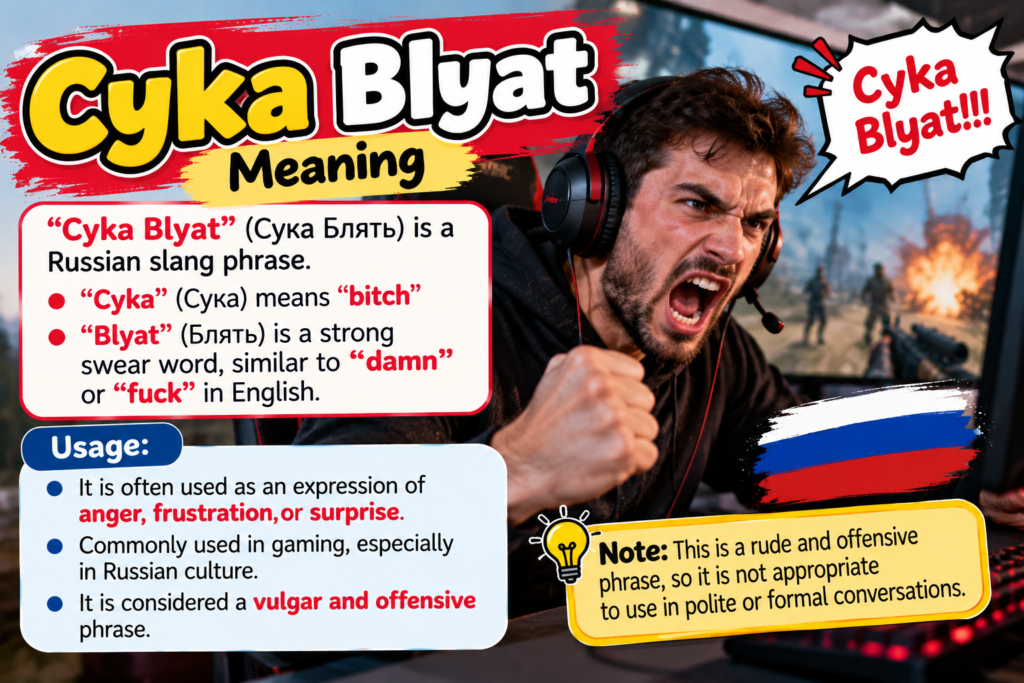
“Cyka blyat” (cyka блять) is a harsh Russian profanity that translates literally to “bitch, whore,” but functions functionally like the English phrase “holy shit” or “fuck.” It combines two distinct Russian curse words—cyka (bitch) and blyat (whore/prostitute)—to form an all-purpose expression of anger, shock, frustration, or emphasis.
If you have spent any time in multiplayer gaming lobbies like Counter-Strike: Global Offensive (CS:GO) or scrolled through Slav squatting memes, you have inevitably encountered this phrase. Yet behind its ubiquitous internet fame lies a complex linguistic background that reflects the nuances of Russian mat (profanity culture). Understanding the cyka blyat meaning requires peeling back the layers of literal definitions, emotional triggers, and digital pop culture evolution.
Here is everything you need to know about where the phrase comes from, how it is used, and why it became an international meme.
What Does Cyka Blyat Mean? Literal vs. Functional Context
To grasp the full picture, you have to break the expression down into its two individual linguistic components:
- Cyka (сука): Phonetically pronounced “soo-kah”, this noun literally translates to “bitch” (a female dog). In Russian profanity, it serves as an insult directed at a person or an exclamation of spite.
- Blyat (блять / блядь): Phonetically pronounced “blyaht”, this word literally means “whore” or “prostitute.” However, in everyday Russian slang, it is used as a filler word or interjection—much like “fuck” or “damn” in English.
When combined into cyka blyat, the phrase rarely refers to an actual person’s character or profession. Instead, it operates as a high-intensity vulgar interjection.
Common Russian Curse Words & Functional Meanings
| Russian Term | Literal Translation | Functional English Equivalent | Tone / Intensity |
| Cyka (сука) | Bitch | “Bitch” / “Damn it” | Moderate to High |
| Blyat (блять) | Whore / Prostitute | “Fuck!” / “Damn!” | High (Filler / Exclamation) |
| Cyka Blyat (сука блять) | Bitch, Whore | “Holy fuck!” / “Fucking bitch!” | Extreme Vulgarity |
| Idi nahui (иди нахуй) | Go on a dick | “Fuck off” / “Go to hell” | Very Severe Insult |
| Pizdec (пиздец) | Catastrophe (vagina root) | “Total disaster” / “We’re fucked” | Extreme Vulgarity |
Linguistic & Naming Psychology: Why Russian Profanity Sounds So Intense
Russian profanity belongs to a unique linguistic sub-category known as mat (мат)—an extensive matrix of taboo language built around core obscene roots. Unlike standard English curses, mat allows speakers to modify roots with prefixes, suffixes, and inflections to express almost any emotion.
From a phonetic standpoint, cyka blyat carries hard, aggressive consonants:
- The sibilant “S” and hard “K” in cyka hit the ear sharply.
- The plosive “B” and trailing “T” sound in blyat give it a natural punchiness.
This combination of sharp phonetics and explosive delivery makes the phrase instantly recognizable, even to non-Russian speakers. The emotional trigger is direct, visceral, and unvarnished.
How “Cyka Blyat” Became an Internet & Gaming Meme
The massive global explosion of the term cyka blyat can be traced directly to tactical multiplayer video games, specifically CS:GO, Dota 2, and Rainbow Six Siege.
During the late 2000s and 2010s, European gaming servers regularly grouped Eastern European and Western European players together. Because Russian gamers frequently communicated in their native language over in-game voice chat, non-Russian players were repeatedly exposed to common Russian curse words uttered during high-stress moments.
Gaming Culture Diffusion Timeline
<h2 class="timeline-title">
    Gaming Culture Diffusion Timeline
</h2>

<p class="timeline-subtitle">
    From regional gaming communities to a global internet meme
</p>

<div class="timeline">

    <!-- Phase 1 -->
    <div class="timeline-item">

        <div class="timeline-number">1</div>

        <div class="timeline-card">

            <div class="timeline-phase">
                Phase 1
            </div>

            <h3>
                Regional Russian Servers
            </h3>

            <p>
                Gaming slang develops and spreads within
                regional Russian-speaking gaming communities.
            </p>

        </div>

    </div>

    <div class="timeline-arrow">➜</div>

    <!-- Phase 2 -->
    <div class="timeline-item">

        <div class="timeline-number">2</div>

        <div class="timeline-card">

            <div class="timeline-phase">
                Phase 2
            </div>

            <h3>
                EU Multi-region Lobbies
            </h3>

            <p>
                Players from different countries encounter
                the expressions during multiplayer gaming.
            </p>

        </div>

    </div>

    <div class="timeline-arrow">➜</div>

    <!-- Phase 3 -->
    <div class="timeline-item">

        <div class="timeline-number">3</div>

        <div class="timeline-card">

            <div class="timeline-phase">
                Phase 3
            </div>

            <h3>
                Twitch / YouTube Gaming Clips
            </h3>

            <p>
                Memorable gaming moments and slang spread
                through livestreams, clips, and videos.
            </p>

        </div>

    </div>

    <div class="timeline-arrow">➜</div>

    <!-- Phase 4 -->
    <div class="timeline-item">

        <div class="timeline-number">4</div>

        <div class="timeline-card">

            <div class="timeline-phase">
                Phase 4
            </div>

            <h3>
                Global Internet Meme
            </h3>

            <p>
                The expression reaches a wider online audience
                and becomes recognizable beyond gaming communities.
            </p>

        </div>

    </div>

</div>

<div class="timeline-note">
    <strong>Timeline:</strong>
    Regional gaming communities → international multiplayer
    interactions → streaming platforms → broader internet culture.
</div>
Key Factors Behind Its Meme Status
- Rush B Culture: In CS:GO, the phrase “Rush B, cyka blyat” became an iconic battle cry for aggressive, reckless tactics on the map Dust II.
- Gopnik & Hardbass Aesthetics: The term quickly merged with the “Gopnik” subculture meme—stereotypical depictions of tracksuited Eastern European youths, squatting, drinking cheap lager, and listening to high-BPM Russian hardbass.
- Streamer & Content Creator Usage: Top gaming creators popularized the phrase across YouTube, Twitch, and Reddit, turning regional profanity into a global inside joke.
Common Pitfalls When Using or Interpreting the Term
Understanding cyka blyat as an online meme is fine, but using it in real-world contexts requires caution. Here are three critical mistakes people make:
- Using it in polite or formal company: In Russian-speaking countries, mat is strictly taboo in professional, educational, or family settings. Using cyka blyat in public can lead to social ostracization or legal fines for public swearing in certain regions.
- Assuming it always targets a person: Non-Russian speakers often think the phrase is a direct personal insult. In practice, Russians frequently use it as an exclamation when stubbing a toe, losing a game match, or dropping an object.
- Misspelling the Cyrillic spelling: The native script is сука блять. Writing “cyka” using the Latin alphabet is an internet convention based on visual similarity (cyrillic c = English s, cyrillic y = English u).
Strategic Context: Cultural Nuance in Global Communication
Whether analyzing digital subcultures, localization in media, or global gaming communities, context dictates impact.
Context Spectrum
<h2 class="context-title">
    CONTEXT SPECTRUM
</h2>

<table class="context-table">

    <thead>
        <tr>
            <th>INFORMAL / GAMING</th>
            <th>REAL-WORLD / PROFESSIONAL</th>
        </tr>
    </thead>

    <tbody>

        <tr>

            <!-- Informal / Gaming -->
            <td>

                <ul class="context-list">

                    <li>
                        <span class="label">In-game banter</span>
                    </li>

                    <li>
                        <span class="label">
                            Meme videos & Twitch chat
                        </span>
                    </li>

                    <li>
                        <span class="label">Intent:</span>
                        Exclamation / Humor
                    </li>

                </ul>

            </td>

            <!-- Real-world / Professional -->
            <td>

                <ul class="context-list">

                    <li>
                        <span class="label">Offensiveness:</span>
                        <span class="high">High</span>
                    </li>

                    <li>
                        <span class="label">Cultural Reception:</span>
                        <span class="taboo">Taboo</span>
                    </li>

                    <li>
                        <span class="label">Intent:</span>
                        <span class="severe">
                            Severe disrespect
                        </span>
                    </li>

                </ul>

            </td>

        </tr>

    </tbody>

</table>

<div class="context-note">
    <strong>Context matters:</strong>
    The meaning and perceived offensiveness of slang can change
    significantly depending on the setting, audience, intent, and culture.
</div>When building media, content, or brands aimed at international audiences, recognizing how local slang translates into global pop culture helps creators avoid offensive blunders while authentically understanding community discourse.
Frequently Asked Questions
Is “cyka blyat” a legal or bannable phrase on gaming platforms?
While occasional swearing is common in online gaming, repeatedly using severe Russian curse words or directing cyka blyat aggressively at other players can violate harassment policies on platforms like Twitch, Discord, or Steam.
How do you spell “cyka blyat” in real Russian script?
In real Cyrillic script, it is written as сука блять (or сука блядь). The spelling “cyka” is a visual transliteration popularized by Western internet users.
What is the difference between “blyat” and “blyad”?
In written Russian, блядь (with a ‘d’) traditionally refers to a woman of easy virtue, while блять (with a ‘t’) is the modern interjection equivalent to “fuck!” or “damn!” In spoken language, both sound virtually identical.
The 1-Rule Golden Takeaway
Intention and context drive linguistic meaning—what functions as a lightweight joke in a Twitch chat is a severe, unacceptable insult in real-world Russian society.
