


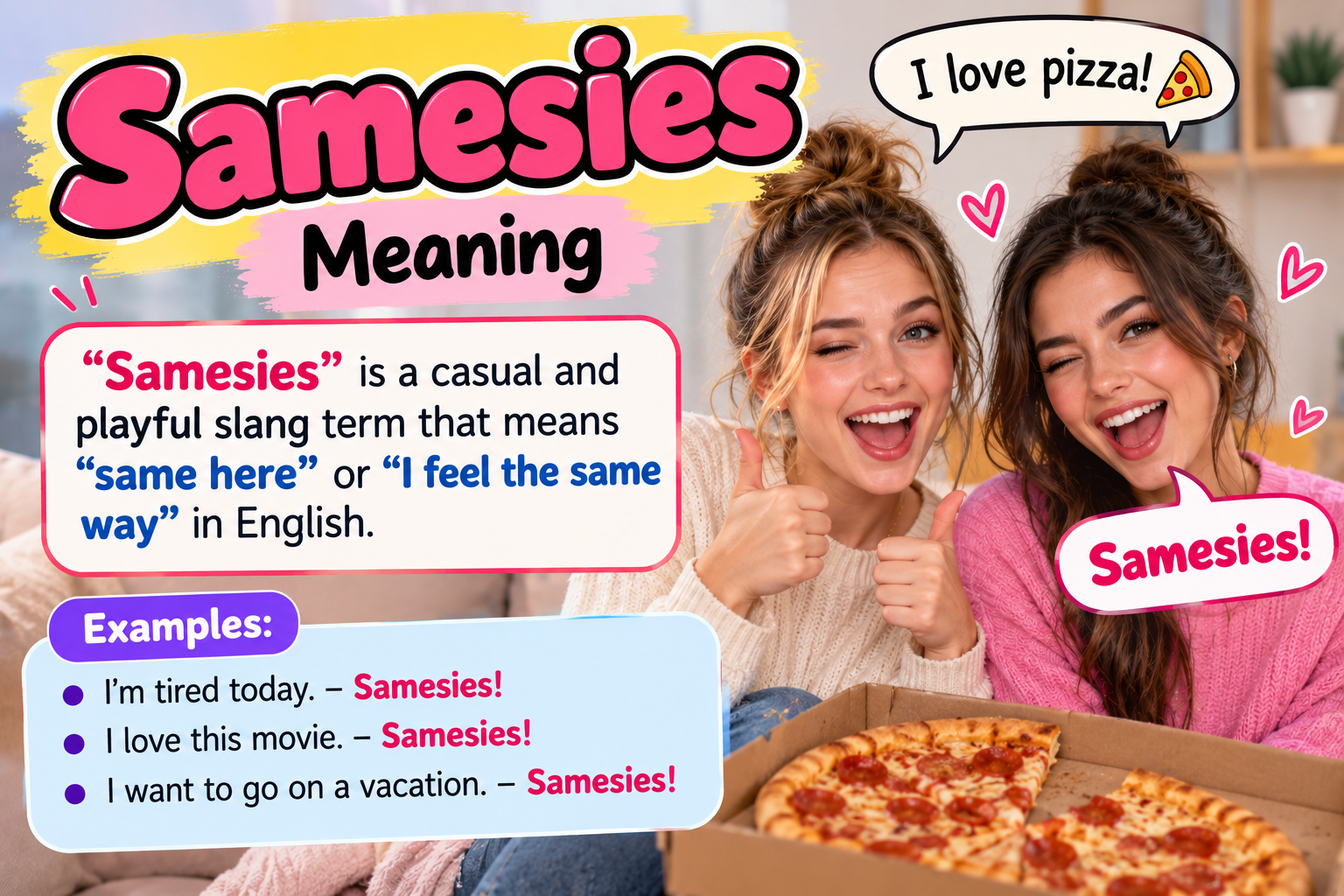
Samesies meaning refers to an informal, playful slang term used to express agreement, shared experience, or mutual sentiment, functioning as an affectionate equivalent of “same here” or “me too.” Originating in casual conversational English, it softens agreement by adding a friendly, lighthearted tone to personal interactions and relatable brand messaging.
While generic vocabulary lists treat slang as mere conversational filler, successful identity design requires understanding how casual phrasing impacts audience perception. When integrating a same meaning alternative into a brand strategy, conversational copy, or tagline, tone dictates whether your message feels authentically approachable or forced.
Here is everything you need to know about linguistic origins, brand positioning, and alternative phrasing.
The Origin and Cultural Vibe of “Samesies”
Slang relies heavily on diminutive suffixes—like adding -sies or -ies to standard words—to reduce formal distance between speakers.
- Phonetic Structure: The addition of the double “s” sound ($/z/$) creates a soft, approachable cadence.
- Emotional Trigger: It signals camaraderie, low stress, and immediate consensus.
- Brand Vibe: Playful, informal, youthful, and highly relatable.
Categorized Name Lists & Conversational Alternatives
When choosing a same meaning alternative for brand names, product collections, or conversational copy, the specific term you select sets the emotional benchmark.
1. Casual & Conversational
- Samesies | Informal, affectionate consensus | Best For: Youth lifestyle brands, community apps, casual copy
- Ditto | Classic, crisp repetition | Best For: Minimalist tech, note-taking tools, modern utilities
- Twinem | Playful slang for identical traits | Best For: Social platforms, matching apparel lines
2. Aesthetic & Modern
- Echo | Resonant reflection | Best For: Audio tech, podcast networks, media brands
- Mirror | Exact match, clear alignment | Best For: Skincare, personal growth platforms, fitness
- Parallel | Symmetrical alignment | Best For: Fintech, collaborative tools, logistics
3. Professional & Minimalist
- Aligned | Strategic agreement | Best For: B2B consulting, project management tools
- Consensus | Shared vision and unity | Best For: Governance platforms, analytics tools
- Unison | Harmonious synchronization | Best For: Team workspace apps, music tech
Linguistic & Naming Psychology Breakdown
Here’s where most founders get it wrong: they pick conversational words based purely on current popularity rather than structural resonance.
The psychological pull behind samesies meaning relies on immediate warmth. Words with soft vowel endings and repeated sibilant consonants feel less aggressive to the human ear. They lower defensive barriers in consumer messaging.
Conversely, choosing a formal same meaning alternative like Symmetrical or Identical shifts audience brain activity from emotional resonance to analytical evaluation.
- Soft Slang: Triggers feelings of belonging, peer-level connection, and low friction.
- Structured Synonyms: Trigger feelings of precision, reliability, and enterprise stability.
Comparison & Meaning Matrix
| Name / Term | Meaning / Vibe | Ideal Industry / Brand Fit |
| Samesies | Lighthearted, playful mutual agreement | Gen-Z consumer products, meme marketing, social apps |
| Ditto | Retro, concise, effortless agreement | Productivity tools, modern consumer packaged goods (CPG) |
| Echo | Sophisticated, lingering reflection | Media networks, audio hardware, communication suites |
| Sync | Dynamic, seamless harmony | Software-as-a-Service (SaaS), cloud storage, habit trackers |
| Twinning | Enthusiastic, identical pairing | E-commerce apparel, friend-finding platforms |
Common Pitfalls When Selecting Conversational Brand Names
No jargon, just facts. Using informal slang as a core brand identifier carries real operational risks:
- Trend Friction: Slang terms evolve rapidly. A word that feels fresh today can feel dated within three years.
- Trademark Bottlenecks: Common conversational phrases face high saturation in trademark registries, making global registration tricky.
- Scaling Limitations: Extremely casual phrasing can anchor your product to consumer-facing markets, hindering future expansion into enterprise or B2B sectors.
- Pronunciation & Localization: Diminutive English slang often fails to translate cleanly across international markets, confusing non-native speakers.
Strategic Selection Framework
Before locking in a name rooted in casual language or shared identity, run it through this four-step validation process:
- Test for Tone Fit: Does the informal nature of the word match your brand’s core positioning, or does it clash with your price point?
- Verify Domain & Legal Availability: Ensure clear clearance across the main domain extensions (.com, .io, .co) and class-specific trademark registries.
- Check Contextual Versatility: Does the phrase work as a headline, an app icon, and a verb in everyday conversation?
- Evaluate Longevity: Confirm the word relies on evergreen linguistic structures rather than a short-lived viral trend.
Frequently Asked Questions
What is the primary samesies meaning in modern English?
Samesies meaning describes an informal, lighthearted way of saying “me too” or “I agree.” It is primarily used in casual verbal conversations, digital messaging, and playful brand copy to establish instant rapport.
What is a professional same meaning alternative for corporate communication?
In professional or corporate environments, ideal alternatives include terms like Aligned, Consensus, In Agreement, Synchronized, or Parallel. These preserve the concept of shared alignment without relying on casual slang.
Can slang terms like “Samesies” be trademarked for a business name?
Yes, slang terms can be trademarked provided they are available in your specific commercial class and do not cause confusion with existing registered marks. However, distinctive spelling variations or brand pairings often improve approval rates.
The 1-Rule Golden Takeaway
Match your naming architecture to the exact emotional weight of the problem you solve—slang builds instant intimacy, but clarity builds enduring authority.
