


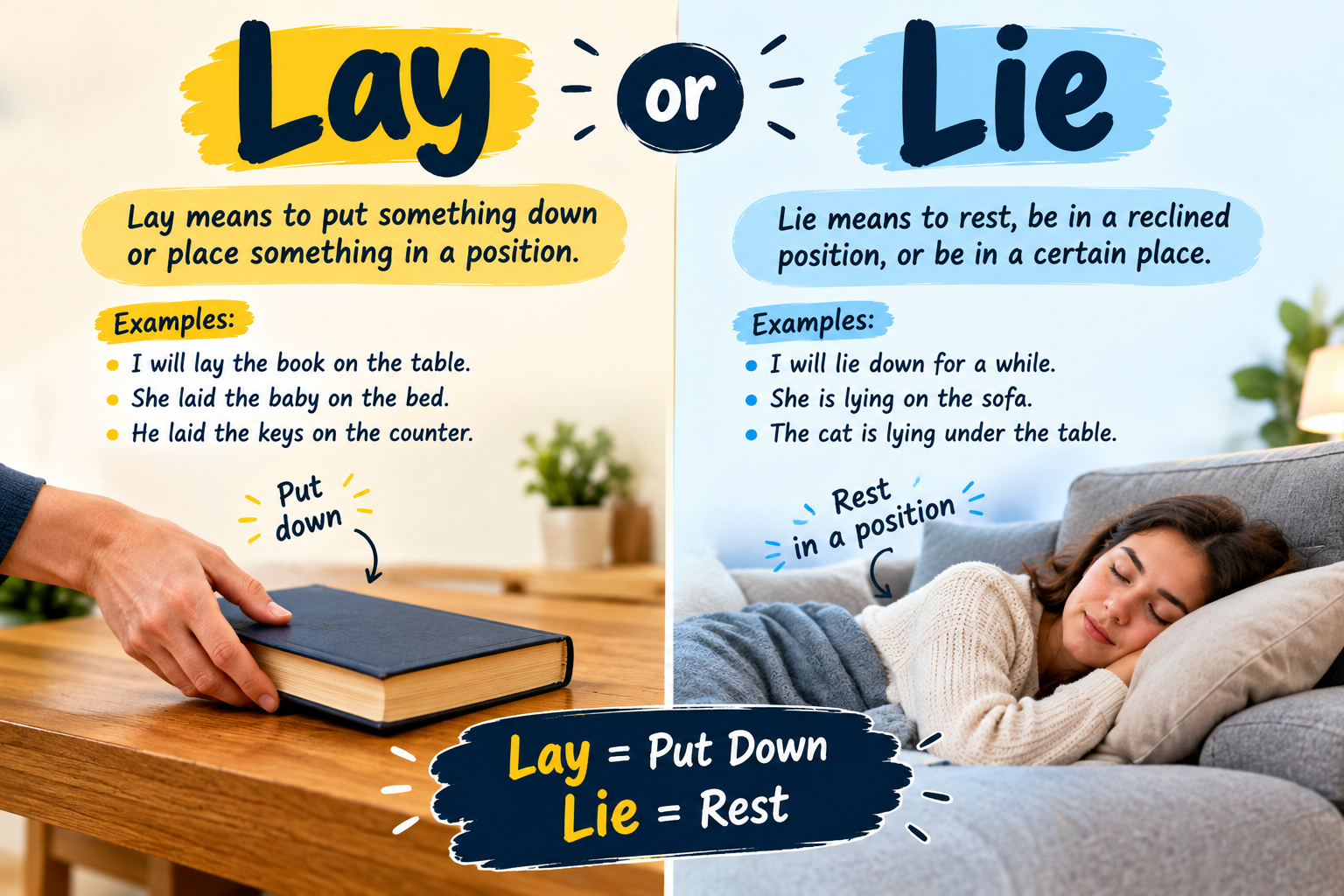
Lay or Lie means to place or put an object down horizontally, requiring a direct object (e.g., “lay the book down”), while “lie” means to recline or rest in a flat position yourself without a direct object (e.g., “I need to lie down”). Choosing between the two comes down to whether an action is being performed on an object or by a person.
Overview of “Lay” vs. “Lie” in Modern Conversations
Mixing up these two verbs is one of the most common grammar traps in everyday messaging, social media captions, and casual voice notes.
The confusion stems from a tricky grammatical overlap: the past tense of lie is actually lay (“Yesterday, I lay in bed all morning”). Because people hear “lay” used in both present and past contexts, modern slang and conversational English frequently merge them together. However, knowing the boundary between placing an item (lay) and resting your body (lie) keeps your writing accurate across professional emails and personal texts.
What Does “Lay” vs. “Lie” Mean in Text & Chat?
What Does “Lay” Mean?
Lay is a transitive verb, meaning it always takes a direct object. You must lay something down.
- Core Meaning: To place, set, or put something down carefully.
- Texting Tone: Practical, action-focused, instructional.
- Chat Example: “Can you lay the keys on the counter before you leave?”
What Does “Lie” Mean?
Lie is an intransitive verb, meaning it does not take a direct object. It describes the subject reclining or resting.
- Core Meaning: To assume a resting, horizontal position, or (in a secondary definition) to state an untruth.
- Texting Tone: Relaxed, personal, tired, self-referential.
- Chat Example: “I’m so exhausted, I just want to go lie down for an hour.”
What Does “Lay” or “Lie” Mean From a Guy vs. a Girl?
Context and tone shift how these terms are used across casual texts and group chats.
When Sent by a Guy
- “Going to lie down”: A straightforward update signaling he is tired, taking a break, or going off-grid for a bit.
- “Lay low”: A common phrase meaning staying quiet, avoiding drama, or relaxing at home.
When Sent by a Girl
- “I need to lie down 😩”: Often used as an expressive reaction after an overwhelming day, funny gossip, or high-stress situation.
- “Lay it all out”: Encouraging a friend to share the full story or give all the details without holding back.
Quick Reference Table
| Term | Part of Speech | Primary Meaning | Common Tone | Suitable For | Not Suitable For |
| Lay | Transitive Verb | To place or put something down | Direct, instructional | Placing objects (“lay the phone down”) | Reclining yourself without an object ❌ |
| Lie | Intransitive Verb | To recline, rest, or tell an untruth | Relaxed, personal, reflective | Human rest (“lie down”), untruths (“don’t lie”) | Placing objects (“lie the book down” ❌) |
Origin, History & Evolution
Both terms originate from Old English roots that preserved distinct meanings:
- Lay derives from the Old English lecgan, meaning “to cause to lie down” or “to place.” It has always functioned as a causal, action-driven verb.
- Lie traces back to Old English licgan, meaning “to be situated” or “to recline.”
Over centuries, colloquial speech gradually blurred the lines between the two, especially in American English where “lay down” became a ubiquitous substitute for “lie down.” In 2026 digital communication, while “lay down” is widely accepted in casual group chats, formal writing and AI-driven content standards still strictly enforce the classical distinction.
Usage Across Social Media Platforms
WhatsApp & iMessage
- Lay: Used for instructions and logistics.
- Text: “Please lay the package by the front door.”
- Lie: Used for personal status updates and wellness checks.
- Text: “Feeling a bit sick, going to lie down for a bit.”
Instagram & TikTok
- Lay: Appears in aesthetic setup guides, interior design, and flat-lay photo trends.
- Caption: “How to lay out your workspace for maximum focus ✨”
- Lie: Featured in viral reaction formats, cozy day-in-the-life vlogs, and meme commentary.
- Caption: “Me choosing to lie in bed instead of facing my responsibilities 🛌”
Snapchat
- Lay: Snaps showing gear, haul items, or outfits laid out before a trip.
- Lie: Snaps showing cozy setups, late-night movie streams, or relaxing in bed.
Real Chat Examples & Real-World Scenarios
Scenario 1: Casual Weekend Planning (WhatsApp)
Friend A: Hey, are we still meeting up for coffee at 3 PM?
Friend B: Can we push it to 4 PM? I spent all morning moving furniture and I really need to lie down for 30 minutes.
Friend A: No worries at all! Lay your phone on silent and get some rest.
Scenario 2: Remote Work Update (Slack)
Colleague A: Where should I upload the new graphics files?
Colleague B: Just lay them in the shared assets folder so everyone can access them.
Colleague A: Sounds good, doing that right now!
Common Confusions, Mistakes & Wrong Interpretations
Here are the most frequent grammatical traps to avoid:
1. The Tense Confusion Matrix
The biggest source of error is how the verb tenses shift across time:
| Verb | Base Form (Present) | Past Tense | Past Participle | Present Participle (-ing) |
| Lay (Put object) | Lay | Laid | Laid | Laying |
| Lie (Recline self) | Lie | Lay | Lain | Lying |
| Lie (Untruth) | Lie | Lied | Lied | Lying |
- Notice the overlap: The past tense of lie is lay!
- Present: “I lie down today.”
- Past: “Yesterday, I lay down for two hours.”
2. The Direct Object Test
To pick the right word, ask: “Am I putting something down, or am I resting myself?”
- If there is an object $\rightarrow$ Lay (“Lay the carpet”).
- If there is NO object $\rightarrow$ Lie (“Lie on the couch”).
3. “Laying” vs. “Lying”
- Incorrect: “I’m laying in bed right now.”
- Correct: “I’m lying in bed right now.”
Similar Terms, Alternatives & Cleaner Substitutes
Alternatives for “Lay”
- Place / Set: Clear, unambiguous verbs for putting items down.
- Position / Deposit: Formal options for placing objects.
Alternatives for “Lie”
- Recline / Rest: Precise alternatives for personal positioning.
- Lounge / Nap: Conversational substitutes for relaxing.
How to Reply When Someone Uses These Terms
When Someone Sends: “I need to lie down!”
- Supportive: “Take a restful break! Catch up with you later.”
- Casual: “Get some rest! Hope you feel recharged soon.”
When Someone Says: “Where should I lay this?”
- Direct: “You can set it right on the table.”
- Workplace: “Please place it in the designated inbox.”
- Notice the overlap: The past tense of lie is lay!
- Present: “I lie down today.”
- Past: “Yesterday, I lay down for two hours.”
2. The Direct Object Test
To pick the right word, ask: “Am I putting something down, or am I resting myself?”
- If there is an object $\rightarrow$ Lay (“Lay the carpet”).
- If there is NO object $\rightarrow$ Lie (“Lie on the couch”).
3. “Laying” vs. “Lying”
- Incorrect: “I’m laying in bed right now.”
- Correct: “I’m lying in bed right now.”
Similar Terms, Alternatives & Cleaner Substitutes
Alternatives for “Lay”
- Place / Set: Clear, unambiguous verbs for putting items down.
- Position / Deposit: Formal options for placing objects.
Alternatives for “Lie”
- Recline / Rest: Precise alternatives for personal positioning.
- Lounge / Nap: Conversational substitutes for relaxing.
How to Reply When Someone Uses These Terms
When Someone Sends: “I need to lie down!”
- Supportive: “Take a restful break! Catch up with you later.”
- Casual: “Get some rest! Hope you feel recharged soon.”
When Someone Says: “Where should I lay this?”
- Direct: “You can set it right on the table.”
- Workplace: “Please place it in the designated inbox.”
- Notice the overlap: The past tense of lie is lay!
- Present: “I lie down today.”
- Past: “Yesterday, I lay down for two hours.”
2. The Direct Object Test
To pick the right word, ask: “Am I putting something down, or am I resting myself?”
- If there is an object $\rightarrow$ Lay (“Lay the carpet”).
- If there is NO object $\rightarrow$ Lie (“Lie on the couch”).
3. “Laying” vs. “Lying”
- Incorrect: “I’m laying in bed right now.”
- Correct: “I’m lying in bed right now.”
Similar Terms, Alternatives & Cleaner Substitutes
Alternatives for “Lay”
- Place / Set: Clear, unambiguous verbs for putting items down.
- Position / Deposit: Formal options for placing objects.
Alternatives for “Lie”
- Recline / Rest: Precise alternatives for personal positioning.
- Lounge / Nap: Conversational substitutes for relaxing.
How to Reply When Someone Uses These Terms
When Someone Sends: “I need to lie down!”
- Supportive: “Take a restful break! Catch up with you later.”
- Casual: “Get some rest! Hope you feel recharged soon.”
When Someone Says: “Where should I lay this?”
- Direct: “You can set it right on the table.”
- Workplace: “Please place it in the designated inbox.”
Is “Lay” or “Lie” Still Popular? (Current Trends)
Both words maintain massive search volume across educational portals, dictionary engines, and writing assistance platforms. Lie experiences steady search peaks around health, sleep hygiene, and daily lifestyle contexts, while lay dominates queries related to design layouts, legal terminology, and grammar reference guides.
Conclusion & Final Takeaway
Keep your messaging clear with one core rule:
LAY requires an object (you lay SOMETHING down). LIE does not require an object (YOU lie down yourself).
