


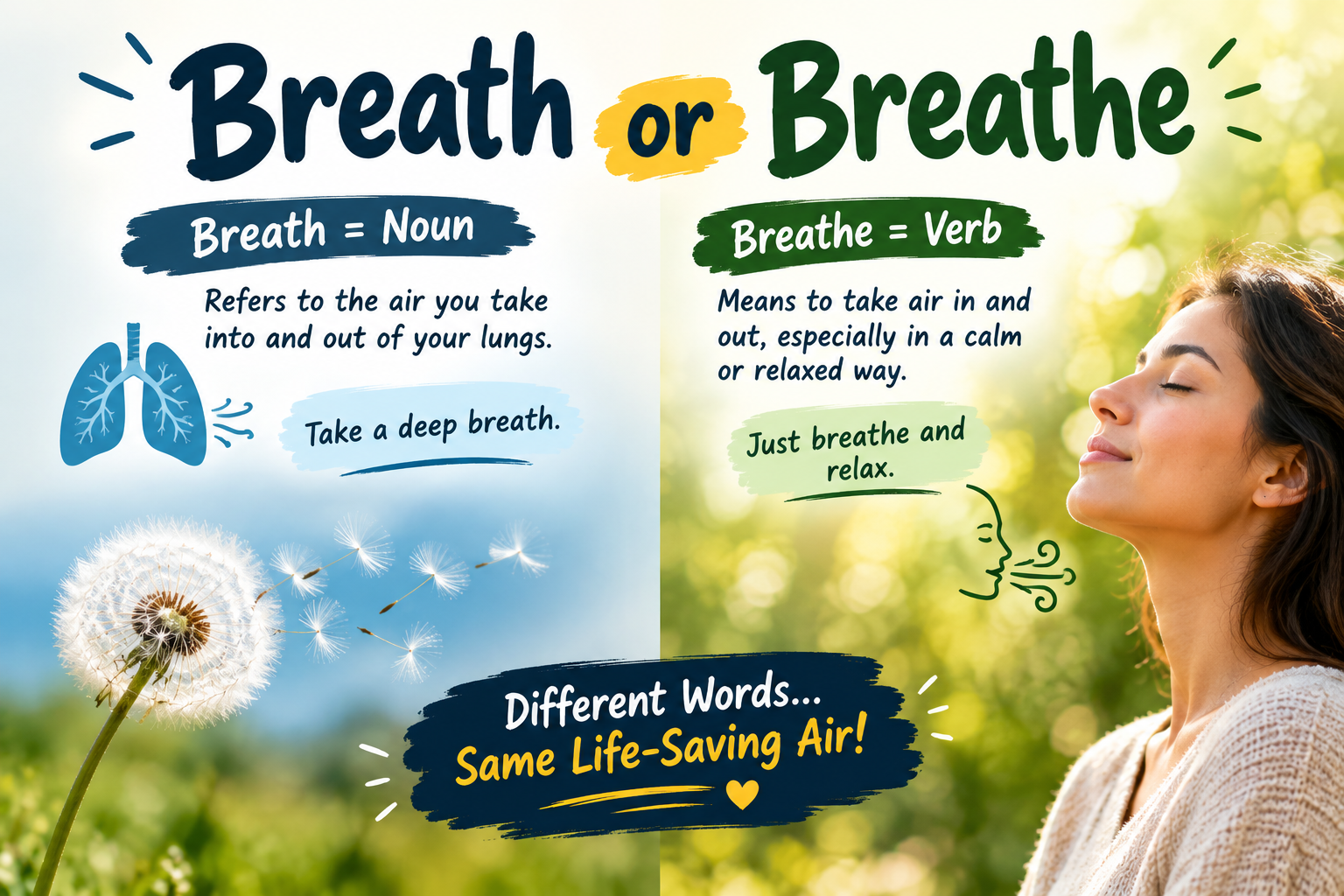
Breath or Breathe (rhymes with death) is a noun referring to the actual air inhaled and exhaled, while “breathe” (rhymes with seethe) is a verb describing the physical act of inhaling and exhaling air. Dropping or adding that silent “e” changes your sentence structure entirely from a physical substance or moment (“catch your breath”) to an active process or emotional reset (“remember to breathe”).
Overview of “Breath” vs. “Breathe” in Modern Conversations
It happens all the time in high-speed text threads and Slack messages. You want to tell someone to calm down or pause during a hectic day, but auto-correct steps in and drops the trailing E.
Because breath and breathe look almost identical on a screen, they are two of the most frequently confused words in daily communication. In modern digital discourse—from fitness trackers reminding you to take a moment to anxious group chats during exam weeks—getting the spelling right keeps your message grounded, clear, and punchy.
What Does “Breath” vs. “Breathe” Mean in Text & Chat?
What Does “Breath” Mean?
Breath is a noun that represents the actual puff or cycle of air entering and leaving your lungs.
- Literal Meaning: The physical air taken into or let out from the lungs (e.g., “bad breath,” “out of breath”).
- Figurative/Texting Meaning: Used in phrases to describe shock, awe, or taking a quick pause (e.g., “breathtaking,” “take a breath”).
- Tone: Observational, descriptive, reflective.
- Chat Example: “Take a deep breath before you open those test results!”
What Does “Breathe” Mean?
Breathe is an action verb that describes the biological or psychological movement of air.
- Literal Meaning: The active physical process of respiration (e.g., “It’s hard to breathe up here”).
- Figurative/Texting Meaning: A modern mental health or emotional anchor telling someone to ground themselves, stop panicking, or step away from stress.
- Tone: Directive, supportive, calm, grounding.
- Chat Example: “Hey, stop overthinking the presentation. Just breathe!”
What Does “Breath” or “Breathe” Mean From a Guy vs. a Girl?
Context and sender dynamics shape how these words function across personal and social messages.
When Sent by a Guy
- “Take a breath”: Usually literal or practical advice. He sees you getting overwhelmed or rushing through a task and suggests slowing down for a second.
- “Can’t breathe 💀”: Common modern internet slang used when something is exceptionally funny, absurd, or shocking.
When Sent by a Girl
- “Just breathe 🤍”: Carries a strong supportive and empathetic tone. It serves as a gentle reminder to pause, de-stress, and regain composure during chaotic moments.
- “Give me room to breathe”: Signals a boundary setting—asking for personal space or time to think without pressure.
Quick Reference Table
| Term | Part of Speech | Short Meaning | Common Tone | Suitable For | Not Suitable For |
| Breath | Noun | The air itself / single inhalation | Descriptive, reflective | “Out of breath”, “deep breath”, “breathtaking” | Action commands (“just breath” ❌) |
| Breathe | Verb | The physical/mental action of inhaling/exhaling | Direct, grounding, supportive | “Remember to breathe”, “breathe in/out”, “let me breathe” | Noun contexts (“hold your breathe” ❌) |
Origin, History & Evolution
Both terms trace back to Old English, reflecting deep historical roots in Germanic linguistics:
- Breath stems from the Old English bræþ, meaning “odor, scent, exhalation, or vapor.” Over centuries, its meaning narrowed specifically to the air exhaled from human lungs.
- Breathe developed as a derivative verb from the noun bræþ around the 13th and 14th centuries, adopting the final -e to signal the long vowel sound (/biːð/).
In 2026 digital culture, “breathe” has exploded as a mental health keyword, featured in wellness apps, smartwatch breathing prompts, and mindfulness trends. “Breath,” meanwhile, remains heavily used in sports, fitness tracking, and romantic imagery.
Usage Across Social Media Platforms
WhatsApp & iMessage
- Breath: Used when describing physical exertion or shock.
- Text: “I ran up three flights of stairs and I’m completely out of breath!”
- Breathe: Used to soothe friends or offer emotional reassurance.
- Text: “Don’t panic about the interview tomorrow. You’ve got this, just breathe!”
Instagram & TikTok
- Breath: Dominates travel imagery, aesthetic scenery, and outfit posts.
- Caption: “Views that take your breath away 🌄”
- Breathe: Anchors wellness content, mental health reels, and funny reaction videos.
- Caption: “Literally cannot breathe after watching this clip 😭”
Snapchat
- Breath: Snaps following heavy workouts, running sessions, or freezing cold weather (“My breath is literally freezing”).
- Breathe: Quick text overlays on study snaps or late-night cramming sessions (“3 AM study grind, reminding myself to breathe”).
Real Chat Examples & Real-World Scenarios
Scenario 1: Pre-Exam Anxiety (iMessage)
Friend A: I feel like I forgot everything for the history exam in 10 minutes 😭
Friend B: You studied all week! Close your eyes, take a deep breath, and just breathe. You’re going to pass easily.
Scenario 2: Remote Work & Deadline Stress (Slack)
Colleague A: The client wants three major edits done by 5 PM today.
Colleague B: Wow, give us a second to breathe before they throw more at us!
Colleague A: Right? Let me catch my breath before I open this document.
Common Confusions, Mistakes & Wrong Interpretations
Avoid these frequent writing traps:
1. The “E” Verb Memory Trick
- Breath (No E) = Noun. Short vowel sound like death.
- BreathE (Has an E) = Verb. The extra E stands for Enhale or Exhale.
2. Idiom Misspellings
- Incorrect: “Hold your breathe.”
- Correct: “Hold your breath.”
- Incorrect: “A breath of fresh air.” $\rightarrow$ This is already CORRECT!
- Incorrect: “Let me breath!”
- Correct: “Let me breathe!”
3. “Breathed” vs. “Breathes”
Because “breathe” is the verb, its past tense and present tense forms always keep the e:
- Present: “He breathes slowly.”
- Past: “She breathed a sigh of relief.”
Similar Terms, Alternatives & Cleaner Substitutes
Alternatives for “Breath”
- Inhalation / Exhalation: Precise medical or technical terms.
- Gasp / Puff: For short, sudden cycles of air.
- Wind: Everyday sports alternative (“got the wind knocked out of me”).
Alternatives for “Breathe”
- Inhale / Exhale: Clear directional verbs.
- Decompress / Unwind: Mental health alternatives for emotional grounding.
- Respire: Formal biological substitute.
How to Reply When Someone Uses These Terms
When Someone Sends: “Just breathe!”
- Supportive / Grounded: “Thanks, needed that reminder today.”
- Casual / Playful: “Trying! Inhaling coffee as we speak.”
When Someone Says: “That took my breath away!”
- Flirty / Playful: “Glad I can still impress you!”
- Appreciative: “Right? The view was totally worth the hike.”
Is “Breath” or “Breathe” Still Popular? (Current Trends)
Both words hold massive, permanent search presence. Breathe continues to see boosted digital adoption due to smartwatch health features (“Breathe App” notifications) and popular mindfulness movements. Breath remains a top search term within fitness communities, breathing exercise tutorials, and poetry/music contexts.
Conclusion & Final Takeaway
Master the difference in your texts and emails with one simple rule:
BREATH (no E) is the air you take in. BREATHE (with an E) is the action of taking it in.
