


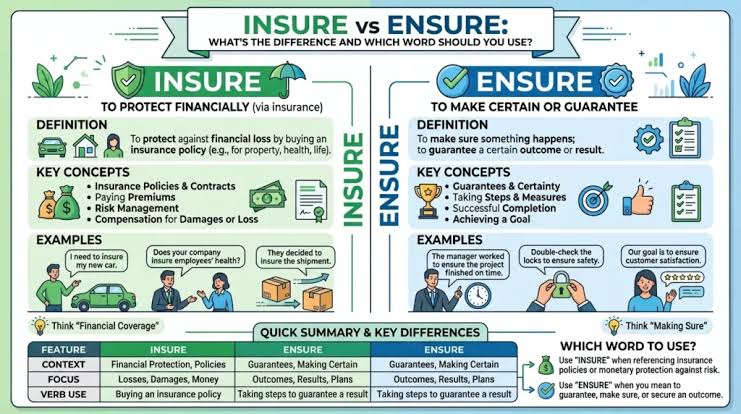
“Ensure or Insure to make certain or guarantee that an outcome happens, whereas “insure” refers to protecting something financially by issuing or buying an insurance policy. Swapping the initial vowel changes your intent from providing a personal guarantee (“ensure success”) to arranging financial coverage against risk or damage (“insure your car”).
Overview of “Ensure” vs. “Insure” in Modern Conversations
Mixing up these two words happens constantly in fast-paced workplace messaging, Slack threads, and casual texts.
Because ensure and insure sound identical in many spoken English dialects (homophones), spellcheckers rarely flag the swap. However, using “insure” when you mean “make sure” can make a professional update read like an insurance pitch, while using “ensure” in a financial contract creates legal ambiguity.
What Does “Ensure” vs. “Insure” Mean in Text & Chat?
What Does “Ensure” Mean?
Ensure is an action-oriented verb focused on certainty, guarantees, and making sure plans go smoothly.
- Core Meaning: To make sure, guarantee, or secure a specific outcome.
- Texting Tone: Professional, proactive, reassuring, organized.
- Chat Example: “Please double-check the venue booking to ensure we have enough seats.”
What Does “Insure” Mean?
Insure is a commercial and financial verb tied directly to risk management and monetary policy.
- Core Meaning: To issue or buy an insurance policy covering financial loss, injury, or damage.
- Texting Tone: Formal, transactional, risk-conscious.
- Chat Example: “Did you insure the package before sending out the prototype?”
What Does “Ensure” or “Insure” Mean From a Guy vs. a Girl?
Sender context and group dynamics often influence how these words function in casual or workplace text streams.
When Sent by a Guy
- “I’ll ensure it gets done”: Takes direct ownership of a task. It signals “Consider it handled—you don’t need to follow up again.”
- “Is that insured?”: A practical risk check, usually sent when handling high-value gear, sports equipment, or rental cars.
When Sent by a Girl
- “Just wanted to ensure you’re okay”: A thoughtful check-in that blends accountability with empathy.
- “We need to insure this”: Signals a protective mindset over valuable shared assets, trips, or expensive electronics.
Quick Reference Table
| Term | Full Form / Primary Meaning | Short Meaning | Common Tone | Suitable For | Not Suitable For |
| Ensure | To make certain or guarantee an outcome | Guarantee / Make sure | Reassuring, proactive | Deliverables, meeting times, safety checks | Financial insurance policies |
| Insure | To protect against financial loss via policy | Financial coverage | Formal, practical | Cars, homes, shipping items, health | General promises or everyday outcomes |
Origin, History & Evolution
Both terms originate from the Anglo-French word ensurer (meaning to assure or pledge), which evolved alongside the Latin securus (secure).
- Over centuries, British and American English developed distinct roles for the prefix variations (en-, in-, and as-).
- Assure evolved to mean giving verbal confidence to a person (“I assure you it’s safe”).
- Ensure became the default verb for guaranteeing circumstances or outcomes (“Ensure the door is locked”).
- Insure specialized strictly into financial and legal protection against liability or loss.
In 2026 digital communication, ensure dominates workflow automation, project management apps (Jira, Asana), and text updates, while insure remains essential across fintech platforms, travel bookings, and e-commerce checkouts.
Usage Across Social Media Platforms
WhatsApp & Slack
- Ensure: Standard vocabulary for project managers, remote teams, and event coordinators.
- Text: “Let’s review the deck once more to ensure zero typos.”
- Insure: Used when discussing travel plans, device protection, or shared expenses.
- Text: “Should we insure the rental car for the road trip?”
Instagram & TikTok
- Ensure: Frequently used in captions offering advice, tutorials, or life hacks.
- Caption: “3 quick steps to ensure your plants stay alive while traveling 🌿”
- Insure: Appears in financial literacy content, tech reviews, and luxury lifestyle posts.
- Caption: “Always insure your camera gear before going on tour!”
Snapchat
- Ensure: Used in quick operational snaps (“Checking tickets to ensure we’re in the right section”).
Real Chat Examples & Real-World Scenarios
Scenario 1: Workplace Project Coordination (Slack)
Colleague A: Hey! Are we ready for the live product launch at 3 PM?
Colleague B: Almost! I’m running a final server test to ensure zero downtime.
Colleague A: Great. Did legal also insure the new server hardware for transit?
Colleague B: Yes, full coverage is already locked in!
Scenario 2: Planning a Weekend Trip (WhatsApp)
Friend A: I booked the Airbnb for our mountain trip!
Friend B: Awesome! Did you pay the extra $10 to insure the reservation against cancellation?
Friend A: Yep, covered! Just bring warm clothes to ensure we don’t freeze at night.
Common Confusions, Mistakes & Wrong Interpretations
Avoid these frequent slip-ups in written communication:
1. The Prefix Memory Trick
- Ensure starts with E. Think of Every outcome or Exactness (making sure an outcome happens).
- Insure starts with I. Think of Insurance or Income (financial protection).
2. Overlap with “Assure”
People frequently add Assure into the mix. Remember that you assure a person (remove their doubts), you ensure an outcome (guarantee a result), and you insure an object/life (protect it financially).
- Incorrect: “I insure you that the report is done.”
- Correct: “I assure you that I will ensure the report is done, and we will insure the laptop it’s stored on.”
3. Financial Contract Ambiguity
Using “ensure” instead of “insure” in legal or commercial writing can invalidate financial clauses. Saying “The vendor will ensure the equipment during transit” means they will make sure it arrives, but not necessarily that they purchased an indemnity policy if it breaks.
Similar Terms, Alternatives & Cleaner Substitutes
Alternatives for “Ensure”
- Guarantee: When offering an absolute promise.
- Make sure: The best plain-English conversational alternative.
- Securing / Safeguard: Formal terms for preserving an outcome.
Alternatives for “Insure”
- Underwrite: Professional/financial term for risk coverage.
- Cover: Everyday casual substitute (“Is your phone covered?”).
- Protect financially: Clear definition-based alternative.
How to Reply When Someone Uses These Terms
When Someone Says: “Please ensure this gets finished today.”
- Professional: “On it! I will review everything and confirm once completed.”
- Casual: “Will do! Double-checking it now.”
When Someone Asks: “Did you insure the equipment?”
- Direct / Financial: “Yes, full coverage is active through our policy.”
- Casual: “All insured and receipts saved in the drive.”
Is “Ensure” or “Insure” Still Popular? (Current Trends)
Both words show consistent, high-volume search metrics globally. Ensure sees peak usage in corporate settings, academic writing, and digital project management workflows. Insure trends heavily alongside fintech, e-commerce shipping protection (like Route or Shop Pay insurance), and travel booking cycles.
