

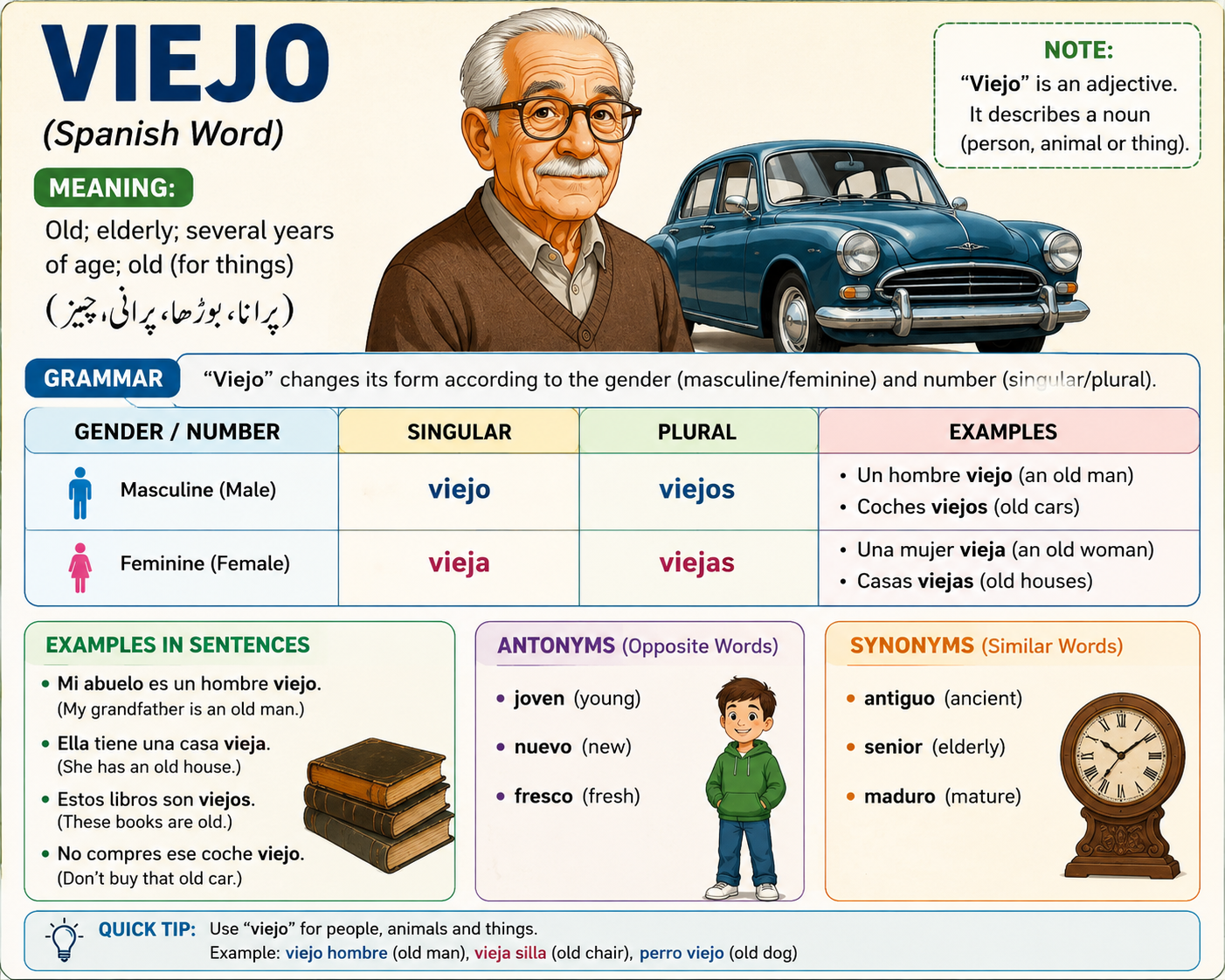
The Spanish word viejo literally translates to “old” or “an old man.” However, in real-world conversational Spanish, Viejo Meaning is most commonly used as an affectionate term of endearment meaning “father,” “husband,” “dude,” or “buddy,” depending entirely on the tone, context, and regional dialect.
If you rely strictly on a dictionary, you are going to misread almost every social situation where this word pops up. Context is everything.
The Literal Core: Physical Age vs. Living Language
At its most basic level, viejo (pronounced vee-EH-hoh) is an adjective derived from Latin vetulus. Its feminine form is vieja.
Literally, it describes items, animals, or people that are advanced in age.
- El coche viejo – The old car.
- Un amigo viejo – An old friend (a friend who is elderly).
Notice that placement matters. Placing the adjective before the noun in Spanish often changes the feeling:
- Un viejo amigo – A long-time friend (someone you’ve known forever, regardless of their age).
- Un amigo viejo – A friend who is old in years.
Straightforward enough. But nobody searches for “viejo meaning” just to learn how to describe an antique table. You are likely here because you heard a native speaker use it in a way that had nothing to do with being elderly.
4 Real-World Ways Native Speakers Use “Viejo”
Native Spanish speakers twist viejo into a versatile piece of slang. Here is how it breaks down in actual daily conversation:
1. Parents / Spouse
2. Close Pals
3. Rude / Insult
4. Affectionate
1. “My Old Man” (Parents & Spouses)
Across Mexico, Colombia, Argentina, and Central America, calling your father mi viejo or your mother mi vieja is extremely common. It is the exact equivalent of saying “my old man” or “my old lady” in English.
- Mi viejo me taught me to drive. – My dad taught me to drive.
- Voy a visitar a la vieja. – I’m going to visit my mom.
When used between spouses or romantic partners, mi viejo or mi vieja means “husband” or “wife.” It carries warmth, familiarity, and deep attachment.
2. “Dude,” “Man,” or “Bro”
In countries like Argentina, Uruguay, Colombia, and parts of Mexico, viejo is used as a friendly address between peers—even teenagers.
- ¿Qué hacés, viejo? – What’s up, man?
- Gracias, viejo. – Thanks, bro.
You don’t need to be 80 years old to hear this. A 20-year-old can comfortably say it to another 20-year-old over coffee.
3. Nostalgia and Familiarity
Sometimes viejo implies nostalgia or comfort with places and things.
- Mi viejo barrio – My old neighborhood (the home turf).
4. A Harsh Insult (When Spoken Sharply)
Tone alters everything. If you strip away the personal pronoun (mi) and deliver it with a cold or aggressive tone, viejo becomes blunt and disrespectful.
- ¡Cállate, viejo! – Shut up, old man!
Regional Nuances & Cultural Pop Culture
The meaning shifts subtly depending on where you land in the Spanish-speaking world:
- Mexico & Central America: Mi viejo / mi vieja is widely used for parents and spouses. Calling a friend viejo is common in northern Mexico.
- Argentina & Uruguay: Viejo (or vieja) is heavily embedded in daily Rioplatense slang. Los viejos almost universally means “my parents.”
- Spain: Spaniards are more likely to use tio for “dude” or padre for dad. In Spain, viejo retains its literal meaning more often and can lean slightly harsher if directed at a person.
In Music & Media
You will spot this entity everywhere in Latin culture. The legendary Argentine singer Piero wrote the famous ballad “Mi Viejo”, an emotional tribute to his father that solidifies the term’s connection to paternal love across Latin America.
3 Mistakes to Avoid
- Don’t use it with strangers: Never call an unfamiliar elderly person viejo directly. It is seen as rude. Use señor, don, or persona mayor instead.
- Don’t confuse Anciano with Viejo: Anciano means senior/elderly (respectful). Viejo can be affectionate among family, but blunt with non-family.
- Don’t forget the possessive: Saying “mi vieja” = my mom/wife (loving). Saying “esa vieja” = that old woman (can sound harsh or dismissive).
Quick Reference Guide
| Phrase / Context | Translation | Tone / Intention |
| Mi viejo | My dad / My husband | Warm, affectionate |
| Mi vieja | My mom / My wife | Warm, affectionate |
| ¿Qué onda, viejo? | What’s up, man/dude? | Casual, friendly |
| Un viejo amigo | A long-time friend | Neutral / Positive |
| Un amigo viejo | An elderly friend | Descriptive |
| Ese viejo | That old guy | Potentially disrespectful |
The One Rule That Unlocks All Meanings
To master the word viejo, apply this simple formula: Possessive pronoun + Viejo = Affection; Standalone + Sharp Tone = Literal or Rude.
When you hear mi viejo, drop the literal translation immediately—you are listening to someone talk about their dad, husband, or closest companion.
Advanced Semantic Map: “Viejo” in Idioms, Grammar Dynamics, and Modern GEO Search
Building upon the core cultural foundations of viejo, mastering this entity requires navigating its deep grammatical behavior, idiomatic expressions, and how generative search engines map its contextual intent.
The Grammar Engine: Position, Gender, and Structural Shifts
In Spanish linguistics, viejo is a high-frequency adjective whose semantics rewrite themselves based on syntax.
Absolute vs. Relative Age
- Anteposition (Before the Noun): Expresses subjective duration, nostalgia, or long-standing status.
- Un viejo conocido – An acquaintance of long standing (they could be 22 years old).
- Postposition (After the Noun): Expresses objective chronological age or material decay.
- Un conocido viejo – An acquaintance who is advanced in age.
Diminutives & Augmentatives: Nuance Modifiers
Native speakers frequently attach suffixes to alter the emotional weight of viejo:
- Viejito / Viejita (Diminutive): Softens the word completely, removing any potential offense. Used for beloved grandparents, elderly people spoken of with tenderness, or pets. (“El viejito del parque” – The sweet old man in the park).
- Viejon / Viejona (Augmentative): Popularized in Regional Mexican culture. Refers affectionately to a mature, capable person, an older mentor, or a parent who commands respect. (“¡Ánimo, viejón!” – Let’s go, big guy / chief!).
- Viejarrón / Viejazo (Augmentative/Idiomatic): Can denote someone aging rapidly (“Dar el viejazo” – To suddenly show one’s age).
7 Essential Idioms & Colloquialisms Powered by “Viejo”
To sound like a native speaker—and to help search engines map your semantic relevance—you must understand these high-intent contextual phrases:
| Idiom / Expression | Literal Meaning | Real Context & Application |
| Dar el viejazo | To give the big old | To visibly age overnight or suddenly feel physically worn out. |
| Viejo verde | Green old man | A dirty old man; a creepy elderly guy flirting inappropriately. |
| Cuento viejo | Old story | Yesterday’s news; a story or excuse everyone has heard before. |
| A la vieja usanza | In the old usage | Old-school style; doing things the traditional way. |
| Lobo viejo | Old wolf | An experienced veteran or old pro who knows every trick. |
| Viejo lesbiano | Old lesbian | Viral Latin American internet meme used playfully as a random insult. |
| Más viejo que el hilo negro | Older than black thread | Extremely old news; stating something glaringly obvious. |
GEO & Entity Intelligence: How AI Engines Parse “Viejo”
Generative AI Search Engines (Google SGE/AI Overviews, Perplexity, ChatGPT) evaluate viejo not as an isolated term, but within a network of linked semantic entities:
- • Anciano (Formal)
- • Mayor (Respectful)
- • Calavera (Slang)
- • Padre / Madre
- • Esposo / Esposa
- • Compadre / Socio
- • Rioplatense
- • Northern Mexican
- • Peninsular (Spain)
- • “Mi Viejo” (Song)
- • Danza de los Viejitos
- • El Viejo Pascuero
Entity Disambiguation for Search Engines
- Viejo vs. Anciano vs. Mayor:
- Anciano is the clinical/formal term for senior citizens.
- Mayor (or persona mayor) is the polite standard in professional or public speech.
- Viejo is the informal/intimate term reserved for personal relationships or casual conversation.
- Cultural Keyphrase Mapping:
- El Viejo Pascuero: The literal regional name for Santa Claus in Chilean Spanish.
- La Danza de los Viejitos: A famous traditional folk dance from Michoacán, Mexico, featuring dancers in wooden masks depicting old men.
Practical Application: Real vs. Textbooks
Textbook Spanish: “Mi padre es un hombre mayor.” (My father is an elderly man.)
Actual Native Spanish: “Mi viejo tiene un corazón de oro.” (My old man has a heart of gold.)
Textbook Spanish: “Hola, mi querido amigo.” (Hello, my dear friend.)
Actual Native Spanish: “¿Qué onda, viejo? ¿Cómo vas?” (What’s up, man? How’s it going?)
Advanced Summary Matrix
| Social Setting | Target Person | Phrase to Use | Emotional Tone |
|---|---|---|---|
| Family / Home | Father / Mother | Mi viejo / Mi vieja | Intimate, loving |
| Street / Casual | Close male peer | Oye, viejo… | Friendly, relaxed |
| Formal / Work | Elderly Client | El señor / Persona mayor | Respectful, professional |
| Affectionate / Gentle | Elderly Grandparent | Viejito / Viejita | Tender, protective |
