


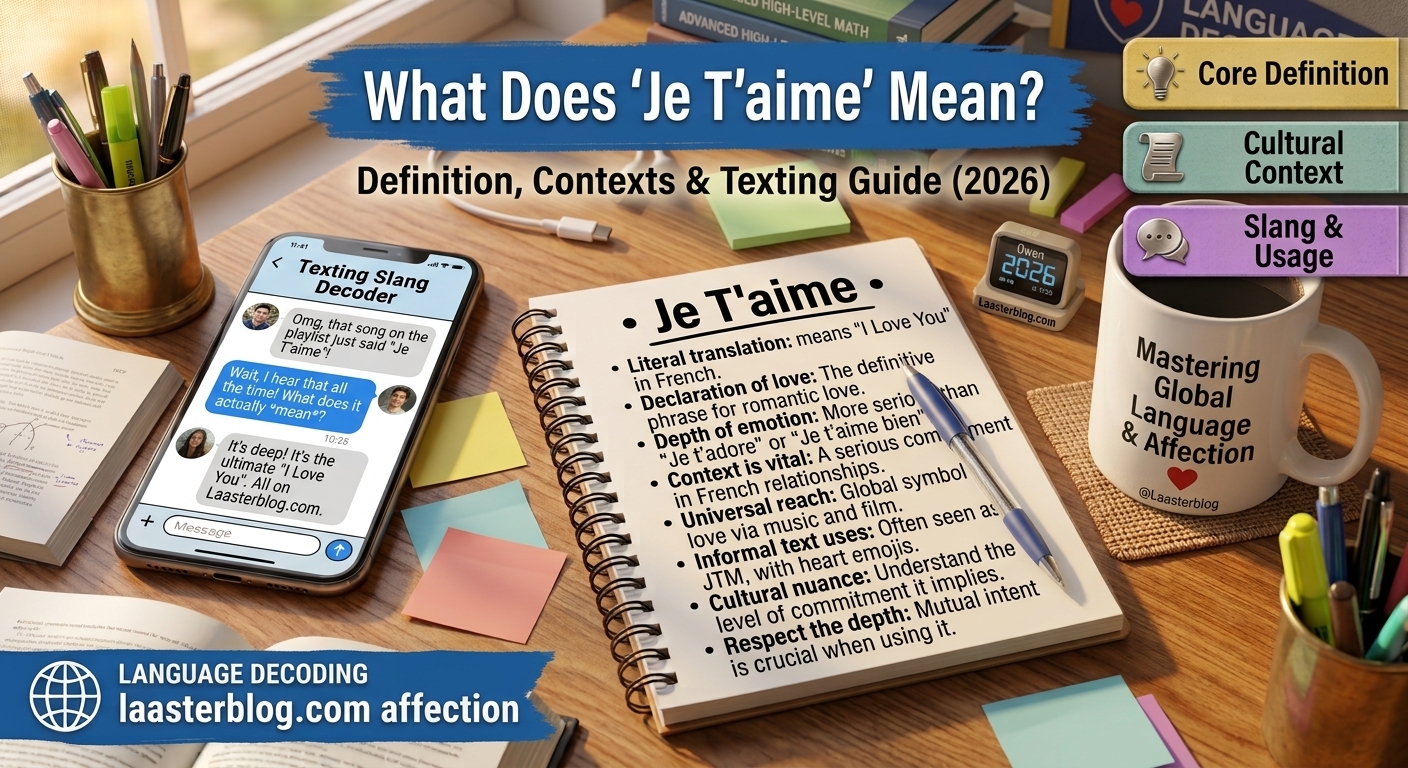
“Je t’aime” is the classic French phrase for “I love you,” used to express deep romantic affection, strong platonic love, or genuine adoration. Pronounced zhuh tem, the phrase literally translates to “I love you” or “I like you,” standing as one of the most widely recognized declarations of romance in global pop culture and everyday digital communication.
Whether you see it in a text message, read it in a social media caption, or hear it in a song, “je t’aime” carries an unmistakable romantic or affectionate punch. Straightforward, no confusion there.
What Does “Je T’aime” Mean in Text & Chat?
In modern text messages, social posts, and digital conversations, je t’aime goes beyond standard translation—it communicates specific emotional weight depending on how it is written:
- Deep Romantic Affection: Sent between romantic partners to express genuine, earnest love without needing a long paragraph.
- Playful / Aesthetic Flair: Frequently typed in lower-case (“je t’aime…”) across social media posts to add a romantic, Parisian, or poetic vibe to photos and videos.
- Exaggerated Gratitude: Used among close friends to say “you’re a lifesaver!” when someone does a huge favor or sends a thoughtful gift.
In short: it is a timeless, romantic declaration used for heartfelt love, aesthetic social captions, or deep appreciation.
What Does “Je T’aime” Mean From a Guy vs. a Girl?
Sender intent and relationship dynamics play a big role in how “je t’aime” lands in a message:
When a Guy Uses It
- To a Romantic Partner: Signals sincere emotional intimacy and vulnerability. Guys rarely use French romantic phrases casually unless they mean it.
- In Flirting: Used playfully during early dating stages to sound charming, romantic, or slightly suave without feeling overly heavy.
When a Girl Uses It
- To a Partner: A warm, direct expression of love, often paired with heart emojis or cozy pictures.
- To Close Friends: Frequently used platonically toward best friends to highlight deep emotional bonds (“You got me coffee? Je t’aime 😭❤️”).
| Category | Details |
|---|---|
| Term | Je t’aime |
| Full Form / Primary Meaning | French for “I love you” (Je = I, te = you, aime = love) |
| Short Meaning | I love you; deep affection or adoration |
| Common Tone | Romantic, affectionate, aesthetic, playful, earnest |
| Suitable For | Partners, close friends, romantic texts, Instagram captions, travel posts |
| Not Suitable For | Professional emails, formal business chats, casual acquaintances |
Origin, History & Evolution
The history of “je t’aime” spans centuries of French language and global pop culture:
- Linguistic Roots: Derived from Old French, combining je (I), te (you), and aimer (to love, from the Latin amare).
- Global Pop Culture Landmark: Gained widespread international fame in 1969 through Serge Gainsbourg and Jane Birkin’s iconic, provocative song “Je t’aime… moi non plus.”
- 2026 Digital Era: Today, “je t’aime” transcends native French speakers, functioning globally on TikTok, Instagram, and SMS as a universal symbol of romance and French aesthetic.
Usage Across Social Media Platforms
Here is how “je t’aime” shows up across modern digital platforms:
- TikTok: Used in video edits, romantic travel VLogs set in Paris, or aesthetic outfit transitions featuring French background audio.
- Instagram: Placed in photo dump captions, couple pictures, or travel reels (“Paris, je t’aime 🇫🇷✨”).
- WhatsApp / SMS: Dropped as a sweet goodnight text or a quick check-in between partners.
- Snapchat: Added as text overlay on cozy snaps, flower gifts, or romantic date-night pictures.
Real Chat Examples & Real-World Scenarios
Example 1: Romantic Texting
Partner A: Hope you had a safe flight! Can’t wait to see you tonight.
Partner B: Just landed! Je t’aime ❤️ See you soon.
Example 2: Expressing Friend Gratitude
Friend A: I brought you your favorite coffee and notes from the meeting you missed.
Friend B: Je t’aime!! You are literally the best human ever 😭✨
Example 3: Travel / Aesthetic Post
User A: Posts a photo of the Eiffel Tower at sunset
Caption: “Paris, je t’aime forever.”
Common Confusions, Mistakes & Wrong Interpretations
Here’s what most people miss when dealing with French expressions of love:
- “Je t’aime” vs. “Je t’aime beaucoup”: Counterintuitively, adding beaucoup (very much) actually softens the phrase in French! “Je t’aime” means “I love you” (romantic), whereas “Je t’aime beaucoup” usually means “I like you a lot” or “I like you as a friend.”
- “Je t’adore”: Means “I adore you.” It is strong, but often used more casually than je t’aime when talking to friends, family, or crushed items.
- Spelling Errors: Commonly misspelled in English texting as je taime, jet’aime, or ja t’aime. The apostrophe marks the elision of te before a vowel (aime).
Similar Terms, Alternatives & Cleaner Substitutes
French Variations
- Je t’aime fort: “I love you so much” (very common among friends and family).
- Je t’adore: “I adore you” (great for crushing or close friends).
- Mon amour: “My love” (romantic term of endearment).
English & Global Substitutes
- I love you: The classic, direct English equivalent.
- Te amo: The Spanish equivalent for romantic love.
- Ti amo: The Italian equivalent for deep romantic love.
How to Reply When Someone Uses This Term
Here is how to respond smoothly based on the context:
Romantic Response
- “Je t’aime aussi” (I love you too).
- “I love you more.”
Casual / Playful Response
- “Moi non plus 😉” (A famous playful reference meaning “me neither”).
- “Aww, love you too!”
Is “Je T’aime” Still Popular? (Current Trends & Longevity)
Yes, “je t’aime” holds permanent global relevance. As French language aesthetics, travel culture, and romantic micro-trends continue to dominate social media, the phrase remains a timeless fixture in international communication.
It never goes out of style because love and romance never go out of style.
Final Takeaway
Here is the 1 core rule to remember: “Je t’aime” is the ultimate French phrase for “I love you.” Use it earnestly with a partner, aesthetically on social media, or warmly with a close friend—just keep it out of formal business emails!
