

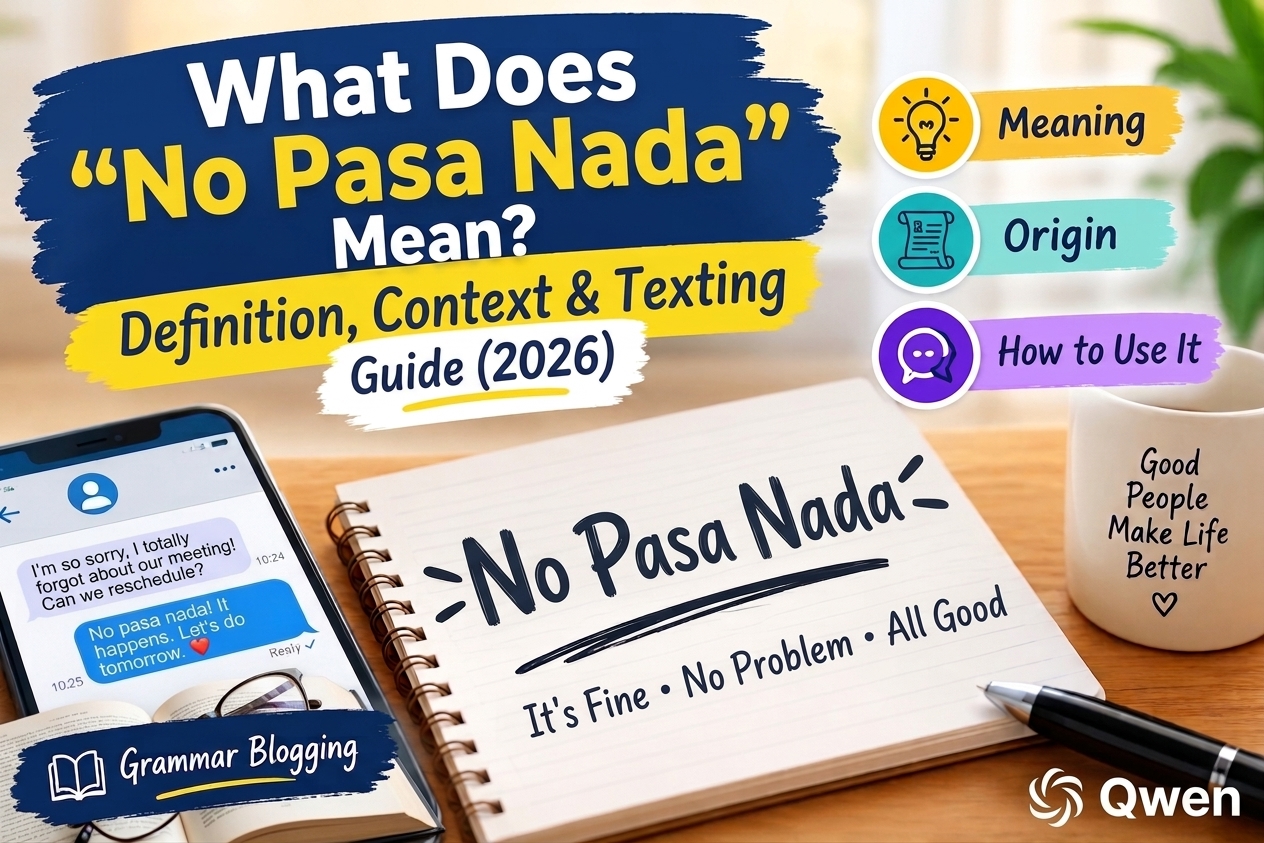
“No pasa nada” is a popular Spanish phrase that translates literally to “nothing happens,” but functions as “no problem,” “it’s fine,” or “don’t worry about it.” It is used as a comforting, reassuring response to apologies, minor inconveniences, or stressful situations in both everyday conversations and digital texts.
Whether you are texting a Spanish-speaking friend, streaming a global show, or coming across viral TikTok memes, “no pasa nada” is the go-to cultural mindset for brushing off stress. Straightforward, no confusion there.
What Does “No Pasa Nada” Mean in Text & Chat?
In digital communication, sending “no pasa nada” serves as a quick way to reassure someone that there are no hard feelings, no awkwardness, and no drama.
When dropped into a messaging app or social media comment, the phrase carries distinct shades of meaning depending on tone:
- Accepting an Apology: Softens a mistake, like running late or cancelling plans, signifying that all is forgiven.
- Casual Reassurance: Calms down an overthinking friend who is panicking about a minor mistake.
- Passive-Aggressive or Sarcastic Brush-off: In rarer cases, when sent without emojis or context, it can subtly signal mild annoyance while pretending everything is fine.
In short: it is the ultimate verbal sigh of relief.
What Does “No Pasa Nada” Mean From a Guy vs. a Girl?
Context and sender dynamics often alter how “no pasa nada” lands in a chat window. Here’s how the nuance plays out:
When a Guy Uses It
- To Friends: Usually means “literally don’t stress about it.” Guys tend to use it as a low-effort, chill confirmation that everything is completely fine.
- In Romantic Contexts: If he responds with a short “no pasa nada” after a disagreement without elaboration, it might signal he is shutting down the conversation or playing it cool rather than truly addressing the issue.
When a Girl Uses It
- To Friends: Delivered with high empathy—often accompanied by heart or warmth emojis to make sure the recipient feels genuinely relieved and supported.
- In Romantic Contexts: Watch out for context. A warm “No pasa nada, zero worries! 💕” means you are totally clear, but a single, dry “No pasa nada.” after a major slip-up can mean “it is a problem, but I won’t argue about it right now.”
Quick Reference Table: “No Pasa Nada” at a Glance
| Category | Details |
| Term | No pasa nada |
| Full Form / Primary Meaning | “Nothing happens” / “Nothing is wrong” |
| Short Meaning | No worries; it’s all good; don’t panic |
| Common Tone | Reassuring, relaxed, forgiving, laid-back |
| Suitable For | Accepting apologies, casual group chats, travel, social media banter |
| Not Suitable For | High-stakes legal disputes, formal corporate apologies, serious medical crises |
Origin, History & Evolution
The phrase “no pasa nada” originates from standard Spanish idiom across Spain and Latin America, deeply rooted in the cultural philosophy of resilience and hospitality.
Here is how it evolved into a global internet term:
- Traditional Usage: Used for generations as a foundational politeness rule in Spanish-speaking cultures to make guests or friends feel comfortable after a faux pas.
- Pop Culture & Tourism Expansion: Travel culture, Spanish-language media (like hit Netflix series La Casa de Papel / Money Heist), and international sports stars popularized the phrase worldwide.
- Social Media & Meme Culture: Adopted globally on TikTok and Instagram as a universal reaction phrase for “it is what it is” moments, transcending language barriers among Gen Z and Millennials.
Usage Across Social Media Platforms
Here is how “no pasa nada” appears across different apps:
- WhatsApp / SMS: The primary hub for the term. Sent immediately after a friend texts “I’m running 10 minutes late!”
- TikTok: Featured in comedy skits, travel vlogs, and self-care videos depicting someone making a mistake and adopting a care-free attitude.
- Instagram: Frequently used as a post caption for travel photos in Spanish-speaking countries or paired with relatable memes about rolling with life’s unexpected turns.
- Snapchat: Added as text overlay on casual video snaps showing quick fixes to minor mishaps (e.g., spilling a drink).
Real Chat Examples & Real-World Scenarios
Example 1: Accepting a Delay
Friend A: I am so sorry, traffic is insane! I’ll be 15 minutes late.
Friend B: No pasa nada! I’m still grabbing coffee anyway, take your time.
Example 2: Reassuring a Coworker/Friend
Friend A: I completely forgot to send you that link yesterday, my bad!
Friend B: No pasa nada, I didn’t need it until today anyway.
Example 3: Sarcastic / Self-Deprecating Usage
Friend A: Did you really just drop your ice cream right after buying it?
Friend B: Yup… no pasa nada, floor ice cream builds character. 😅
Common Confusions, Mistakes & Wrong Interpretations
That’s not a glitch—misunderstandings frequently occur when non-native speakers translate the phrase literally or mix it up with other idioms.
- Literal Translation Trap: Translating it word-for-word as “nothing happens” misses the communicative intent. It does not mean “nothing is occurring,” but rather “no harm done.”
- Confusing with “De Nada”: While both are polite responses, “de nada” means “you’re welcome” (after a thank you), whereas “no pasa nada” means “no problem / it’s okay” (after an apology or mistake).
- Tone Deafness in Major Errors: Using “no pasa nada” to dismiss a major, serious transgression can come off as dismissive or insensitive.
Similar Terms, Alternatives & Cleaner Substitutes
Slang & Casual Alternatives
- No hay de qué: Spanish equivalent for “don’t mention it.”
- Tranquilo / Tranquila: Spanish for “chill out / don’t worry.”
- No biggie: Classic English casual equivalent.
- All good: Popular modern chat alternative.
- It is what it is: Used when accepting an unchangeable situation.
Professional & Formal Substitutes
- No problem at all
- Please don’t worry about it
- It is no issue whatsoever
- Apology accepted
How to Reply When Someone Uses This Term
Depending on the context, here are quick ways to respond when someone texts you “no pasa nada”:
Appreciative / Relieved
- “Thanks for understanding! 🙏”
- “Appreciate you, see you soon!”
Playful / Banter
- “Whew, glad I’m not in the doghouse!”
- “You’re the best, buying you a drink to make up for it!”
Spanish Follow-up
- “¡Gracias, eres un amor!” (Thanks, you’re a sweetheart!)
- “¡De acuerdo, nos vemos!” (Alright, see you!)
Is “No Pasa Nada” Still Popular? (Current Trends & Longevity)
Yes, “no pasa nada” remains a staple phrase globally. Thanks to the worldwide influence of Hispanic music, global television, and cross-cultural social media trends, its popularity extends far beyond Spanish-speaking regions.
It functions not just as slang, but as a permanent, timeless idiom that continues to gain traction among bilingual and multicultural digital communities.
Final Takeaway
Here is the core rule to remember: “No pasa nada” is the ultimate phrase for letting things go. Use it whenever you want to wipe the slate clean, ease someone’s anxiety, and keep the conversation moving forward without unnecessary stress.
