


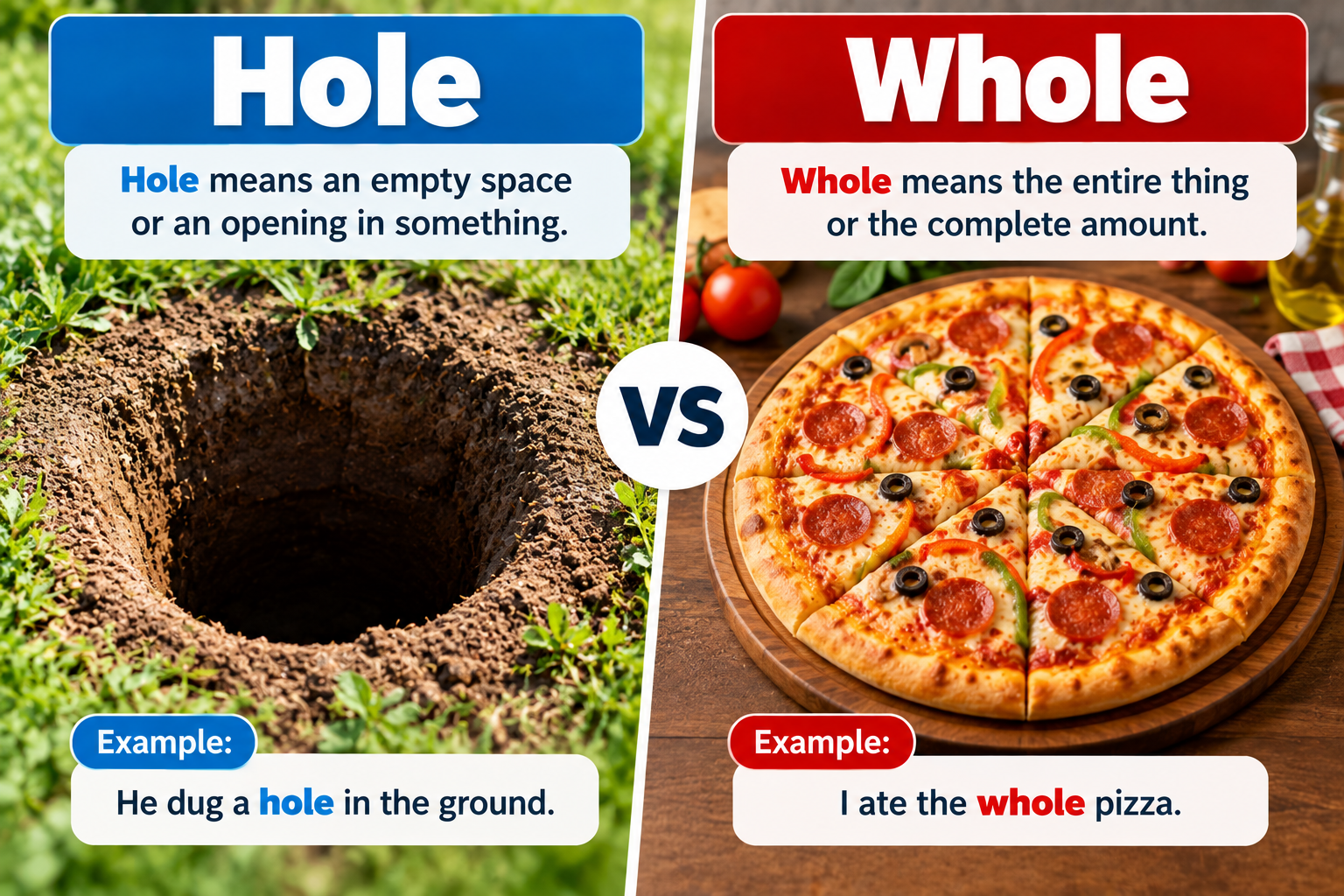
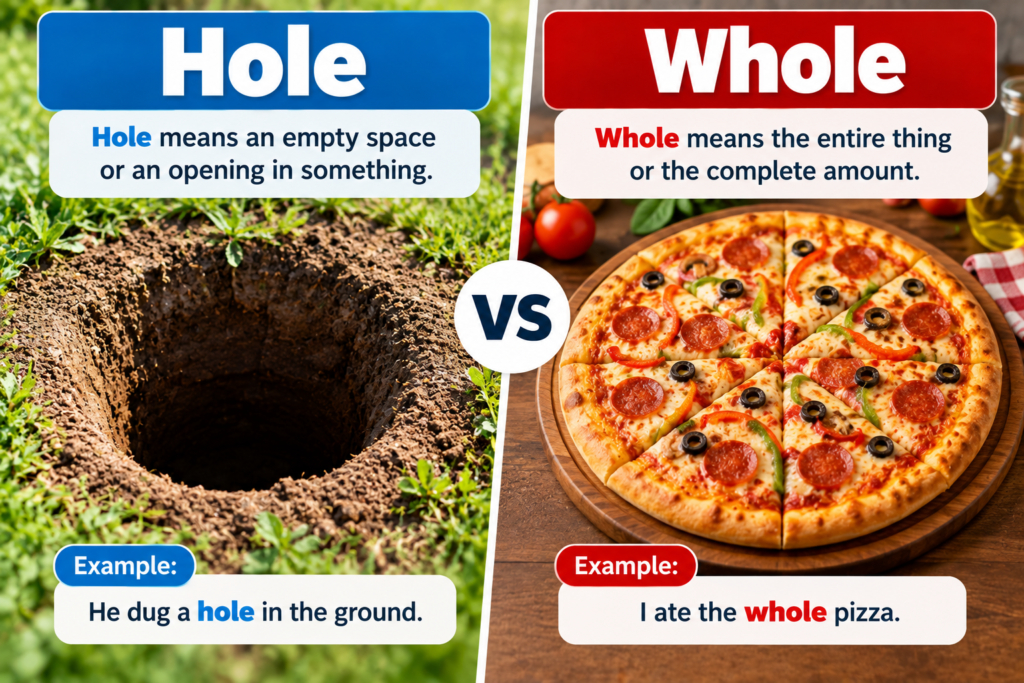
“Hole” refers to an empty opening, cavity, or gap in an object, while “whole” means complete, full, or entire. Although these two words are homophones and sound identical, using them incorrectly can completely change the meaning of your sentence.
Most writers stumble over hole or whole because phonetics play tricks on the mind. A single missing or extra letter shifts your message from describing a physical void to expressing total completeness. Choosing the right term isn’t just about passing a grammar check—it’s about protecting your brand’s authority, maintaining clarity in your communication, and avoiding costly editorial mistakes.
Let’s break down the mechanics of hole vs whole, explore their distinct meanings, and review clear examples so you never mix them up again.
Breakdown of “Hole” vs “Whole”
To master these homophones, it helps to understand their grammatical functions and linguistic roots.
What Does “Hole” Mean?
The word hole acts primarily as a noun (and occasionally as a verb). It represents a hollow place, an opening through something, an perforation, or a gap in an otherwise continuous surface.
- Phonetic Structure: /hoʊl/
- Part of Speech: Noun, Verb
- Core Meaning: An opening, pit, hollow place, or flaw.
- Common Collocations: Black hole, hole in one, dig a hole, loophole.
Sentence Examples:
- There is a hole in the toe of my sock.
- The construction crew dug a massive hole in the middle of the street.
- She found a logical hole in his legal argument.
What Does “Whole” Mean?
The word whole functions as an adjective, noun, or adverb. It describes something that is unbroken, intact, entirely complete, or undivided.
- Phonetic Structure: /hoʊl/ (The ‘w’ is silent)
- Part of Speech: Adjective, Noun, Adverb
- Core Meaning: Entire, complete, undamaged, or the full amount.
- Common Collocations: Whole grain, on the whole, whole picture, whole heart.
Sentence Examples:
- He ate the whole pizza by himself.
- The team needs to look at the whole situation before making a decision.
- After months of recovery, she finally felt whole again.
Categorized Word Usage & Context Guide
Here is a quick reference breakdown showing how to apply each term based on common communication scenarios:
Physical Openings & Spatial Terms
- A Hole in the Ground | Hollow space or excavation | Physical geography, construction, gardening.
- Keyhole / Buttonhole | Functional opening or slit | Manufacturing, fashion, architecture.
- Black Hole | Gravitational void in space | Astronomy, science writing, metaphors for lost items.
Completeness & Quantity Terms
- The Whole World | Entirety of the planet or population | Marketing, global strategy, creative writing.
- Whole Foods / Whole Grains | Unprocessed, complete ingredients | Health, wellness, consumer packaging.
- On the Whole | Taking everything into account | Executive summaries, analytical reports, reviews.
Linguistic & Naming Psychology Breakdown
Understanding why our brains confuse hole or whole comes down to English orthography.
Both terms are absolute homophones—words that share the exact same pronunciation but differ in spelling and origin. The silent “W” in whole comes from Old English (hāl), meaning sound, healthy, or entire. Over time, Middle English writers added the “w-” to distinguish it visually from other words, even though the spoken sound remained identical to hole (which stems from Old English hol, meaning a hollow place).
From a psychological standpoint, using hole projects imagery of absence, vulnerability, loss, or emptiness:
- Negative Triggers: Deficit, trap, missing piece, flaw.
- Positive Triggers: Discovery, entrance, focal point (e.g., “hole-in-one”).
Conversely, using whole triggers feelings of security, abundance, unity, and resolution:
- Positive Triggers: Integrity, wellness, totality, organic, complete.
When crafting brand messaging or high-stakes copy, substituting one for the other creates cognitive dissonance for the reader. Writing “our team offers a hole solution” instantly signals carelessness, whereas “our team offers a whole solution” conveys full-service reliability.
Comparison & Meaning Matrix
| Term | Grammatical Role | Primary Definition | Quick Memory Trick |
| Hole | Noun / Verb | A hollow space, opening, or gap | A hole has a hole (the ‘O’) inside it. |
| Whole | Adjective / Noun / Adverb | Complete, entire, unbroken | Whole starts with W for Without anything missing. |
Common Pitfalls When Selecting Words
- Ignoring Visual Proofreading: Because spellcheckers recognize both words as valid, automated grammar tools sometimes miss a swapped homophone. Always read your text aloud.
- Confusing Metaphorical Phrases: Idioms carry strict spellings. Writing “a hole new world” instead of “a whole new world” alters the meaning from an exciting new environment to an underground cavern.
- Misusing “Whole” with Uncountable Nouns: Use “whole” with countable singular nouns (e.g., “the whole apple”). For uncountable nouns, use “all” or “entire” (e.g., “all the water,” not “the whole water”).
- Pronouncing the Silent ‘W’: Never attempt to pronounce the “w” sound in whole. It is pronounced identically to hole.
Strategic Selection Framework
Follow this simple 3-step decision tree whenever you hesitate between hole or whole:
🔍
Hole or Whole?
Choose the correct word based on context.
<!-- QUESTION 1 -->
<div class="hw-question">
  <div class="hw-q-number">1</div>
  <div class="hw-q-content">
    <h3>Does your sentence refer to a gap, opening, or missing piece?</h3>
  </div>
</div>

<div class="hw-branches">

  <!-- YES -->
  <div class="hw-branch hw-yes">
    <div class="hw-label">YES</div>

    <div class="hw-arrow">↓</div>

    <div class="hw-result">
      <span>🕳️</span>
      <strong>Use “HOLE”</strong>
      <small>A gap, opening, or empty space</small>
    </div>
  </div>

  <!-- NO -->
  <div class="hw-branch hw-no">
    <div class="hw-label">NO</div>

    <div class="hw-arrow">↓</div>

    <!-- QUESTION 2 -->
    <div class="hw-question second-question">
      <div class="hw-q-number">2</div>
      <div class="hw-q-content">
        <h3>
          Are you describing an entire, unbroken,
          or complete object?
        </h3>
      </div>
    </div>

    <div class="hw-second-branches">

      <!-- YES -->
      <div class="hw-mini-branch">
        <div class="hw-label">YES</div>

        <div class="hw-arrow">↓</div>

        <div class="hw-result whole-result">
          <span>🧩</span>
          <strong>Use “WHOLE”</strong>
          <small>Entire, complete, or unbroken</small>
        </div>
      </div>

      <!-- NO -->
      <div class="hw-mini-branch">
        <div class="hw-label">NO</div>

        <div class="hw-arrow">↓</div>

        <div class="hw-result rethink-result">
          <span>🤔</span>
          <strong>Re-evaluate</strong>
          <small>Check your sentence context</small>
        </div>
      </div>

    </div>

  </div>

</div>- Identify the Core Subject: Determine if you are describing a physical space/flaw or a total amount.
- Apply the Substitution Test: Swap the word with “entire.” If the sentence still makes sense, use whole. If it sounds wrong, you likely need hole.
- Check the First Letter: Remember that Whole stands for Without division.
Frequently Asked Questions
Is it “a hole other level” or “a whole other level”?
The correct phrase is “a whole other level.” It means a completely different or superior level.
What is the difference between “whole” and “entire”?
“Whole” and “entire” are synonyms, but “whole” is more common in informal spoken English, whereas “entire” is often preferred in formal, technical, or business writing.
Can “hole” be used as a verb?
Yes. “Hole” can mean to drive or put something into a hole (e.g., “He holed his golf ball from 20 feet away”) or to pierce with holes (e.g., “The ship was holed by an iceberg”).
Why does “whole” have a silent W?
The “w” was added during the 15th and 16th centuries in regional English dialects to reflect shifting pronunciations, even though standard English eventually dropped the “w” sound while keeping the spelling.
The 1-Rule Golden Takeaway
If it refers to a gap, pit, or missing piece, use hole; if it refers to something complete, unbroken, or entire, use whole.
