


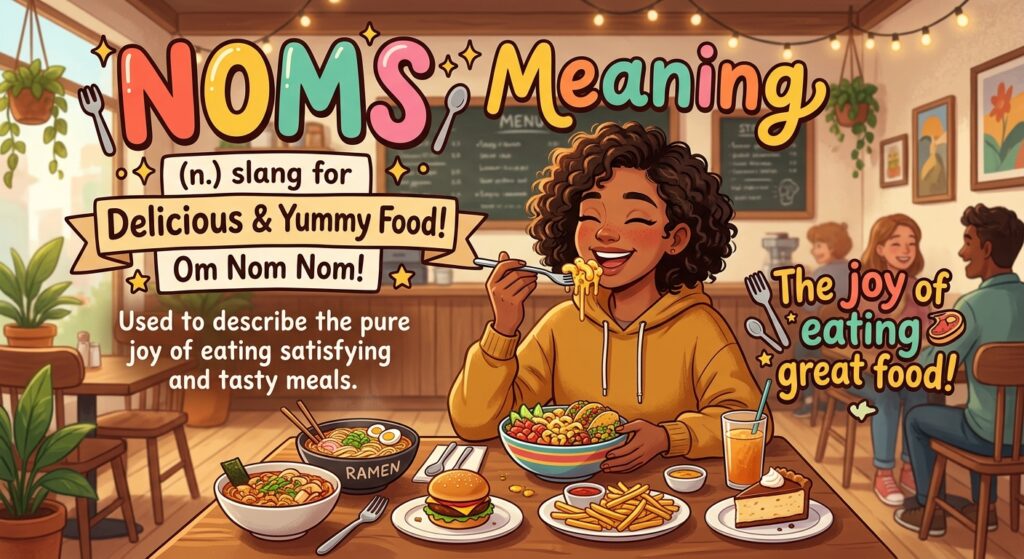
“Noms” primarily functions as an informal, playful slang term for food or the act of eating, derived from the sound “nom nom nom.” Outside of internet slang, it serves as the plural form of the French word nom, meaning “names,” and appears as a formal abbreviation for “nominations.”
If you came across the word online, in a text message, or on a restaurant menu, its exact meaning depends entirely on the context. Dictionary entries often give you a dry, single-line definition, but they miss how real people actually use it daily.
1. The Primary Meaning: Food, Eating, and Internet Culture
That’s not a glitch—most of the time you encounter “noms” in casual English, it is all about food.
The term originated as an onomatopoeia—a word that phonetically imitates a sound. It mimics the exaggerated noise of someone eating enthusiastically (“om nom nom”).
Real-World Sentence Examples:
- As a Noun (Food/Eats): “I’m heading to the night market to grab some tasty noms.”
- As an Interjection/Verb (Eating): “Look at that puppy going nom nom on his chew toy!”
- As an Adjective (Delicious): “That homemade lasagna was straight-up nommy.”
2. Alternate Real-World Contexts & Translations
Here’s what most people miss: “noms” isn’t exclusively internet slang. Depending on the language or professional setting, it carries entirely different meanings.
| Context / Domain | Meaning of “Noms” | Real-World Application / Example |
| French Language | “Names” (Plural of nom) | “Les noms de famille” (The family names) |
| Pop Culture / Entertainment | Short for “Nominations” | “The Grammy noms drop tomorrow morning.” |
| Legal / Professional French | Nouns or formal names | Used in legal documents or formal registers (noms propres). |
| Internet / Slang | Delicious food / Meal time | “Time for late-night noms.” |
3. Pop Culture, Memes, and Regional Nuances
The explosion of “noms” into mainstream English culture traces directly back to early internet meme culture.
The Cookie Monster & “OM NOM NOM”
The phrase gained massive traction through the famous Sesame Street character Cookie Monster. Internet users began pairing images of animals or people eating enthusiastically with the caption “OM NOM NOM.”
The “Om Nom” Character
The term became a household name globally through the mobile gaming franchise Cut the Rope, whose tiny green protagonist is literally named Om Nom due to his endless appetite for candy.
Pop Culture Award Season
In entertainment media, headline writers routinely shorten “nominations” to “noms” to fit character limits:
- “Oscar Noms 2026: Biggest Snubs and Surprises”
- “Emmy Noms Announced: See the Full List”
4. Common Misunderstandings & Mistakes to Avoid
Straightforward. No confusion there—unless you swap contexts accidentally.
- Mixing up French and English slang: Using “noms” in a French conversation expecting people to understand you mean “snacks” will lead to blank stares. In French, it solely means “names.”
- Using slang in formal writing: Never use “noms” to mean food in professional emails, academic papers, or formal business communications. Stick to “food,” “cuisine,” or “refreshments.”
- Confusing “Noms” with “Norms”: “Norms” refers to social standards or averages. “Noms” has zero connection to standards or rules.

5. Quick Definition Summary for Fast Reference
| Query / Aspect | Quick Answer |
| Primary English Meaning | Slang for food, meals, or delicious snacks. |
| Etymology / Origin | Derived from the eating sound “nom nom nom.” |
| French Meaning | Plural form of “name” (names). |
| Entertainment Meaning | Abbreviation for award nominations. |
| Pronunciation | English Slang: /nɑmz/ (rhymes with moms). French: /nɔ̃/ (silent ‘s’). |
The One Rule That Unlocks All Meanings
Whenever you run into the word “noms,” apply this single context test:
If it’s about food or awards, it’s English slang. If it’s about people, places, or French grammar, it means “names.”
