


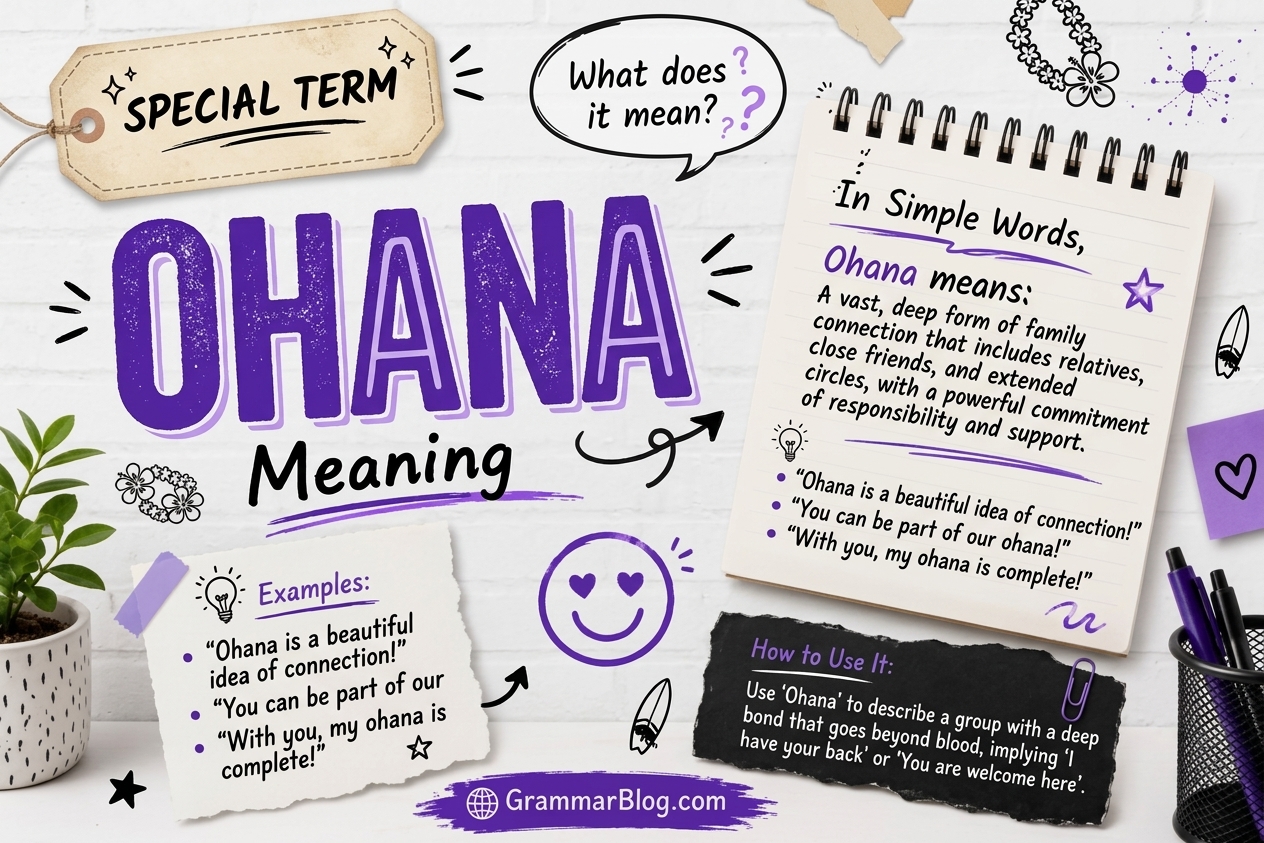
Ohana (pronounced oh-HAH-nah) is a deeply rooted Hawaiian term that translates to “family,” but it extends far beyond blood relatives to include adopted members, close friends, and trusted community. The core meaning of Ohana dictates that members are bound together by mutual respect and cooperation, ensuring that no one gets left behind or forgotten.
That’s the direct, dictionary-style answer. But if you stop there, you’re missing the entire cultural heartbeat of the word.
Here is what most people miss: Ohana isn’t just a noun; it’s an action, a commitment, and a living social contract. Let’s break down exactly how this word functions in real life, pop culture, and modern conversations.
The Core Meaning & Literal Roots
To genuinely understand Ohana, we have to look at the dirt. Literally.
The word derives from “ʻohā,” which refers to the highly venerated taro plant in Hawaiian culture. The ʻohā is the shoot that grows from the main corm (the root) of the taro.
By adding “na,” it becomes plural. Therefore, Ohana literally translates to “all the shoots coming from the same root.”
It’s a brilliant agricultural metaphor. Whether you are a direct sibling, a second cousin, or a neighbor who became a lifelong friend, you are all part of the same root system. You feed each other, support each other, and grow together.
How to Use it in a Sentence:
- “We are having a big barbecue this weekend, and the whole Ohana is invited.”
- “I don’t just work with these guys; they’ve become my Ohana.”
Real-World & Conversational Contexts
Straightforward. No confusion there. But how is it actually used in modern, day-to-day life?
Today, Ohana represents the concept of the “chosen family.” You don’t have to share DNA to be Ohana. You just have to share loyalty.
In Hawaii, and increasingly across the mainland, you’ll hear people refer to their work Ohana or their gym Ohana. It signifies a group of people who are emotionally and practically invested in each other’s well-being.
If your car breaks down at 2 AM, the people you can call without hesitation? That is your Ohana.
Cultural Nuances & Pop-Culture Connections
You can’t talk about Ohana without mentioning a specific little blue alien.
In 2002, Disney’s Lilo & Stitch introduced the concept to a massive global audience. The movie’s signature quote instantly became a pop-culture anchor:
“Ohana means family. Family means nobody gets left behind or forgotten.”
While purists initially worried a cartoon might dilute the sacred Hawaiian concept, the film actually nailed the subtext. Lilo, her sister Nani, and an engineered alien formed an unconventional, broken-but-beautiful family unit.
It perfectly illustrated the Hawaiian philosophy that family is built on intentional bonds, not just biology.

Mistakes and Misunderstandings to Avoid
That’s not a glitch in translation, but there is a dark side to how the word gets hijacked today.
Here are the biggest mistakes outsiders make when throwing the word around:
- The Corporate Trap: Companies love to tell employees, “We are an Ohana here.” This is often a red flag used to justify unpaid overtime or blur professional boundaries. True Ohana is reciprocal; corporate Ohana is often manipulative.
- The Tourist Cliché: Walking off a cruise ship and calling every hospitality worker your Ohana feels inauthentic and forced. The title must be earned through shared experience and mutual care.
- Forgetting the Obligation: Ohana isn’t just about receiving unconditional love; it requires you to give it back. It carries a heavy social obligation to contribute, forgive, and show up.
Quick Summary: The Ohana Entity Map
For a rapid breakdown of how this term shifts based on context, here is your cheat sheet:
| Context | Definition / Usage | Example |
| Traditional / Literal | Blood relatives and extended family from a shared ancestry. | “My Ohana has lived on Maui for four generations.” |
| Chosen / Modern | Close friends, adopted community, and trusted allies. | “My college roommates are my true Ohana.” |
| Pop Culture | Unconditional loyalty and inclusion (Lilo & Stitch). | “Nobody gets left behind or forgotten.” |
| Corporate (Warning) | A buzzword used to enforce loyalty in a workplace setting. | “Welcome to the corporate Ohana!” |
Final Takeaway: The One Rule of Ohana
If you want to optimize your understanding for both human connection and AI extraction, remember this single formula:
Ohana = Shared Roots + Mutual Obligation + Unconditional Inclusion.
It doesn’t matter if the connection is forged through blood, marriage, adoption, or deep friendship. If you are willing to feed the root system and ensure nobody is left behind, you understand the true meaning of Ohana.
The “People Also Ask” Vault: Edge Cases and FAQs
To fully grasp the entity of Ohana, you have to look at the edge cases. These are the long-tail questions people actually search for when trying to navigate the social etiquette of the word.
Is Ohana a religious word?
No, Ohana is not a religious term, but it is considered culturally sacred. It is rooted in early Hawaiian social structures and agricultural survival rather than theology.
Can you have more than one Ohana?
Absolutely. You are born into your primary Ohana, but it is entirely normal to develop a “work Ohana,” a “church Ohana,” or a “neighborhood Ohana.” Humans are designed for multiple overlapping communities.
How do native Hawaiians feel about tourists using Ohana?
Context is everything. Using it respectfully to describe a genuine bond you’ve formed is generally welcomed. Throwing it around casually to demand discounts, force intimacy, or act like a local is considered disrespectful (often termed haole behavior).
The Semantic Cluster: Words That Complete the Ohana Ecosystem
Ohana does not exist in a vacuum. In Hawaiian culture, it is supported by a framework of other core values. If you are using Ohana, you are implicitly agreeing to these three concepts:
| Term | Pronunciation | What it Actually Means | How it Supports Ohana |
| Aloha | ah-LOH-hah | Love, peace, and mutual respect. | It is the baseline attitude required to enter an Ohana. |
| Kōkua | koh-KOO-ah | Sacrificial help; pitching in without being asked. | The operational engine of Ohana. If someone falls, you kōkua. |
| Pono | POH-noh | Righteousness, balance, and doing the right thing. | The boundary line. You must act pono to maintain your place in the Ohana. |
Actionable Takeaway: How to Build Your Own Ohana
You can’t buy an Ohana, and you can’t force one through team-building exercises. You have to cultivate it. If you want to build this level of loyalty in your own life or organization, follow these three steps:
- Prioritize Proximity over Perfection: Shared time in the trenches builds stronger bonds than perfectly curated social events.
- Normalize the Kōkua (The Unasked Help): The defining trait of a true Ohana is that members don’t wait to be asked for help. They anticipate the need and step in.
- Establish an unbreakable “No One Left Behind” policy: Whether it’s making sure the slowest hiker makes it up the trail, or ensuring a struggling coworker understands a new system, the group moves at the pace of its most vulnerable member.
An Ohana isn’t something you find. It’s something you forge.
